Turkey has never been a full-fledged democracy. Throughout its modern history, the country has experienced military interventions, restrictions on political freedoms and serious human rights violations. Yet, despite these shortcomings, Turkey held a significant place within the Western democratic order. It became a founding member of the Council of Europe in 1949, joined NATO in 1952, and accepted the right of individual petition to the European Court of Human Rights (ECtHR, the Court) in 1987 and the compulsory jurisdiction of the Court in 1990.1
Following the rise of the Justice and Development Party (AKP) in 2002, Turkey, an official candidate for EU membership since 1999, embarked on a series of legal and institutional reforms, largely driven by the European Union accession process.2 These reforms strengthened civilian control over the military, expanded certain human rights protections, and contributed to Turkey’s image as a potential model of democratic governance in countries whose populations are predominantly Muslim. Its strategic position, economic dynamism, and growing diplomatic influence further reinforced this perception.
Nonetheless, after the AKP’s third consecutive electoral victory in 2011, this timid democratization trajectory began to reverse. The Gezi Park protests and the corruption investigations of 2013 accelerated the turn, and the failed coup attempt of 15 July 2016 marked a decisive break, as the government embraced emergency powers that would fundamentally reshape the country’s institutions.
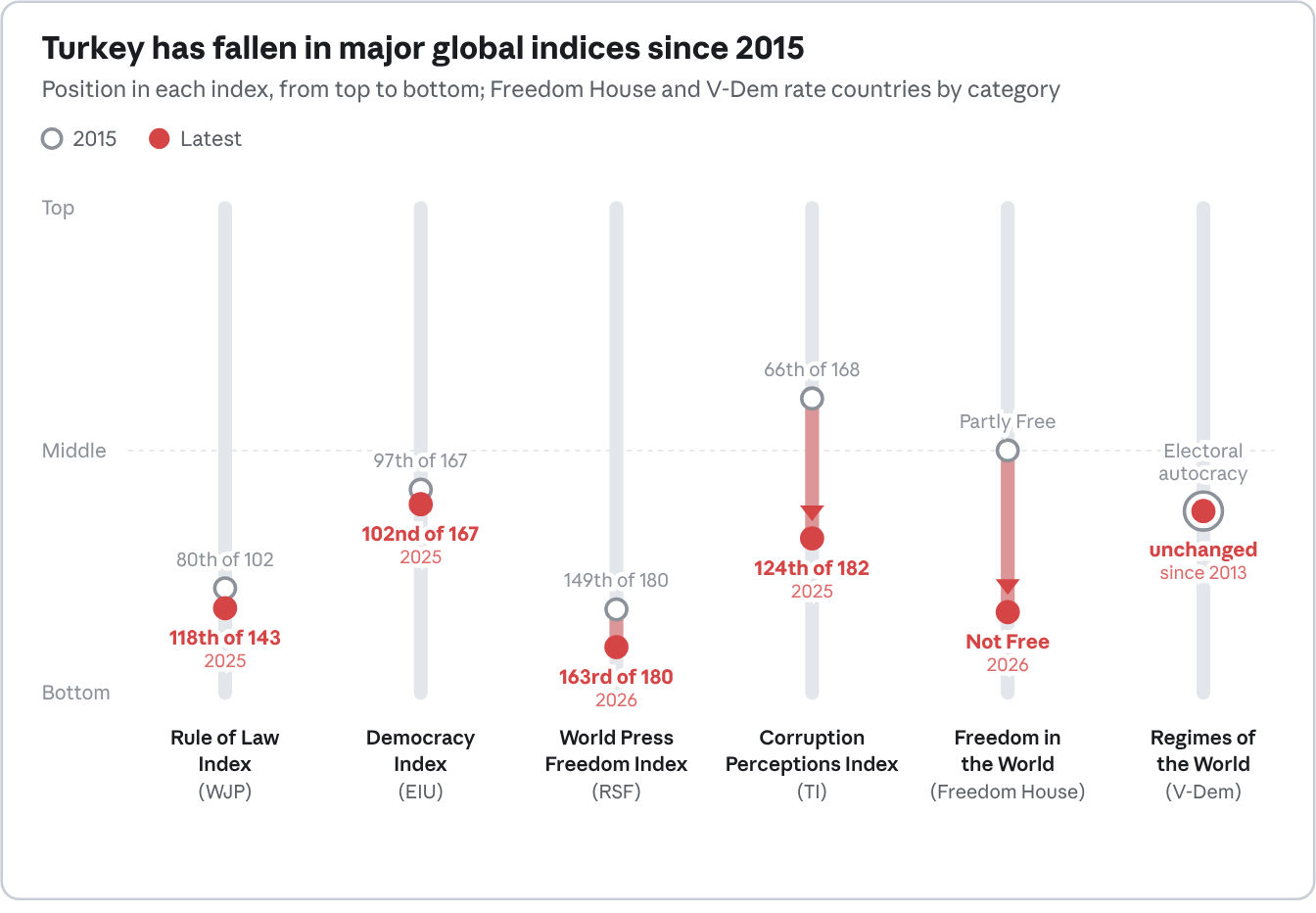
The scale of that transformation is recorded by every major international index. Freedom House downgraded Turkey from “Partly Free” to “Not Free” in 2018 and has since placed it among the ten countries with the steepest decline in freedom over the past decade.3, 4 In the World Justice Project’s Rule of Law Index, Turkey fell from 80th in 2015 to 118th of 143 countries in 2025.5 The Economist Intelligence Unit classifies it as a “hybrid regime” close to the authoritarian threshold, V-Dem as an electoral autocracy, and Reporters Without Borders ranked it 163rd of 180 for press freedom in 2026.6,7,8 Its score in Transparency International’s Corruption Perceptions Index fell to a record-low 31 in 2025.9
These rankings capture the scale of the decline, but not its mechanics. This article argues that the measures first deployed against the Gülen Movement, a group that had been gradually dehumanized over the preceding years, became the template for a far broader authoritarian transformation.10 It first examines the crackdown on the Gülenists, then the extension of the same methods to Kurdish political actors, journalists, academics and civil-society organizations, other religious groups and, later, the main parliamentary opposition. The account draws on the findings of domestic and international courts, United Nations bodies and independent monitoring organizations.
Erdoğan attributed responsibility for the coup attempt to the Gülenists, who had previously been considered allies of the ruling party between 2002 and 2013. The relationship between the two actors had already collapsed following the 17-25 December 2013 corruption investigations, which targeted prominent figures close to the AKP government, including the sons of three cabinet ministers and, in a second wave that was blocked before it could proceed, then-Prime Minister Erdoğan’s son, Bilal Erdoğan., Four ministers left the cabinet. The government characterized these investigations as a “judicial coup” and began targeting the members of the judiciary and police who ran the corruption cases.
In the same vein, the government launched a campaign to tighten its control over the judiciary and to turn it into a punitive instrument against its critics. In June 2014, it established a new type of court, the Criminal Peace Judgeships, which have since been widely used to order pre-trial detention, access blocking and the appointment of trustees, particularly against political opponents and members of the Gülen Movement. Because their decisions can be challenged only before another judgeship of the same rank, they operate as a closed circuit largely immune from effective appellate review. The government also amended the law governing the High Council of Judges and Prosecutors (HSYK) and subsequently reshuffled a large majority of judges and prosecutors, securing its grip over the judiciary.
A state of emergency was declared on 20 July 2016 and remained in force for two years. Throughout this period, the government ruled by decree-laws which the Constitutional Court declined to review, and the fundamental rights of millions of citizens were curtailed without meaningful judicial control.
President Erdoğan described the coup attempt as a “gift from God,” an opportunity to purge the State of dissenters and to restructure the military and the judiciary. During the state of emergency, almost 130,000 public servants were dismissed by decree, without individualized reasoning or a hearing, with a lifelong ban from public service and the cancellation of their passports. Only hours after the coup attempt, on 16 July 2016, the Judicial Council convened and suspended 2,745 judges and prosecutors, nearly one-fifth of the judiciary, most of whom were subsequently detained. A list of that size could not have been compiled overnight; it strongly suggests that these individuals had been blacklisted beforehand. In the following months, the dismissals rose to more than 4,000 judges and prosecutors, roughly one-third of the profession.
Through a series of emergency decree-laws, 180 media outlets, more than 2,300 private institutions, 15 universities, 29 publishing houses, more than 1,500 associations and 141 foundations were closed, most of them on the grounds of alleged affiliation with the Gülen Movement, and their property was transferred to the State without any judicial decision. The value of assets seized on this ground exceeds USD 50 billion.
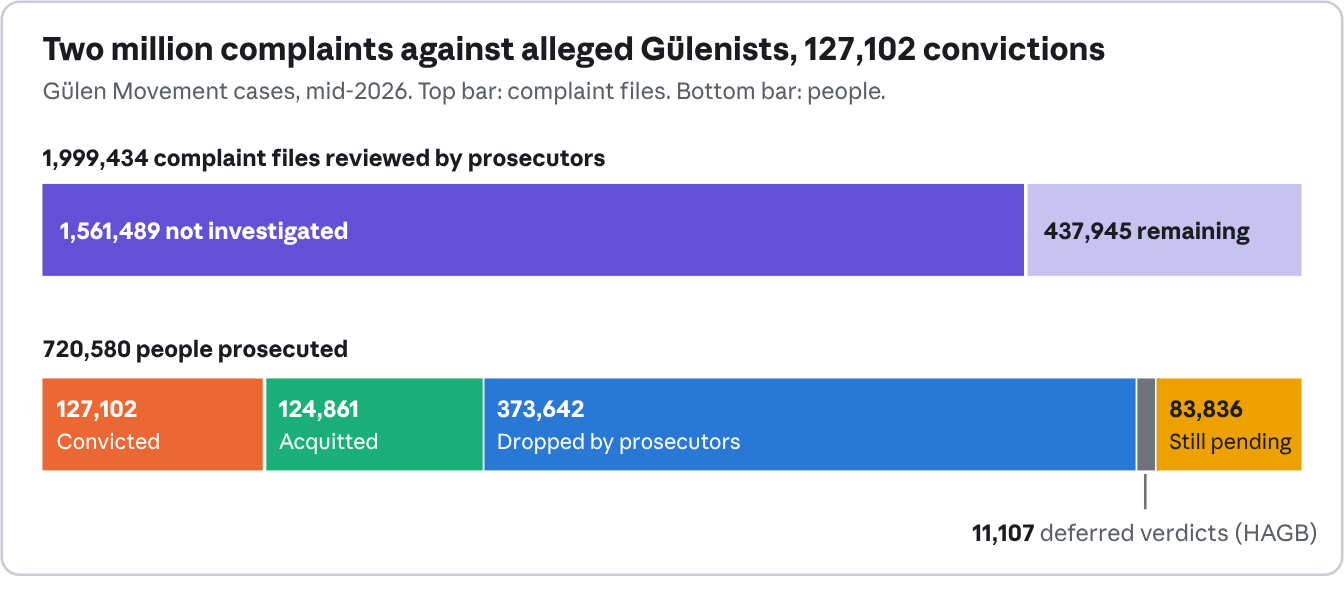
Mass prosecutions on terrorism charges followed against alleged members and sympathizers of the Movement. By July 2026, criminal proceedings had been brought against 720,580 people. Of the 636,744 whose cases had been decided, 127,102 were convicted, 124,861 acquitted, 11,107 received a deferred verdict (HAGB), and 373,642 saw prosecutors drop the case. Proceedings were still ongoing for a further 83,836. According to Justice Minister Akın Gürlek, security forces carried out 1,065 operations against the Movement in the first six months of 2026 alone, taking 2,451 suspects into custody. The evidence relied upon was deemed to constitute mere indicators of affiliation rather than proof of criminal or violent activity. The use of the ByLock messaging application was treated as irrefutable evidence. Other ordinary activities—such as depositing money in Bank Asya, enrolling children in Gülen-affiliated schools, subscribing to Gülen-related media outlets, or membership in associations or trade unions linked to the Movement—were also relied upon as incriminating evidence. Witness statements focused primarily on social or religious activities rather than any criminal conduct.
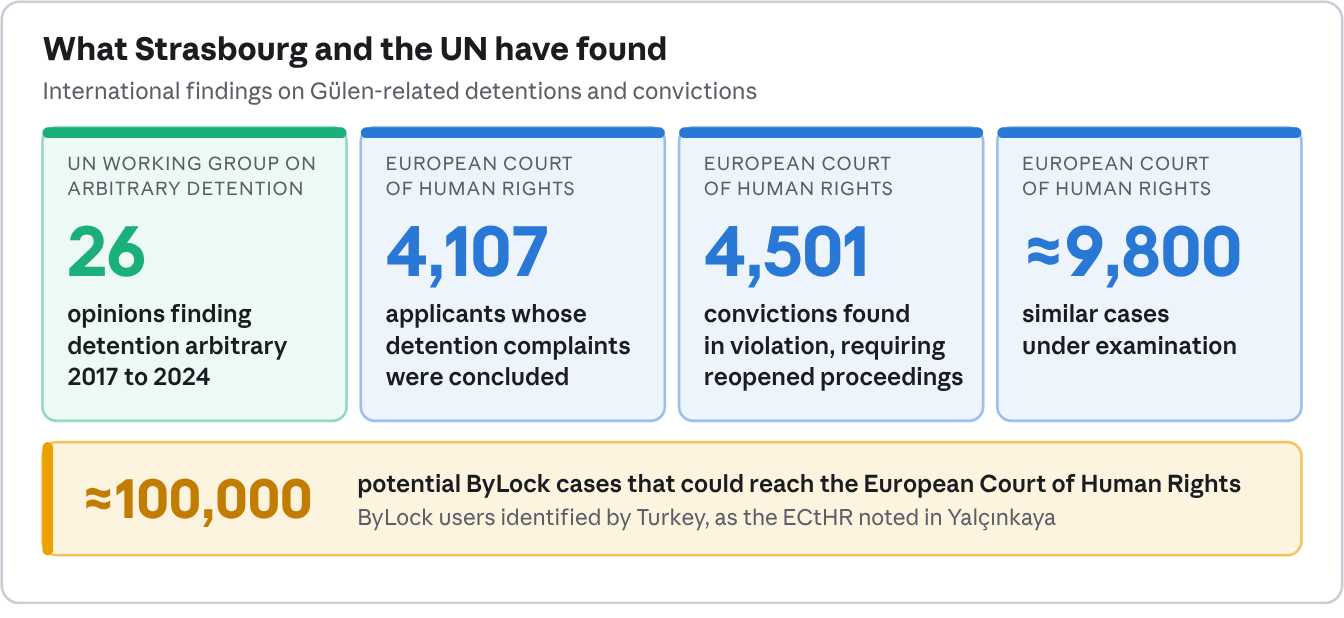
Between June 2017 and November 2024, the United Nations Working Group on Arbitrary Detention (WGAD) issued 26 opinions concerning arbitrary detention in Turkey, including cases of individuals detained abroad and unlawfully transferred to Turkey. Across these opinions, the WGAD consistently concluded that the detention of individuals accused of affiliation with the Gülen Movement was arbitrary. It found that such detentions lacked a legal basis, resulted from the exercise of rights protected under the International Covenant on Civil and Political Rights (ICCPR), failed to comply with fundamental fair trial guarantees, and were discriminatory, being based solely on the detainees’ perceived political opinions or alleged association with the Movement.
Most recently, in its opinion concerning former Air Force Commander General Akın Öztürk, whom the Turkish authorities accused of masterminding the coup attempt, the WGAD reaffirmed these conclusions. Notwithstanding the exceptional seriousness of the allegations, it held that his detention was arbitrary and contrary to international law. The significance of this finding lies precisely in its context: if even the detention of the man presented as the leader of the coup attempt fails to meet international standards, the deficiencies cannot be attributed to the weakness of individual case files but reflect the structure of the proceedings themselves. The opinion thus also casts serious doubt on the reliability of the Turkish judicial findings on which the official narrative of the coup attempt rests.
The European Court of Human Rights first examined the unlawful detention complaints of the dismissed members of the judiciary. They had been detained a few hours after the coup attempt pursuant to the doctrine of flagrante delicto based only on their perceived relations with the Movement, which was used to waive strict judicial tenure guarantees. The Court ruled that their pre-trial detentions were unlawful due not only to the absence of a “reasonable suspicion” at the time of detention but also to the complete disregard of procedural safeguards applicable to magistrates.
As regards ordinary citizens, the first judgment specifically addressing the use of ByLock evidence in detention proceedings was the Akgün judgment. The Court held that the applicant’s detention was not supported by a reasonable suspicion that he had committed the alleged offence, finding that reliance on ByLock evidence alone was insufficient to justify deprivation of liberty. Following these leading cases, the Court has examined and concluded the unlawful detention complaints of 4,107 applicants through several group cases.
The Yalçınkaya judgment of 26 September 2023 represented a turning point in identifying the fundamental deficiencies of Turkish judicial practices concerning terrorism-related charges linked to the Gülen Movement.
The Court concluded that the Turkish practice bypassed the requirement to establish the specific actus reus (the material elements) and mens rea (the criminal intent) of the offence, thereby violating the fundamental principle of criminal law: nullum crimen, nulla poena sine lege (no crime and no punishment without law). Although violations of this principle have been found in a limited number of cases, the existence of such a problem cannot be considered a mere technical error when it results from a systemic practice affecting hundreds of thousands of individuals. In Yalçınkaya itself, the Court stressed the systemic nature of the problem, noting that the Turkish authorities had identified approximately 100,000 ByLock users and highlighting the considerable number of similar cases that could reach it. Such a situation represents a serious warning sign in a democratic society governed by the rule of law.
In the recent Yasak judgment, the Court further clarified its position by sending an even clearer message to Turkey. In this case, the applicant was not merely accused of affiliation with the Gülen Movement based on automatic assumptions; he was a genuine follower who had assumed organizational responsibilities within the Movement. Nevertheless, Strasbourg found that the applicant’s conviction was imposed without establishing the required mental element (mens rea) for membership in a terrorist organization, particularly given that his alleged activities had ended in 2014 and did not demonstrate any criminal conduct.
Given the scale of the problem, the Court has begun examining similar cases through groups of applications, with the number of pending cases reaching 9,800., The Court has already found violations requiring the reopening of domestic proceedings in Turkey in 4,501 cases concerning convictions linked to the Gülen Movement.
Taking into account the findings of the WGAD and the large number of violation judgments delivered by both UN bodies and the ECtHR, I argued in my latest article that the detention and mass conviction practices targeting individuals associated with the Gülen Movement should be examined through the framework of crimes against humanity.
The Gülen Movement had long faced hostility from various segments of Turkish society, including parts of the radical left and ultra-nationalist groups. Although it had existed since the late 1960s, the Movement became increasingly visible and influential from the early 1990s onward, notably through its schools, media and business networks.
During the “post-modern coup” of 28 February 1997, the Movement, along with many other religious and conservative citizens, was among those targeted by the military’s campaign against religious actors and institutions. After the AKP came to power in 2002, the ruling party and the Movement formed a loose alliance to support reforms aimed at reducing the military’s influence over politics and state institutions.
Later on, the controversial Ergenekon and Balyoz (Sledgehammer) trials, in which several hundred senior military officers and certain civilian figures accused of coup plotting were prosecuted and detained for extended periods, polarized Turkish society. While the main opposition criticized the trials, then-Prime Minister Erdoğan openly supported them, famously declaring himself the “prosecutor” of the Ergenekon case. After the 2013 corruption investigations, however, the government distanced itself from the trials to strike a political alliance with the generals convicted in the Ergenekon and Balyoz (Sledgehammer) trials. Together, the AKP and the ultra-nationalists laid responsibility for them on the so-called Gülenist members of the judiciary. Then, they began dismantling what they described as Gülen-affiliated influence within the judiciary and law enforcement through legal amendments, administrative measures and large-scale reshuffles.
These reshuffles were followed by investigations targeting companies, media organizations and civil-society institutions allegedly affiliated with the Movement. Much of the political opposition remained largely silent as the crackdown expanded, even though the measures relied on the very practices, such as prolonged pre-trial detention, that the same opposition had denounced during the Ergenekon and Balyoz era.
That silence was matched, and in part sustained, by an active culture of denunciation. According to the Ministry of Justice, as of 30 June 2026 prosecutors’ offices had received 1,999,434 denunciations relating to the Movement, in a country of some 85 million people. Nearly four in five (1,561,489) were dismissed on preliminary review as not even warranting an investigation. These figures say less about the Gülen Movement than about the society around it: neighbors, colleagues, business rivals and even relatives used the label as a weapon in private disputes, knowing that the accusation alone could cost its target a job, a passport or liberty. The sheer volume of denunciations reflects the depth of the social hysteria and a society that had already accepted the logic of scapegoating.
The repression intensified in the months preceding the coup attempt. In October 2015, the Koza-İpek media group was placed under trusteeship; in March 2016, Zaman, Turkey’s largest-circulation newspaper, was seized in the same manner along with its affiliated outlets. Both takeovers were ordered by Criminal Peace Judgeships, the very instrument later turned against other critics. Although some opposition voices criticized these measures, the reaction remained limited and failed to generate broader resistance.
Following the coup attempt, responsibility was immediately attributed to the Gülen Movement, and a state of emergency was declared. Few political actors challenged the official narrative at that moment. Instead, the AKP, the CHP and the MHP rallied together at Yenikapı on 7 August 2016, a rally to which the pro-Kurdish HDP was not invited, and what became known as the “Yenikapı spirit” prioritized national unity over scrutiny of the extraordinary measures adopted by the government.
Under the state of emergency, Gülen-affiliated media outlets, companies, schools and universities were closed or transferred to state control. The assets of businesspeople accused of links with the Movement were first placed under the trusteeship of the Savings Deposit Insurance Fund (TMSF) and later confiscated following lengthy criminal proceedings. More than 130,000 public servants were dismissed, detained and prosecuted.
The opposition largely assumed that these unlawful practices would remain confined to the Gülen Movement and hoped that this would undermine the AKP government. However, the purge fundamentally altered the institutional balance of power. Thousands of judges and prosecutors had been dismissed and replaced by newly appointed members of the judiciary, often inexperienced and affiliated with the ruling AKP–MHP coalition. The mechanisms capable of restraining executive authority were critically weakened, and any remaining judicial resistance could be neutralized through further reshuffles. Meanwhile, the 2017 constitutional referendum, held under the state of emergency, concentrated executive power in the presidency, and in July 2018 Law No. 7145 carried several emergency powers over into ordinary legislation, where they were repeatedly extended after the state of emergency had formally ended.
The “Gülenist threat” was eliminated. Yet the extraordinary powers acquired to fight it remained and gradually became normalized: trusteeship over private assets and elected offices, membership charges built on lawful conduct, Criminal Peace Judgeships and a reshaped judiciary could now have new targets. The opposition’s assumption that such instruments would never be directed against them proved to be a grave miscalculation.
Kurdish political actors were among the first to feel the full weight of these instruments, although pressure on them had existed long before the coup attempt. The collapse of the peace process between the government and the PKK in 2015 was followed by extended urban curfews and security operations in the majority-Kurdish southeast. In May 2016, Parliament lifted the immunity of numerous deputies through a constitutional amendment supported by the AKP, the MHP and the leadership of the main opposition Republican People’s Party (CHP), whose leader, Kemal Kılıçdaroğlu, declared that the proposal was unconstitutional but that his party would vote “yes.” Although aimed primarily at the pro-Kurdish Peoples’ Democratic Party (HDP), it soon exposed CHP deputies too, one of whom, Enis Berberoğlu, was imprisoned in 2017. Selahattin Demirtaş, co-chair of the HDP, then the third-largest party in Parliament, was arrested in November 2016. As of early 2026 he remained imprisoned despite judgments of the European Court of Human Rights, including a 2020 Grand Chamber ruling, which found that his detention pursued the ulterior purpose of stifling pluralism and called for his release.,
Beyond individual leaders, the government made extensive use of trustee appointments to replace elected Kurdish mayors. Numerous mayors of the HDP and of its successor DEM Party, elected in 2014, 2019 and 2024, were removed from office and replaced by government-appointed administrators. Those removed include Ahmet Türk, the veteran Kurdish politician elected mayor of Mardin, and, in a sign that the practice was spreading beyond Kurdish parties, Ahmet Özer, the CHP mayor of Istanbul’s Esenyurt district., Large numbers of party members and officials were also prosecuted on terrorism charges, including in the “Kobani” case concerning the October 2014 protests, in which Demirtaş and other former HDP figures received lengthy sentences. The government links these prosecutions to the PKK, which Turkey, the European Union and the United States designate as a terrorist organization. Kurdish organizations and international observers characterize many of the measures as the criminalization of lawful political activity.
More recently, these dynamics have unfolded alongside a renewed, government-initiated process concerning the Kurdish question and the PKK. In early 2026, a parliamentary framework was discussed that tied legal reforms to verified PKK disarmament; the DEM Party welcomed the process while objecting to the characterization of the Kurdish issue as solely a matter of terrorism. The reinstatement of officials removed by trustee appointment, and the situation of imprisoned Kurdish politicians, have featured in that debate. That the release of politicians held in defiance of binding Strasbourg judgments has become a bargaining chip in a political negotiation shows how far the judiciary’s role has been subordinated to political calculation.
Restrictions on the press intensified over the decade. Beyond the trusteeships imposed on Zaman and other outlets before the coup attempt, 180 media outlets were closed by decree under the state of emergency. Turkey has since remained among the countries holding the largest numbers of journalists in detention; in its World Report 2026, Human Rights Watch recorded 27 journalists and media workers in pretrial detention or serving sentences.
Control has also been exercised through ownership and regulation. Reporters Without Borders estimated several years ago that around 90 percent of national media was under direct or indirect government control. The broadcasting regulator RTÜK has imposed fines and license suspensions on critical outlets. The authorities have made extensive use of content removals and access blocking, largely ordered by Criminal Peace Judgeships, including the blocking of the social-media account of Istanbul Mayor Ekrem İmamoğlu. In June 2026, NATO declined to accredit journalists from several critical Turkish outlets seeking to cover its summit in Ankara; a NATO spokesperson said the alliance relied on the host country’s assessments of journalists from its own country.
Since 2025, the trustee mechanism first used against Koza-İpek and Zaman has become the main instrument for reshaping what remains of the national broadcast sector. The pattern is consistent. It begins with an alleged criminal investigation, typically for fraud, money laundering, illegal betting or espionage rather than for journalism. A court order then transfers the channel to the Savings Deposit Insurance Fund (TMSF), and a sale often follows.
Flash TV and Ekotürk were seized in 2025 in illegal-betting investigations. Flash TV was later sold to a buyer who announced that it would move away from news. On 11 September 2025, prosecutors placed Can Holding, a 121-company conglomerate, under TMSF trusteeship on fraud, tax-evasion and money-laundering charges. This brought Habertürk, Show TV and Bloomberg HT, among the country’s most-watched channels, under state administration, where they remained more than a year later. In October 2025, TELE1 was seized through a trusteeship over its parent company, ABC, after its editor-in-chief, Merdan Yanardağ, was detained in the espionage investigation that also targets İmamoğlu. Most of its staff were dismissed, some journalists resigned in protest, and in April 2026 the TMSF put the channel up for sale for 28 million lira, less, according to Yanardağ, than three months of its operating costs. TELE2, the channel his former team launched in its place, stopped broadcasting in October 2026 after failing to pay a license fee to RTÜK.
On 30 September 2026, a court ordered the blocking of the independent news outlet T24’s website and social media accounts. Most recently, on 14 October 2026, the TMSF was appointed trustee of Halk TV, the leading opposition news channel, and its broadcasts were cut. The appointment came in an investigation against its owner, Cafer Mahiroğlu, for bribery, bid-rigging and money laundering. The channel’s journalists had already been prosecuted, it had faced a ten-day broadcast ban, and calls to review its license had intensified in the days before the seizure.
Whatever the merits of the individual allegations, the cumulative effect is unmistakable. In about twenty months, the leading opposition broadcaster and several national channels passed under state administration through the same device used to silence the Gülen-affiliated press a decade earlier. These conditions are reflected in Turkey’s standing in the World Press Freedom Index, discussed above.
The authorities have also brought the major social-media platforms within reach of the same apparatus. Law No. 7253 of July 2020, amending Internet Law No. 5651, required foreign social-media platforms with more than one million daily users in Turkey to appoint a local representative. It also obliged such platforms to answer users’ complaints within 48 hours and made them liable for damages if they failed to remove content found unlawful by a court within 24 hours. The sanctions for refusing to appoint a representative escalated from heavy fines to advertising bans and, ultimately, to throttling the platform’s bandwidth by 50 percent and then by up to 90 percent, which in practice would make it unusable. The so-called “disinformation law” of October 2022 tightened these obligations further, requiring platforms to hand over data identifying users suspected of certain offences on pain of a 90 percent throttling, and created a new offence of publicly disseminating “misleading information,” punishable by one to three years’ imprisonment, increased by half if committed anonymously or within an organization.
The local representatives thus became the channel through which the platforms carry out restriction orders, usually issued by Criminal Peace Judgeships or, in “urgent” cases under Article 8/A of the Internet Law, by the executive itself. Compliance has become routine. In May 2025, X withheld an account belonging to the jailed Istanbul mayor, Ekrem İmamoğlu, in Turkey, while saying it would challenge the order; in August 2026, a Criminal Peace Judgeship ordered it to do the same with his presidential candidacy office account. In September 2026 alone, the Freedom of Expression Association (İFÖD) documented orders blocking at least 1,270 X accounts and X carried out 90 percent of them, among them the accounts of significant alternative news outlets such as T24. On 30 September 2026, a court also ordered access to Bianet’s X account to be blocked. By the end of 2025, according to İFÖD, more than 1.5 million websites and domains had been blocked in Turkey. The local-representative requirement, presented as a matter of accountability, has thus turned global platforms into instruments for enforcing domestic censorship.
Academic freedom was affected early. In January 2016, more than 1,100 scholars signed a petition, “We will not be a party to this crime,” calling for an end to security operations in Turkey’s southeast and a return to negotiations. The signatories, known as the “Academics for Peace,” were subjected to dismissals, travel bans and prosecutions; 822 were charged with propaganda for a terrorist organization, and 406 were dismissed from public service by emergency decree. In July 2019, the Constitutional Court held, by a single-vote majority, that the convictions violated freedom of expression. Implementation nonetheless remained limited: by late 2025, only four of the dismissed academics had been formally reinstated. Even a favorable ruling of the country’s highest court thus proved largely incapable of undoing the effects of an emergency decree.
Civil-society organizations were affected both by the emergency closures, which included more than 1,500 associations and 141 foundations, and by prosecutions of individual defenders., Osman Kavala, detained since November 2017 and sentenced in 2022 to aggravated life imprisonment in the Gezi Park trial on charges widely criticized by international observers, remains imprisoned despite repeated Strasbourg judgments and the infringement proceedings discussed below. In February 2026, United Nations special rapporteurs wrote to the government expressing concern that counterterrorism legislation was being used to prosecute human-rights defenders and lawyers, identifying the Human Rights Association (İHD) as a particular target. In its 2026 annual report, Amnesty International concluded that restrictions on rights had worsened during 2025, citing increased prosecutions of rights defenders and a deepening culture of impunity.
A recurring feature of the period is the non-implementation of adverse international judgments. In Kavala’s case, the Committee of Ministers of the Council of Europe referred Turkey to the Court under Article 46 § 4 of the Convention for failing to comply with a judgment requiring his release, a procedure the Committee had used only once before; in 2022, the Grand Chamber found that Turkey had breached its obligation to implement that ruling. On 25 August 2026, the Grand Chamber went further, describing his conviction as a “flagrant denial of justice” and ordering his release. On 13 October 2026, an Istanbul court rejected his requests for release and retrial, and Kavala remains imprisoned. In April 2026, a group of members of the Parliamentary Assembly of the Council of Europe tabled a motion calling for targeted sanctions against Turkish judges and prosecutors over the failure to implement binding rulings, including in the Kavala and Yalçınkaya cases. In February 2026, the President of Turkey’s Constitutional Court stated publicly that the court had no authority to enforce the execution of Strasbourg judgments.
Most recently, in September 2026, a large-scale operation targeted LGBTI organizations and human rights defenders across the country. Police have since arrested at least 116 people in 15 provinces following raids on homes, venues and the offices of LGBTI rights organizations. At least 83 people have been placed in pretrial detention, and criminal investigations have been launched against more than 160. Hundreds of social-media accounts belonging to LGBTI organizations and activists, journalists, media outlets and others have been blocked or restricted, along with a number of websites; those affected include the X account of Amnesty International’s Turkey section.
The methods refined against the Gülen Movement have recently been turned against other religious communities with no connection to the Movement. In August 2026, the Ankara Chief Public Prosecutor’s Office launched an operation against the Süleymanlı (or ‘Süleymancı’) community, one of Turkey’s oldest and largest religious networks., Its leader, Alihan Kuriş, was arrested on 13 August and placed in pre-trial detention three days later on charges of corruption, money laundering and tax offences. In successive waves, dozens of other members were arrested.
Days after he publicly criticized the operation against the Süleymanlı community, Alparslan Kuytul, leader of the Furkan Foundation and a long-standing Islamic critic of President Erdoğan, was arrested in Adana together with his wife, and both were placed in pre-trial detention., The charges include leading a criminal organization, money laundering, aggravated fraud and forgery. The authorities also appointed trustees to five companies and blocked access to 349 social-media accounts linked to the group. This was not Kuytul’s first prosecution: arrested in 2018, in a case widely linked to his criticism of the Afrin military operation, he spent nearly two years in pre-trial detention before being acquitted of all charges in 2020.
The toolkit is familiar: simultaneous raids across several provinces, mass pre-trial detention, the seizure of assets through trusteeship and the blocking of online content. It is now being applied to faith communities that, unlike the Gülen Movement, have never been labeled terrorist organizations by the AKP government.
Comparable measures have now reached the main parliamentary opposition. Ekrem İmamoğlu, elected Mayor of Istanbul in 2019 and re-elected in 2024, has been detained since March 2025. His arrest came one day after his university diploma was annulled, a step that, if upheld, bars him from standing for president, and days before the CHP formally nominated him as its presidential candidate. He has since been tried in several parallel cases, including corruption, espionage and diploma-forgery proceedings. Days after his detention, the TMSF was appointed trustee of İmamoğlu Construction, the family company founded by his father, Hasan İmamoğlu, as part of a wider seizure of 24 companies in the investigation.
The leadership of the party itself was then targeted. The election of Özgür Özel as CHP leader in November 2023 was challenged in court, and on 21 May 2026 the Ankara Regional Court of Appeal annulled the congress on grounds of “absolute nullity,” suspended Özel and the party’s elected organs, and reinstated the former leader, Kemal Kılıçdaroğlu. In July 2026, Özel and some ninety deputies left the CHP to found the New Party (Yeni Parti), which has since displaced the CHP as the largest opposition group in Parliament. A court had, in effect, replaced the elected leadership of the main opposition party.
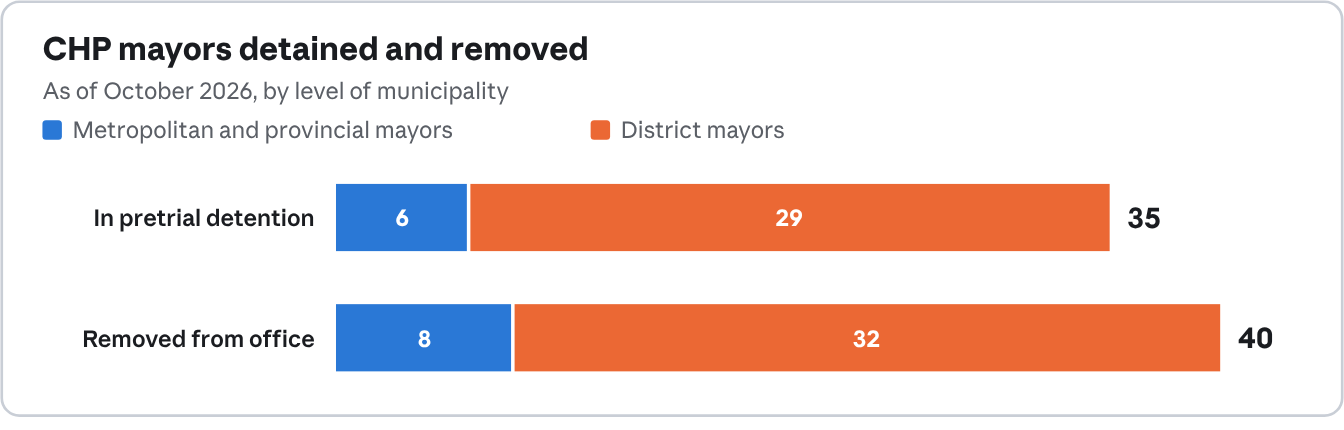
Meanwhile, numerous CHP mayors, including those of major cities, have faced investigations and detention. As of October 2026, 35 CHP mayors were in pretrial detention (six metropolitan or provincial mayors, including İmamoğlu, and 29 district mayors), and 40 had been removed from office. These practices have had a profound chilling effect. Several opposition mayors have defected to the ruling party, most strikingly İzmir Metropolitan Mayor Cemil Tugay, who had won Turkey’s third-largest city for the CHP in 2024 by a margin of nearly twelve points, and who joined the AKP on 7 October 2026 after leaving the CHP in the wake of the court-ordered change of leadership. Özel’s New Party attributed the switch to “threats, blackmail and pressure.”
These measures built upon the earlier, and by then normalized, practice of removing elected Kurdish mayors and appointing trustees. The government maintains that these cases concern ordinary criminal allegations, including corruption; the opposition and independent observers characterize them as politically motivated. Whatever the merits of individual files, the pattern, from the timing of the proceedings and the routine use of pre-trial detention to the reliance on confessor witnesses and the role of Criminal Peace Judgeships, closely mirrors the methods first tested on the Gülen Movement.
Over the past decade, mechanisms introduced as exceptional responses to a specific security threat became embedded in ordinary governance and were progressively applied to a widening range of actors: from the Gülen Movement to Kurdish political actors, journalists, academics, civil-society organizations, LGBTI activists and other religious communities and, most recently, the main parliamentary opposition. The period has been marked by a durable expansion of executive power and a corresponding weakening of the institutions that ordinarily constrain it: the courts, the media and civil society.
The findings of the UN Working Group on Arbitrary Detention and the European Court of Human Rights, together with the trajectory of independent indices, describe a consistent decline in democratic standards, the rule of law and human-rights protection in Turkey. On these measures, Turkey now ranks among the clearest cases of democratic backsliding of the past decade.
This trajectory was neither inevitable nor the work of the government alone. Having long turned a blind eye to the persecution of others, Turkey’s political actors and much of the public simply looked away again when the government turned on the Gülen Movement. They treated its followers as acceptable scapegoats whose rights could be suspended without consequence for anyone else. That indifference proved costly. The extraordinary measures the AKP government deployed against them have become ordinary instruments of rule, used against ever-larger segments of society.
The lesson reaches beyond Turkey. The rule of law cannot be suspended for one disfavored group without being weakened for all. How far this democratic backsliding will go remains an open question. What is already clear is that those who turn a blind eye to the scapegoats may become the next victims soon.