The Syrian Democratic Forces (SDF) emerged as a dominant military and territorial actor in eastern Syria following the U.S.-led campaign against ISIS. Their control of large areas has created sustained tension with Turkey, which views the SDF as an extension of the PKK. Turkey’s opposition to an independent SDF military structure, alongside Damascus’s efforts to reassert authority in eastern Syria, has made the status of the YPG, the SDF’s armed wing, a central issue in the negotiations, including the most recent talks in December.
U.S. Military Backing and Territorial Control After ISIS
The rise of the SDF is inseparable from the U.S.-led campaign against ISIS. When Washington intervened militarily in Syria, it recruited the YPG as its primary local partner on the ground. Supported by extensive U.S. air power, YPG forces led ground operations against ISIS in eastern Syria, reportedly losing around 11,000 fighters. Following ISIS’s defeat, the SDF took control of most of the territory previously held by the group, including areas along the Euphrates River that account for the bulk of Syria’s oil production.
During the Syrian civil war, the SDF avoided direct confrontation with the Assad regime. Instead, it pursued a policy of non-aggression and selective cooperation. This arrangement allowed the SDF to consolidate its territorial control. While regime forces retained enclaves within SDF-controlled territory, such as military bases in Hasakah, the SDF also maintained a presence in some neighborhoods of Aleppo that remained formally under regime authority. This coexistence was not necessarily the result of political alignment but of mutual convenience.
The arrangement collapsed with the fall of the Assad regime at the end of 2024. With the Assad regime’s authority gone, the SDF rushed to fill the power vacuum created by the regime’s withdrawal by moving into several towns around Deir ez Zor, while simultaneously facing the risk of encirclement west of the Euphrates by HTS and Turkish-backed armed groups. Following negotiations, the SDF withdrew its forces from west of the Euphrates, with the exception of a few neighborhoods in Aleppo, and transferred control of certain settlements in western areas around Deir ez Zor.
Despite these setbacks, the SDF remains one of the strongest military formations in Syria. It possesses heavy weaponry supplied by the United States and equipment seized from retreating regime forces. While the SDF claims to have around 100,000 fighters, the actual number of active combatants is likely lower. However, the YPG appears to have trained a large pool of personnel and may retain a significant reserve capacity that could be mobilized in the event of renewed conflict.
Turkey’s Security Approach to Northern Syria
The SDF has formally disassociated itself from the PKK. Nonetheless, its cadre structure, ideological orientation, thousands of PKK members in its ranks, and the pervasive presence of Abdullah Ocalan’s imagery across SDF-controlled areas indicate continuity rather than rupture. This continuity is decisive for the Turkish government. In this regard, Ankara does not distinguish between the PKK and the YPG, the armed wing of the Syrian Democratic Forces (SDF), and treats the SDF as a PKK-led entity operating along its southern border.
One of the primary drivers behind Turkey’s military interventions in Syria after 2016 was to prevent the territorial expansion and consolidation of the YPG following the defeat of ISIS. Despite objections from Russia, Iran, the Assad regime, and the Pentagon, Ankara treated the YPG’s growing control as a direct national security threat. Turkey expanded the areas under its control in northern Syria whenever conditions permitted, either through direct military operations or via proxy forces.
In this context, Ankara conducted four major cross-border operations aimed at disrupting YPG territorial continuity and providing shelter to armed opposition within Syria: Operation Euphrates Shield (2016), Operation Olive Branch (2018), Operation Peace Spring (2019), and Operation Spring Shield (2020). As Turkey lacked a UN Security Council mandate or the consent of the Assad regime, it justified these military interventions primarily on the basis of self-defense and counterterrorism, while also making secondary references to humanitarian concerns and UN-led political processes.
Ankara’s approach toward the SDF is a direct extension of its domestic security policy against the PKK. The PKK’s declaration that it had dissolved itself and laid down arms does not fundamentally change this picture. In practice, the organization has merely ended active hostilities with the Turkish armed forces and repositioned some units to Iraq to avoid skirmishes. Nonetheless, its armed capacity remains intact, as do its affiliated organizations in Syria, Iraq, and Iran, along with its networks in Europe and elsewhere. Rather than a genuine dissolution, the declaration resembles a temporary ceasefire, similar to previous episodes. In any case, the so-called peace process with the PKK has largely halted Turkish military operations in Syria and Iraq.
The March 10 Agreement Between Damascus and the SDF
Against this background, the March 10 agreement between the Syrian government and the SDF represented a significant but fragile compromise. The deal would place all civil and military institutions in northeastern Syria, including oil and gas facilities, under state authority, strengthening Damascus’s claim to sovereignty. However, the agreement deliberately avoided resolving the most contentious issue: the integration of the SDF’s armed wing, the YPG, into the Syrian army.
These questions were deferred to future negotiations, making implementation the central test of the deal. For Turkey, the agreement reduced the immediate likelihood of large-scale military operations in eastern Syria but failed to meet Ankara’s core demand: the dismantling of the YPG as an autonomous armed force.
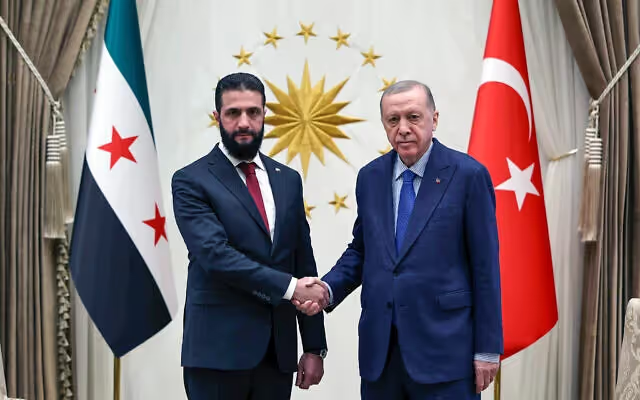
Nearly a year after the agreement, these issues remain unresolved and tensions continue to build. Turkish officials have repeatedly stated that the March 10 agreement must be fully implemented. President Recep Tayyip Erdogan has repeatedly emphasized Syria’s territorial integrity, while Foreign Minister Hakan Fidan stressed that no state can tolerate the existence of two separate armed forces within its borders.
Damascus–SDF Talks: Breakthrough or Stalemate?
According to several reports, the Sharaa government has put forward a new proposal this week to the SDF aimed at resolving their differences. The most significant provision of this proposal is that it would allow the SDF to reorganize into three divisions within the Syrian army. In addition, Damascus is said to have agreed to allocate several senior security positions to SDF figures within the Syrian government, including deputy minister of defense, deputy minister of interior, and deputy chief of staff.
At this point, reporting diverges. Some sources close to Turkish intelligence claim that other divisions of the Syrian army would be permitted to deploy in eastern Syria. By contrast, sources inside Syria suggest that no units from Damascus’s security forces would be allowed to deploy there.
If accurate, this discrepancy may constitute an unbridgeable difference and a potential deal breaker. The SDF seeks to preserve a degree of autonomy, while the Syrian government appears willing to make limited concessions in order to bring northeastern Syria under its authority. Against this backdrop, Reuters has reported that several sources have downplayed the likelihood of a comprehensive, last-minute agreement, indicating that further negotiations are required.
While the current international environment does not favor a major Turkish intervention, Ankara is signaling that refusal by the SDF to integrate into the Syrian army and insistence on maintaining an independent military command structure could trigger military action, as in previous years. On December 18, the Turkish foreign minister stated once again that both the Syrian government and other actors—likely a reference to some senior officials in the Trump administration—believe the SDF is deliberately delaying the process in anticipation of future opportunities to consolidate its gains. He stressed that Turkey does not wish to resort to military means again, but warned that the SDF must recognize that the patience of the relevant actors is nearing its limits. He further stated that the SDF has reached a point at which it must fulfill its obligations under the March 10 Agreement, emphasizing that all parties expect the agreement to be implemented promptly and without distortion, and that any deviation would be unacceptable.
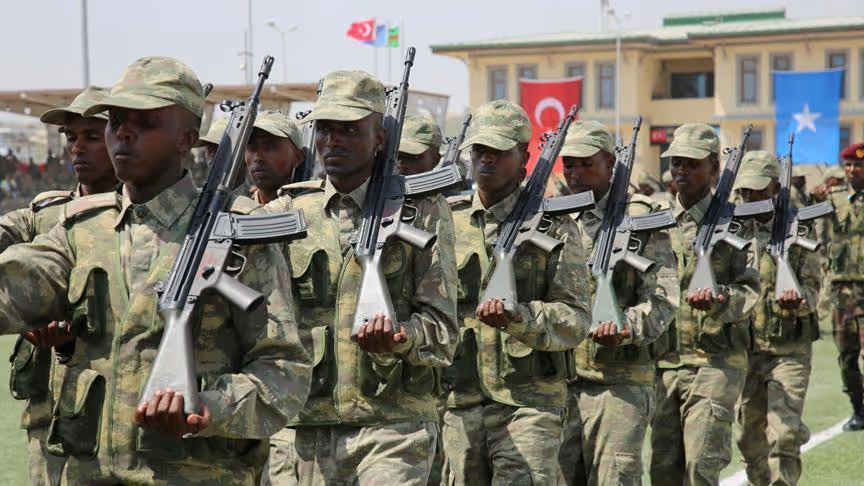
In this context, Turkey has recently reinforced its military presence in northern Syria. These troop movements appear intended as a warning rather than preparation for an imminent large-scale operation.
Turkey coordinates closely with the Damascus administration on the SDF issue and continues to press the Trump administration for the SDF’s dissolution within the Syrian army. By contrast, the SDF views its armed forces as the main guarantee of its political leverage and autonomy. Without an independent military structure, the Kurds would have little capacity to extract concessions from Damascus, and prospects for federalism or enhanced autonomy would effectively disappear.
For this reason, the SDF is unlikely to lay down its arms without firm external security guarantees. The United States, while continuing to cooperate with the SDF, has shown little interest in underwriting Kurdish federalist ambitions in Syria, despite Israeli calls to that effect. Some senior U.S. officials, such as the U.S. Ambassador to the Republic of Turkey and Special Envoy for Syria, Tom Barracks, have even explicitly dismissed notions of federalization.
As long as the YPG retains an independent military structure, Turkey will likely continue to treat it as a security threat. The talks between Damascus and the SDF have postponed confrontation but have not resolved the underlying conflict. Tensions between Turkey, Damascus, and the SDF will persist without a substantive agreement.



.svg.avif)