Local tribes taking control of cities, armed convoys coming under fire from settlements they had controlled with ease until yesterday, the liberation of prisoners from jails—these are scenes not from the final days of Assad in Syria a year ago, but from the clashes between the Syrian army and the Syrian Democratic Forces (SDF) over the past few days.
The Syrian army has recently made rapid advances after the lines of the SDF collapsed. The ceasefire signed on January 18 between Damascus and the SDF was not the product of prolonged bargaining or mutual compromise. It was imposed by developments on the ground that had already stripped the SDF of its bargaining power. As such, the ceasefire agreement formalizes the collapse of the March 10 deal and largely marks the end of the SDF’s ability to shape outcomes in Syria.
The terms of the agreement largely correspond to positions Turkey has articulated for years regarding the SDF. Ankara has welcomed the January 18 agreement in Syria. Yet, this agreement is also likely to have ramifications for Turkey’s domestic politics and the so-called peace process with the PKK.
The Chain of Events That Preceded the Ceasefire
The chain of events that culminated in the ceasefire did not begin with the fighting east of the Euphrates. It began earlier this month with talks held in Paris between Syria, the U.S., and Israel, where it was reiterated that territories west of the Euphrates were to fall under the authority of the Damascus government. What followed was not just escalation, but also the gradual implementation of these talks through the use of force on the ground.
The first concrete manifestation of this shift occurred in Aleppo. The SDF-held neighborhoods in the city were violently taken over between January 6 and 10. Following events in Aleppo city, pressure moved eastward. Between January 13 and 16, Syrian government forces launched an operation against the SDF around Deir Hafir and Maskana. These settlements were designated as military zones, access roads to Maskana were closed, and Syrian reinforcements were deployed from Latakia. Anticipating more intense fighting than in Aleppo, the SDF also reinforced the area with units from Hasakah, Shaddadi, and Qamishli. Damascus asserted that these reinforcements included PKK elements as well as former officers who had served in the Assad-era military.
On January 16, in the face of the growing military build-up and the intervention of the U.S. military, the SDF began to withdraw from Deir Hafir and Maskana. Following the SDF’s withdrawal, the Syrian army launched a further operation to control areas west of the Euphrates on January 17. As it became more apparent that the SDF was unable to hold its positions and that the United States would not intervene to protect them, fighting ensued in other theaters.
The next and final phase of the military operation unfolded east of the Euphrates. As Arab tribes began switching sides, Syrian government forces have been able to make quick gains. The SDF, which relied heavily on tribal cooperation to administer vast and sparsely populated areas, has begun losing positions almost simultaneously across multiple fronts. Raqqa and Deir ez-Zor have passed under Damascus’s control. Government forces have since reached the outskirts of Hasakah. This has not been a gradual erosion but a sudden loss of depth.
With the loss of Raqqa and much of Deir ez-Zor, the SDF also lost control of oil fields along the Euphrates. For the SDF, oil was the backbone of its economic model and its main source of independent revenue. Before the civil war, Syria produced roughly 400,000 barrels of oil per day, a figure that has fallen to around 40,000 barrels, which remains substantial for the SDF. Once those fields were lost, it is no longer feasible for the SDF to maintain an autonomous political and military structure.
From the March 10 Framework to January 18
This collapse has directly invalidated the tenets underpinning the March 10 agreement. That framework was negotiated at a moment when the SDF still believed it could negotiate from a position of relative strength. The idea of integrating SDF forces into the Syrian army while retaining their command structure, potentially through the formation of several organized units, is now gone for good.
The ceasefire agreement of January 18 establishes an immediate ceasefire and defines the framework for the reintegration of SDF-held areas into the Syrian state. SDF security personnel may join state institutions only on an individual basis, subject to vetting and reassignment, with no provision for collective integration. Control over border crossings, oil and gas facilities, and internal security is transferred to Damascus. The agreement also calls for the removal of non-Syrian PKK elements from Syrian territory.
Civil and administrative institutions in Raqqa, Deir ez-Zor, and Hasakah are to be absorbed into the Syrian state. Perhaps most consequentially, responsibility for the fight against ISIS and for the detention of former ISIS members is handed over to the Syrian government. The ISIS issue was the SDF’s primary source of international legitimacy. Without it, the SDF loses its principal argument for continued US backing.
The SDF’s Strategic Miscalculations
These outcomes were, to a significant extent, the product of a series of miscalculations by the SDF. One of the most consequential errors was its failure to correctly read the evolving regional and international environment. Expecting prolonged instability in western Syria, the SDF dragged its feet in implementing the March 10 agreement at a time when it still retained leverage. Meanwhile, the new leadership in Damascus consolidated control in the west, undermining the assumptions on which the SDF’s delaying strategy rested.
The SDF also misjudged the trajectory of regional alignment. Once Turkey, Saudi Arabia, and Qatar coalesced around Damascus, the Trump administration decided to give Sharaa a chance. Damascus, rather than the SDF, has emerged as Washington’s primary partner in Syria. The SDF failed to internalize the implications of this shift, continuing to operate on the assumption that its role east of the Euphrates was unshakeable.
Warnings pointing in this direction were repeatedly discounted by the SDF leadership as individual assessments, such as the clear statements of the U.S. Ambassador to the Republic of Turkey and Special Envoy for Syria, Tom Barrack, rather than as signals of a broader policy change. This misreading proved costly. The SDF’s territorial control had always been contingent on U.S. military backing. Once it became clear to the SDF that Washington would not actively obstruct Syrian government advances, it was already too late.
Moreover, the SDF was never a cohesive or uniform force. A substantial portion of its manpower consisted of Arab fighters embedded within tribal structures where loyalty is fluid. In such an environment, allegiance shifts quickly when incentives change. As oil revenues declined and Syrian government forces gained momentum, defections became inevitable.
Ankara’s Reaction to the Recent Developments
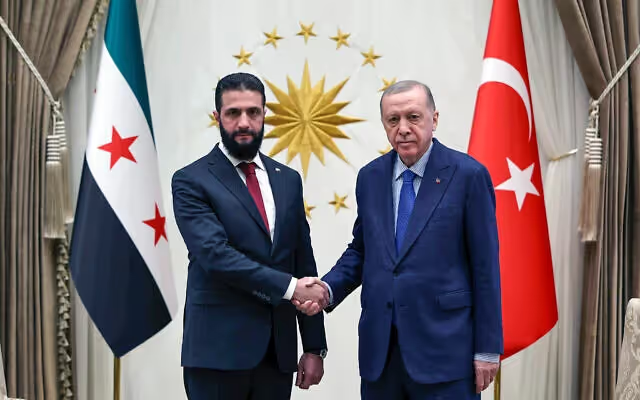
The Turkish government is content with the collapse of the SDF. Erdoğan told Sharaa in a phone call on the day of the ceasefire agreement, January 18, that “the complete removal of terrorism from Syrian territory is necessary for both Syria and the entire region.” The first official statement of the Turkish Foreign Ministry welcomed the agreement and stated that “we hope that it will be fully understood by all groups and individuals in the country that the future of Syria is not through terrorism and division, but through solidarity and integration. Turkey will continue to support the anti-terrorism efforts of the Syrian Government.”
Accroding to Ankara, the agreement addresses Turkey’s long-standing security concerns in Syria. The removal of non-Syrian PKK elements from Syria and the departure of PKK-linked cadres strike at the core of Ankara’s objections to the SDF project. The withdrawal of heavy forces from Kobani and their replacement by local security units tied to the Syrian Ministry of Interior are also a positive development for Ankara.
On the other hand, the PKK’s 2025 announcement of its dissolution was primarily driven by a desire to safeguard its gains in Syria. This included the SDF’s establishment of a semi-independent entity with aspirations for future independence should regional dynamics align favorably. With those gains now being dismantled, the organization faces a strategic dilemma. How can it survive in this entanglement? The collapse of the Syrian Democratic Forces (SDF) in northeastern Syria, therefore, carries significant ramifications for Turkey’s ongoing “Terror-Free Turkey” peace process with the PKK.
The heavy setbacks suffered by the SDF in recent days now threaten to derail the Turkish solution process entirely, as PKK elements have openly implied that continued aggression against their Syrian counterparts could force a reevaluation of the ceasefire and negotiations. PKK leaders said last week that the clashes in Aleppo call into question the ceasefire with Turkey. Similarly, Abdullah Öcalan, the imprisoned leader of the PKK, described the Syrian developments as “an attempt to sabotage the Peace and Democratic Society Process.”
If the peace process weakens or collapses, Ankara is likely to increase pressure on pro-Kurdish political actors. In that case, the DEM Party could again face legal and political crackdowns, as has occurred during earlier breakdowns in the peace process.
The intransigence of the SDF leadership in capitalizing on the March 10 agreement cost it dearly. The SDF’s decade-long quest for autonomy has ended not with a negotiated settlement, but with absorption into a centralized state framework under far stricter conditions. Cultural rights and limited political participation remain possible, but they fall far short of the decentralized governance model once envisioned by the SDF.
The ceasefire of January 18 underscores the SDF’s defeat on the battlefield and closes the door on meaningful autonomy in northeastern Syria. This also introduces new uncertainties for Ankara’s domestic peace process with the PKK. Last but not least, there is no guarantee that the terms of the agreement will be fully implemented, which could result in further bloodshed in the remaining areas under SDF control in northeastern Syria.




.svg.avif)