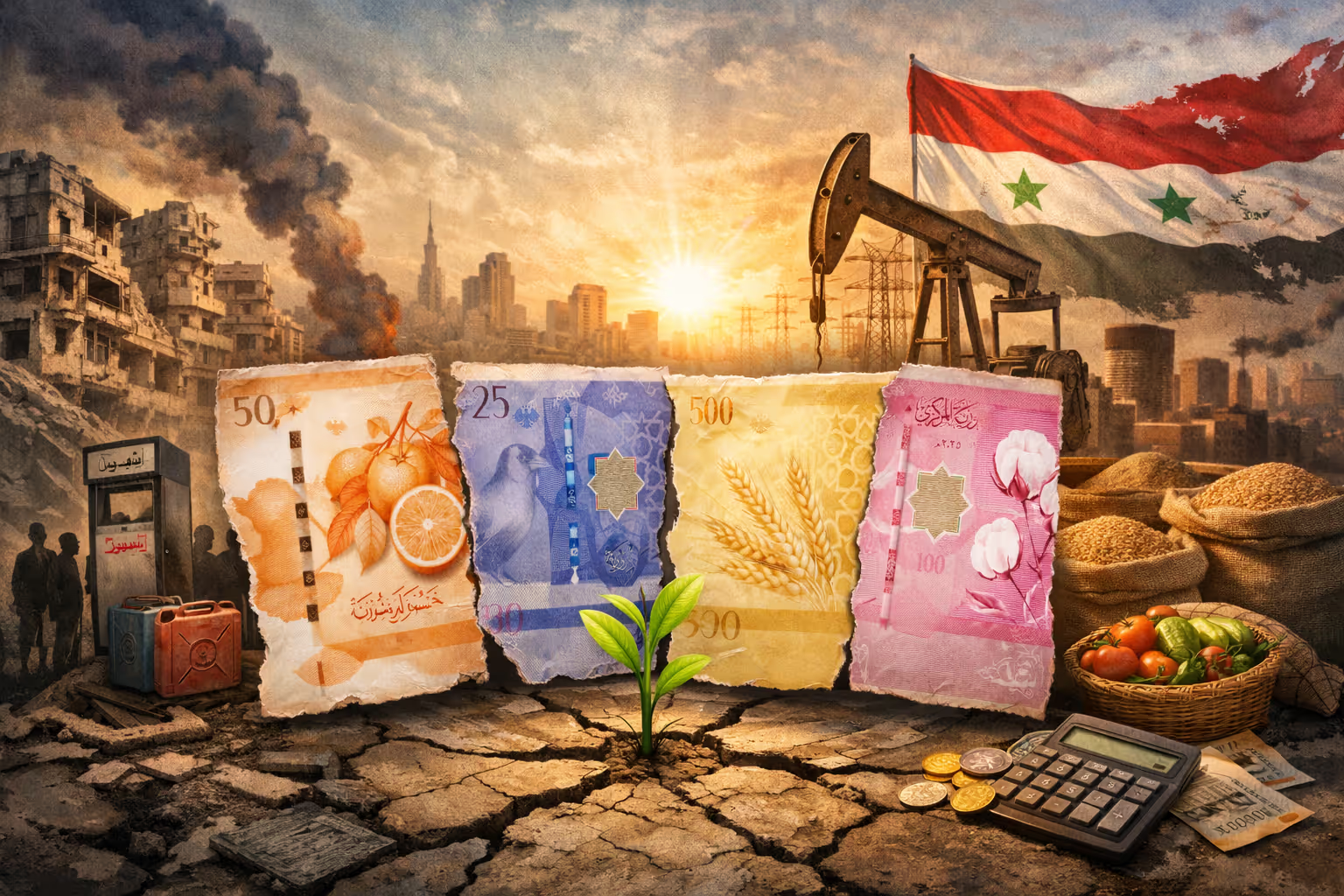
On the eve of the civil war, Syria was a lower-middle-income country with steady growth and relatively stable macroeconomic indicators. Between 2000 and 2010, real GDP grew by an average of 4.8 percent annually, inflation averaged 4.9 percent. Trade accounted for 64 percent of GDP, and GDP per capita stood at 2,731 dollars in 2010. Agriculture accounted for roughly 20–25 %of GDP, with the country largely self-sufficient in wheat, while industry contributed a significant share through textiles, food processing, chemicals, and construction materials. Tourism generated more than $6 billion a year from some 8.5 million tourists.
Syria had developed economic relations with regional partners. Syria–Turkey Free Trade Agreement signed in 2004 aimed to progressively liberalize trade, enabling developing commercial and manufacturing linkages. The idea of a Gaziantep–Aleppo industrial corridor symbolized this integration, with complementarities between Turkish and Syrian firms in light manufacturing and logistics.
The outbreak of civil war in 2011 shattered this economic fabric. According to official statistics, Syria’s gross domestic product contracted by 53 percent between 2010 and 2022. By contrast, World Bank estimates based on nighttime light data, used as a proxy for economic activity, point to a much steeper decline of 84 percent between 2010 and 2023. Exports collapsed from more than $8,8 billion in 2010 to roughly $1.8 billion by 2021.
The country’s official state budget fell sharply from 9 billion dollars in 2020 to 6.8 billion in 2021, 5.3 billion in 2022, and 3.6 billion dollars in 2023 at the official exchange rate. Syria’s evolution into a quasi-narco-state was closely linked to the regime’s economic collapse along with the civil war. Partly in response to economic contraction, the Assad regime increasingly relied on Captagon trafficking. This drug trafficking was reportedly generating approximately 5.7 billion dollars in 2021 alone, turning narcotics into Syria’s primary revenue stream.
With the overthrow of the Assad regime in December 2024, Syria’s transitional authorities have confronted a deeply fragmented and damaged economy. The country’s GDP fell by around 1.5 percent in 2024, the continuation of a long contraction under wartime conditions, but modest growth near 1 percent is expected in 2025 according to the World Bank, signaling a very early phase of recovery.
Syria’s new leadership has indicated a move toward a free-market economic model, marking a break from decades of tightly controlled state management. Proposed reforms focus on dismantling restrictive trade and customs systems within the country to attract investment and reconnect the economy with global markets.
Reconstruction Costs and Infrastructure Needs
The scale of physical damage of the civil war underscores the enormity of the task. The World Bank estimates that $216 billion will be required to rebuild infrastructure, housing, and economic assets destroyed during the conflict—nearly ten times Syria’s 2024 GDP. One of the largest needs are in electricity networks, transport corridors, and urban infrastructure in highly damaged areas such as Aleppo and the Damascus countryside.
Due to devastation of the civil war, the Assad regime could only supply electricity a few hours daily. At the end of 2025, thanks to new power plants and a steady gas supply from Turkey, the government in Syria has been able to provide reliable electricity to major cities, a development that is crucial for industrial revival.
Oil and Energy: Lost Potential and Future Role
Oil was once a cornerstone of Syria’s export earnings and fiscal revenues. Prior to the civil war, production hovered in the 400,000 of barrels per day; by 2023, output had fallen to under 40,000 barrels per day. Rehabilitating oil and gas infrastructure in Syria could significantly bolster state revenues, reduce import dependence, and finance reconstruction. This will necessitate foreign capital, technology transfer, and stable governance agreements covering exploration rights and resource management.
Economic theory suggests that internal trade integration lowers incentives for conflict and supports peace, as economic interdependence expands shared gains and reduces zero-sum competition. Syria’s economic geography today is shaped by de facto political fragmentation. The transitional authorities in Damascus control roughly two third of the Syrian territory, while the Syrian Democratic Forces (SDF) govern about a third, including most of the country’s hydrocarbon resources,.
This fragmentation hinders oil revenue sharing, coordinated infrastructure planning, and the establishment of integrated energy and transport networks. Without comprehensive agreements between Damascus and the SDF on fiscal transfers, and pipeline access, each region will remain economically disjointed.
Sanctions and International Reintegration
Monetary institutions are central to economic recovery. Syria’s Central Bank under new leadership has embarked on ambitious reforms. Confidence-building steps include plans to redenominate the currency (removing zeros) to strengthen price stability and rebuild trust in the Syrian pound. At the same time, the bank is tightening fiscal financing practices, stabilizing monetary policy, and partnering with global financial services players to modernize payments. These moves lay foundational groundwork for renewed private credit and investment.
Despite early stabilization, trade remains far below pre-war levels. Exports that was $8.8 billion in 2010 have collapsed to low single-digit billions. Reviving external trade requires reducing barriers to cross-border commerce and full integration into global financial and payment systems, such as SWIFT. In this regard, international sanctions that isolated Syria for over a decade have been progressively eased in 2025. The U.S. Congress repealed the Caesar sanctions in December 2025. Introduced in 2019 to penalize the Syrian state for systematic human rights abuses, the Caesar sanctions had severely constrained Syria’s economy by limiting access to international finance and discouraging investment. The EU has also suspended restrictive measures, enabling engagement in trade and finance, though security-related restrictions remain. Their removal was intended to support economic stabilization and reconstruction after years of war and isolation, while signaling political backing for the post-Assad leadership from the U.S. and the EU.
Regional Roles: Turkey, Gulf and Europe
For Turkey, keeping the Sharaa government in power in Syria is a priority. Turkey is backing this through practical steps, including facilitating trade measures, aid and housing projects, repairing infrastructure, providing military training, expanding counter-terrorism cooperation, and improving access to education and psychosocial support. Reinvigorating the Gaziantep–Aleppo corridor could also boost trade and investment inflows.
Gulf states, including Saudi Arabia and Qatar, have already contributed financially to debt clearing and invested in infrastructure. Their capital and political support remain crucial for large-scale infrastructure and public investment.
The European Union and United States play an indispensable role by easing sanctions and potentially opening markets. Diaspora flows between Europe and Syria, especially from countries with significant Syrian communities, offer channels for remittances, foreign expertise, and investment — bridging post-conflict reconstruction with global economic integration.
Agriculture: Food Security and Rural Livelihoods
Agriculture, historically accounting for a large share of GDP and employment, remains central to Syria’s economy. Before the war, Syria was mostly self-sufficient in wheat, a staple crop, and cultivated export crops such as cotton. And, Syria was producing up to four million tons of wheat in strong harvest years and exporting roughly one million tons of that output. However, recent droughts have reduced wheat production by nearly 40 percent in 2025 and resulted in deficit of 2.73 million metric tons according to the UN.
Reviving agriculture requires repairing irrigation infrastructure, restoring landmine-contaminated fields, and rehabilitating supply chains. International assistance and partnerships will be critical to rebuild agricultural production and food security, and to re-establish Syria as a net exporter of selected commodities.
Prospects and Challenges
Syria’s post-war economic landscape is marked by immense reconstruction needs, deep human and physical losses. One year after the regime change, early signs of stabilization, such as modest growth prospects, Central Bank reforms, export recovery efforts, and international engagement provide cautious optimism.
The path ahead requires sustained investment in energy, agriculture, and transport infrastructure. If these building blocks converge, alongside inclusive political agreements and effective use of diaspora networks, Syria’s economy can begin a gradual transition to recovery.





.svg.avif)