The fall of the Assad regime in Syria has opened a new chapter in Turkish–Israeli relations. For a long time, the Assad regime was a major security concern for Turkey. For Israel, it was “the devil they knew.” Israel focused on containing the Assad regime and Iran’s proxies, while Turkey’s military presence in Syria remained a secondary issue. The overthrow of Assad has since complicated Israel’s security environment, along with Turkey’s increasingly active role in Syria.
From Managed Threat to Growing Uncertainty
Israel’s Syria policy has mainly been shaped by a threat perception emanating from Hezbollah and its backer, Iran. With the outbreak of the civil war, Tehran and its proxies expanded their activities in the region, and Syria increasingly served as a corridor for the transfer of weapons to Hezbollah in Lebanon. In this regard, Israel has adopted a strategy of fighting the enemy away from its borders and eliminating their capacity to retaliate. Therefore, over the years, Israel has entrenched itself along its northern border.
The defeat of Hezbollah, the killing of senior leaders including Hassan Nasrallah, and the ensuing 12-day war with Iran weakened—though did not entirely eliminate—the threat posed by Tehran and its proxies. With this menace reduced, Israel’s focus has shifted. For the Netanyahu government, the main concern is now the new government in Syria and the uncertainty it brings.
Competing Visions: A Unified Syria versus a Fragmented One
Israel’s policy in Syria focuses on preventing the emergence of a strong, unified state that could pose a security threat. This new Israeli strategy in Syria, which can be defined as containment, has led the IDF to conduct regular attacks. Over the past year, Israel has carried out more than 600 air, drone, and artillery strikes across Syria—nearly two attacks a day—according to data from the Armed Conflict Location and Event Data (ACLED). Quneitra was the most heavily targeted area with at least 232 strikes, followed by Deraa with 167 attacks, while Damascus governorate was hit at least 77 times, including 20 strikes on the capital itself. Israel has also occupied further Syrian territories after the fall of the Assad regime.
Turkey, however, strongly advocates for a stable and unified Syria, while helping to consolidate the new regime and forcing the Kurdish entity to become part of the central government. In the meantime, Turkey has ramped up its efforts to consolidate the new regime, integrate it into the international community and provide support in all fields to re-establish a functioning state. According to state-run Anadolu Agency, President Erdoğan has instructed the ministries to start the post-war reconstruction in coordination with the Syrian regime. Although Turkey has the capacity to realize these projects to some extent, it certainly needs financing from the international community. More importantly, these projects need a politically stable regime and security on the ground.
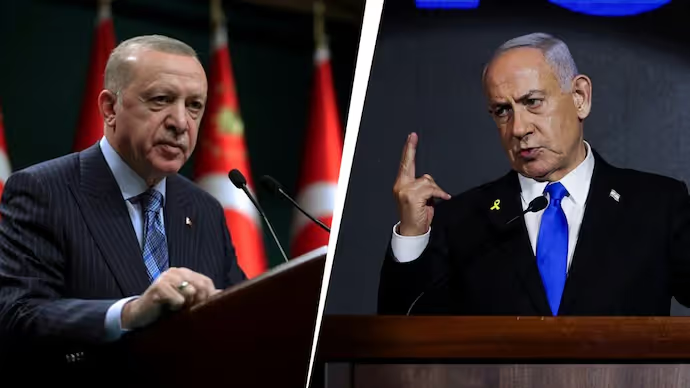
In this context, heated exchanges between Turkish and Israeli governments have grown increasingly confrontational. Turkey has been criticizing Israel’s strikes as destabilizing and fostering chaos, calling the international community to act against Israel’s operations in the region. Israel rejects Ankara’s accusations of destabilization and claims that Turkey wants to have a protectorate state in Syria. Therefore, some in Israel even started to view Turkey as the new Iran, considering its activities in Syria. More reasonable voices in Israel, however, acknowledge that Turkey is not Iran but a threat to Israel’s security.
These diverging policies towards Syria have heightened the tension between Turkey and Israel. The exchange of loaded charges against each other paved the way for speculation about a direct confrontation between Turkey and Israel. Fearful of Turkey’s entrenchment in Syria after the fall of Assad, Israel basically obliterated Syria’s remaining military capabilities and destroyed the infrastructure that could be or were planned to be used by Turkey.
While the Sharaa government is eager to work with Ankara, other groups in the country will welcome any kind of support from Israel. Relying on the U.S. as well as Israeli support, Syrian Democratic Forces have resisted the idea of integrating their forces with the new Syrian regime. In this regard, although Israel has so far avoided providing tangible support to a secessionist Kurdish movement, the developments in Syria today could make such support more likely in the future.
On the one hand, Israel could push the U.S. administration to obstruct both the Turkish government and the Syrian regime, to the detriment of efforts to consolidate authority in Damascus. On the other hand, relying on its air superiority and existing operational freedom in Syria, Israel may conduct critical operations targeting the Syrian regime to prevent any security entrenchment against its interests. Israel also feels unhindered in supporting the Druze community in southern Syria.
The Gaza War and Hardening Positions
The Israeli-Palestinian conflict complicates matters for Turkey and Syria. Although Erdoğan has been pragmatic and successful in managing the public sentiment against Israel in the past, the situation in Gaza after 2023 has hardened the Turkish public against Israel. The erosion of trust, or should we say an unprecedented level of mistrust, between the parties has led Israel to reject Turkey’s participation in the Gaza Stabilization Force. Tensions around the Palestinians will deepen the mistrust and will have the capacity to render any de-escalation mechanisms in Syria meaningless.
Nonetheless, Israel’s ability to keep Turkey out of regional initiatives may be wearing thin, especially given President Donald Trump’s close relationship with President Erdoğan. Speaking alongside Israeli Prime Minister Benjamin Netanyahu in December 2025, Trump highlighted his personal rapport with both leaders, saying, “I know Erdoğan very well and as you all know, he’s a good friend of mine. I believe him and I respect him. So does Netanyahu.” As one source quoted by The Jerusalem Post put it, “There is a limit to how many times Israel can say ‘no’ to Trump regarding President Erdoğan.” In this vein, the United States has facilitated direct talks between Israel and Syria. In January, senior Israeli and Syrian officials met in Paris and agreed to establish a joint communication cell to support intelligence coordination, military de-escalation, and diplomatic engagement under the supervision of the United States.
Compared to Turkey’s more ambitious plans, Israel’s strategic objectives in Syria are easier to achieve. After all, building a new nation is far harder than fueling divisions in an already vulnerable country. Turkey and Israel have serious doubts about each other’s intentions. Yet, both sides are aware of the costs of such a direct confrontation. This has led them to engage in de-escalation talks, making a direct military clash less likely.
Overall, Syria is evolving into a geopolitical challenge for Israel and Turkey, with each pursuing conflicting agendas. These differences are hard to align and will remain a persistent source of tension between Turkey and Israel.




.svg.avif)