Turkey's decision to nominate Feridun Hadi Sinirlioğlu for UN secretary-general looks, at first glance, like a proud moment for Turkish diplomacy. He has spent more than four decades in the Turkish foreign service. He served for many years as undersecretary of the Foreign Ministry and represented Turkey at the United Nations in New York. He was briefly Turkey's foreign minister in 2015. And he now serves as secretary general of the Organization for Security and Co-operation in Europe (OSCE). When a diplomat with that résumé is put forward for the world's top diplomatic job, it is worth taking notice.
But a list of offices and titles makes for an incomplete portrait. Sinirlioğlu did not simply watch Turkish foreign policy transform under Erdoğan's Justice and Development Party (AKP), but did his best to drive that transformation. Any serious assessment of his candidacy has to look at how he wielded power in Ankara, the foreign-policy choices he advocated, and the record of the years when he was in charge.
Sinirlioğlu was born on January 30, 1956, in a small town in the Black Sea province of Giresun. He studied political science at Ankara University and entered the Foreign Ministry in 1982. He also earned a PhD in political science and international relations from the prestigious Boğaziçi University.
After overseas postings in The Hague and Beirut, he joined Turkey's mission to the UN in New York. In 1996, at just 40, he became chief foreign-policy adviser to President Süleyman Demirel, a post he held until 2000. Two years later, he became ambassador in Tel Aviv, where he served until 2007. He then returned to Ankara as deputy undersecretary and, in 2009, became undersecretary, at the time the top position for a career diplomat in the Turkish foreign service.
He served as undersecretary for an extraordinarily long time, from 2009 to 2016. In between, he served as foreign minister in the interim government, which was in office from August to November 2015.
Sinirlioğlu then spent seven years, from 2016 to 2023, as Turkey's permanent representative to the UN. In 2023, the UN secretary-general tapped him to lead an independent assessment of Afghanistan, and in December 2024, he was named secretary general of the OSCE.
This is an impressive diplomatic career. He is an expert on the Middle East, on Turkey's relations with Washington and Tel Aviv, and on energy diplomacy. Most relevant to his candidacy, he has extensive experience in multilateral diplomacy.
Yet what makes his career interesting is not his experience alone. More telling is how he climbed the ranks of the Turkish bureaucracy and, above all, how long he stayed at the top, both of which are quite extraordinary.
Until the post was abolished, the undersecretary was the Foreign Ministry's most senior career official: the civil servant who ran the ministry under the minister, more like a British permanent secretary than an American under secretary. Those appointed to this position typically served for two to three years. When Sinirlioğlu assumed this post in 2009, he became one of the most influential figures in a new era of Turkish foreign policy. He held the position until 2015 and, after his brief stint as foreign minister that year, returned to it and remained there until late 2016. In a ministry known for its traditions, rigid professional hierarchy, and long institutional memory, holding the top post for that long is remarkable in itself.
Competence alone cannot explain it. His standing with Recep Tayyip Erdoğan, who was prime minister for most of those years and has been president since 2014, the political trust Erdoğan placed in him, and his close ties to the inner circle of power all played a major role in shaping his career.
That trust became evident at several points. He was appointed foreign minister in the 2015 caretaker government. In January 2021, on the very day he turned 65 and should have retired, he was named chief adviser to the president, with the title of ambassador, allowing him to continue serving as Turkey's representative to the UN. Later, the way was cleared for him to take on international roles.
Sinirlioğlu also had a special relationship with Ahmet Davutoğlu. Just three months after becoming foreign minister, Davutoğlu appointed Sinirlioğlu as undersecretary. Sinirlioğlu served under Davutoğlu for five years, until Erdoğan chose Davutoğlu to succeed him as prime minister. By appointing Sinirlioğlu as foreign minister in his interim government, Davutoğlu once again demonstrated his personal trust in him. Their relationship looked more personal than professional. Sinirlioğlu used to address him as “my professor” (Hocam), a reference to Davutoğlu's academic title, rather than the formal “Mr. Minister.”
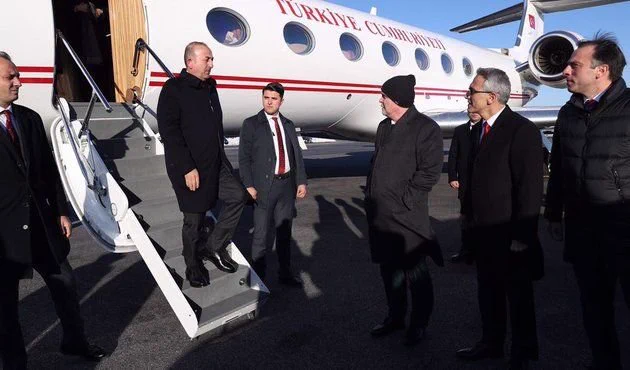
Accounts of a tight-knit team of loyalists, with its own internal hierarchy, taking shape around Sinirlioğlu inside the ministry during his years as undersecretary lie at the heart of the debate over his management style. His personal style reinforced this aura of power. His casual manner, occasional disregard for protocol, and idiosyncrasies set him apart from the traditional image of a Turkish diplomat. When a photograph showed him greeting then–Foreign Minister Mevlüt Çavuşoğlu at the airport in New York in 2017, wearing a beret and with his hands in his pockets, it was seen as more than a breach of etiquette. In a bureaucratic culture where a minister is greeted with a formal, almost deferential posture, the image could be read as a statement about who really held power in the ministry.
Sinirlioğlu has his admirers. They point to his role in normalizing relations with Israel, his work with Washington, his experience at the UN and the OSCE, his skill as a negotiator, and his network in international diplomatic circles.
He did play an important role in the 2016 rapprochement between Turkey and Israel, leading the Turkish negotiating team. And his appointment as OSCE secretary general in 2024 shows that he enjoys a measure of international acceptance.
But these achievements tell only part of the story. Success in diplomacy is not measured by attending summits, cultivating foreign counterparts, or holding important posts. It is measured by how well you protect your country's interests, how early you see a crisis coming, and what you do to limit the damage of bad policy.
Sinirlioğlu's years as undersecretary coincided with some of the most consequential and turbulent moments in modern Turkish foreign policy. The Syrian civil war broke out in 2011, and Ankara's Syria policy became an ever-greater security and diplomatic liability. Those years also brought the Mavi Marmara crisis in 2010, the seizure of Turkey's Consulate General in Mosul by ISIS in 2014, and the downing of a Russian warplane in 2015.
It would be unfair to pin all of this on a single bureaucrat. Foreign-policy decisions are made by political leaders, and their outcomes are shaped by many hands. But a ministry's most senior official cannot escape responsibility altogether, least of all for crisis management, institutional coordination, diplomatic foresight, and keeping the machinery of state in good working order.
So how much responsibility does Sinirlioğlu, who sat at the heart of Turkish foreign policy for so many years, bear for that period's strategic mistakes and institutional failures?
Given where Turkey's Syria policy ended up, what happened in Mosul, and the heavy price Ankara paid in its regional relationships, merely having held office cannot be passed off as diplomatic success.
My view of Sinirlioğlu's management style is not based solely on what I observed from the outside. Two incidents I witnessed while serving in the Foreign Ministry say a great deal about the culture of those years.
The first incident took place when I went to the undersecretary's private office to have a document initialed before it went up to Sinirlioğlu himself. As I approached the room of one of the staff members to drop it off, I noticed that the door was ajar and overheard instructions being given to a group of young colleagues assigned to units under the undersecretary.
They were told to be as tough as possible with anyone who came to the office, that these were the undersecretary's own orders, and that the point was to bring the ministry's officials and diplomats into line. They were even told that, junior and probationary as they were, they could be harsh with a department head, and that everyone in the building should learn to fear the undersecretary's office.
The second incident occurred during a far graver crisis. A day or two before ISIS overran the Consulate General in Mosul, I was the ministry's duty officer, responsible for handling urgent communications after hours. Near the end of my shift, cables arrived from Mosul that needed to reach the relevant departments immediately. The safety of our colleagues was at stake.
I called a high-ranking official in Sinirlioğlu's private office. She told me they were in the United States, that Undersecretary Sinirlioğlu was busy preparing for a meeting, and that he was not to be bothered with something so trivial.
I told her that standing instructions required me to report exactly this kind of situation, and that our colleagues in Mosul were in grave danger. I was scolded anyway and told not to disturb her, the undersecretary, or any other senior official at that hour. I reminded her of the instructions once more and said I would record our conversation in the duty log. Then I passed the urgent messages from Mosul on to the relevant units myself.
There was, of course, another troubling aspect of this exchange. I was being told not to disturb the undersecretary, or anyone else in senior management, with something apparently so trivial, when Sinirlioğlu was himself in Washington precisely to discuss the deteriorating situation in Iraq, the growing ISIS threat, and bilateral cooperation with American officials.
When ISIS overran the Consulate General on June 11, 2014, all 49 people there, including the Consul General and consular staff, were taken hostage. They would remain in captivity for 101 days. The fall of Mosul was not an unforeseeable catastrophe. The warning signs had been accumulating for weeks.
What links the two incidents is that the ministry's institutional procedures and the basic requirements of public service came second to deference toward those at the top and a highly personal sense of hierarchy.
Then there is the matter of his wife, Ambassador Ayşe Sinirlioğlu, who also rose to the ministry's upper ranks during his tenure. She became acting deputy undersecretary in September 2014 and was formally appointed that December, making her, in effect, one of her husband's deputies. A married couple holding senior posts in the same institution is not improper in itself. But the family and institutional ties that form around such a powerful office deserve scrutiny in any discussion of merit and institutional independence.
Turkey announced Sinirlioğlu's nomination on October 30, 2026, making him its first-ever candidate for UN secretary-general. He has already faced his first test. On November 5, he took part for the first time in the Security Council's straw poll, the informal secret ballot members use to gauge support for each candidate. According to reported results, he drew three “encourage” votes, eight “discourage” votes, and four “no opinion” votes, placing sixth among the eight candidates.
It was not always this hard for Ankara to win friends at the UN. In the 2000s, Turkey was on the rise: its soft power and regional clout were growing, and it was increasingly seen as an assertive player on the world stage. Its seat on the UN Security Council in 2009–2010, its mediation efforts, and its high profile in multilateral diplomacy all reflected that ascent.
In the years that followed, that standing eroded, worn down by criticism of authoritarian drift, democratic backsliding, contested policies in regional crises (Syria above all), and friction with Western allies. Against that backdrop, Ankara's decision to field a candidate for the UN's top job is intriguing, to say the least.
And however impressive Sinirlioğlu's résumé may be, it raises questions when measured against the usual profile of a secretary-general. Many previous secretaries-general had served lengthy terms as foreign ministers, headed governments, or operated at the highest levels of international politics. The outgoing secretary-general, António Guterres, for example, is a former prime minister of Portugal. Career diplomats have held the job before, notably Myanmar's U Thant and Peru's Javier Pérez de Cuéllar, but they are in the minority. Sinirlioğlu's strengths lie elsewhere: more than four decades of diplomatic experience, senior posts at the UN and the OSCE, and deep familiarity with multilateral diplomacy. Nor should it be forgotten that all 57 OSCE participating states agreed by consensus to appoint him.
Still, his bid faces political hurdles that no personal qualifications can overcome on their own: the informal regional rotation, under which many expect the job to go to a candidate from Latin America and the Caribbean, mounting pressure to choose the UN's first woman secretary-general, and, above all, the positions of the Security Council's five permanent members.
Sinirlioğlu's titles and international appointments should not be treated as a certificate of success that places every past decision and practice beyond question. My own firsthand experience of how he ran things as undersecretary, along with the power dynamics inside the ministry and the foreign-policy crises of those years, calls for a more critical examination of his record.
The question to ask about Feridun Hadi Sinirlioğlu as he seeks the UN's top job, then, is this: Behind his rise through the ranks of international diplomacy, is there a genuinely accomplished statesman, or a powerful bureaucrat who remained untouchable in Turkey for years thanks to political trust and bureaucratic clout?
The answer lies not in the offices he has held, but in the record he leaves behind.