
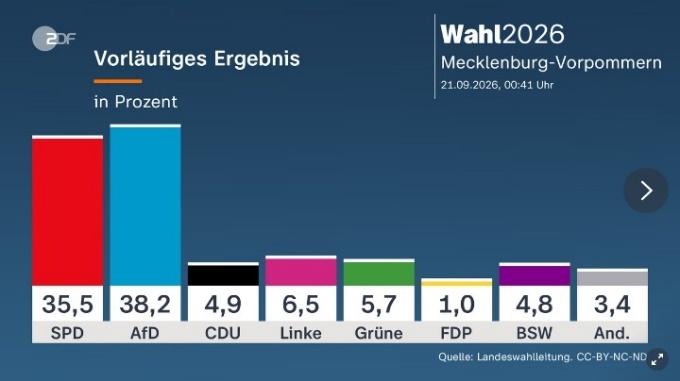
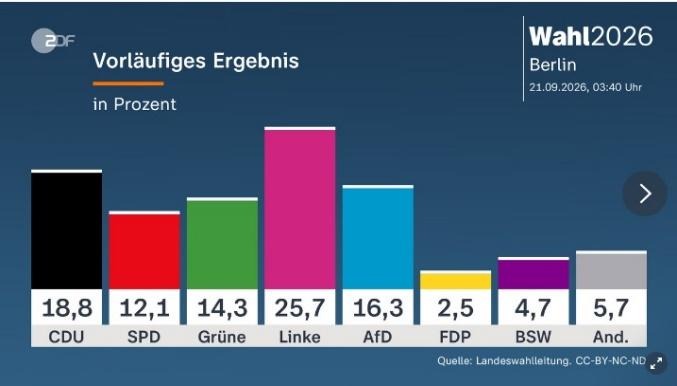
Germany's latest regional elections have produced two very different political victories. In Mecklenburg-Western Pomerania, the Alternative for Germany (AfD) emerged as the strongest party with 38.2 percent of the vote, more than doubling its 2021 result. In Berlin, meanwhile, Die Linke (the Left) achieved a striking breakthrough, rising from 12.2 percent in 2023 to 25.7 percent in 2026 and becoming the strongest party in the capital.
At first glance, these results seem to tell completely different stories. One is a victory for the AfD in eastern Germany. The other is an unexpectedly strong performance by the Left in one of Germany's most diverse cities. Yet both elections reveal a similar mechanism. Voters respond when a political party succeeds in identifying a problem they consider immediate and presents itself as the clearest political vehicle for their dissatisfaction.
This is also the central lesson of the AfD's victory in Saxony Anhalt, discussed in my previous analysis. The AfD did not create the frustrations that brought voters to the ballot box. It organized them. Berlin shows that other parties can occupy the same political space, but through a very different message.
Die Linke's result in Berlin was not simply an incremental improvement. The party more than doubled its previous result and built its campaign around one issue above all others: housing.
Rents and the housing crisis were among the most important issues for Berlin voters. For younger Berliners, the issue is about whether they can afford to remain in the city. For families, it is about rent and available space. For lower income households, it is about the cost of living. For long term residents, it is about whether their neighbourhoods are becoming unaffordable.
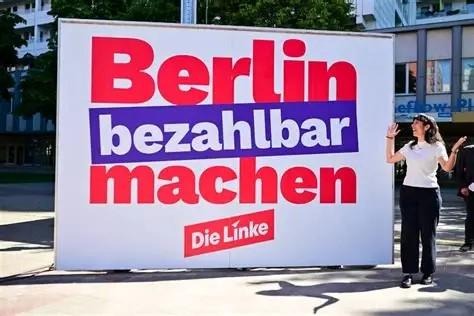
Die Linke therefore did not need to convince every voter of the same ideological worldview. It needed to convince them that housing was one of Berlin's defining problems and that it had a distinctive answer to it. Its campaign focused on measures such as a rent freeze in state owned housing and the implementation of the referendum on the socialisation of large property companies. It was also the party voters trusted most to address the housing crisis.
The political significance of this strategy is difficult to miss. Rather than asking voters to support the party primarily as an ideological alternative, Die Linke presented itself as a response to a problem Berliners experience every day.
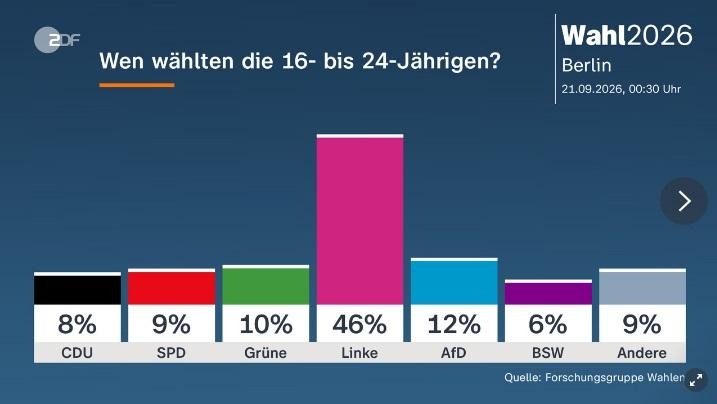
This message was particularly powerful among younger voters. For many young Berliners, the housing crisis directly affects whether they can afford to move out, find a home in the city or remain in Berlin as rents continue to rise. By making housing affordability one of the central themes of its campaign, Die Linke connected a broader message about social justice to a problem that younger voters experience in their everyday lives. The effect showed at the ballot box: forty six percent of Berliners aged 16 to 24 voted for Die Linke, while the party also reached 33 percent among voters aged 30 to 44. A significant share of its new voters had not voted in the previous election. Die Linke therefore did not simply persuade voters to switch parties. It also succeeded in mobilising people who had previously stayed home.
Voters do not necessarily move towards a party simply because they suddenly embrace its entire ideology. They can move because they believe that party has identified their problem more clearly than its competitors.
This is where Berlin connects directly to the argument of my previous article. The AfD's success in Saxony Anhalt was also based on its ability to transform dissatisfaction into political mobilisation. Migration, economic insecurity, public services and distrust in established parties became part of a broader narrative of lost control.
The AfD has been highly effective at telling voters that the political system has lost control. Die Linke's Berlin campaign instead told voters that Berlin had become unaffordable and that housing policy could change that.
Both approaches answer the same underlying question: “What is the problem making my life harder, and which political party is actually talking about it?” That may be one of the most important lessons of these elections.
There is another important dimension to the Berlin result. Elif Eralp, the daughter of Turkish immigrants, emerged as one of the most visible figures of Die Linke's campaign at a time when migration, discrimination and political representation remain highly contested issues in Germany.
But reducing the result to her background would miss the larger political story. Eralp's candidacy combined representation with a concrete policy agenda. Her campaign was closely connected to the question of affordability and the housing crisis, while the party's broader message emphasised social justice and inclusion.
Her background made representation particularly visible, but the electoral data suggests that identity alone cannot explain Die Linke's breakthrough. Housing was the dominant issue, and Die Linke was the party voters trusted most to address it.
A candidate from a migrant family succeeding at a time of intensified debates about racism and migration does not mean that these conflicts have disappeared. It demonstrates that representation can become politically powerful when it is combined with issues that directly affect people's everyday lives.
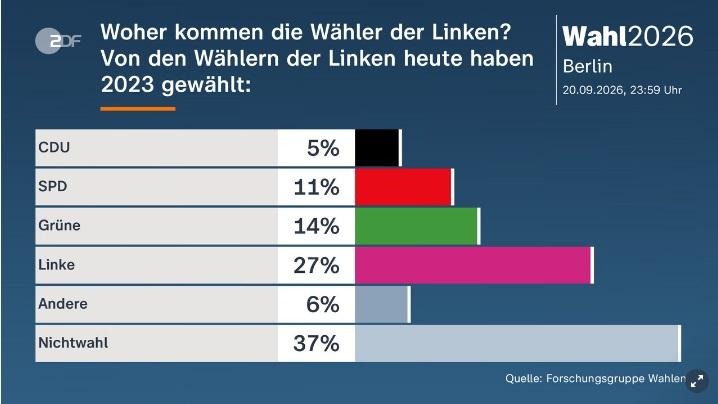
What is particularly striking, however, is that Die Linke's support did not come exclusively from its traditional voter base. 37 percent of those who voted for Die Linke in the 2026 election had not voted in 2023. This suggests that the party was able to reach beyond its established electorate and mobilise a substantial share of previous non-voters.
Mecklenburg-Western Pomerania provides a useful contrast. The AfD won 38.2 percent, compared with 35.5 percent for the SPD. In 2021, the AfD had received only 16.7 percent.
Federal politics also played a major role. Among AfD supporters, issues such as support for Ukraine, pensions and fuel prices were frequently mentioned. Much of the frustration was directed at the federal government rather than specific state level policies.
The AfD was therefore able to turn dissatisfaction with the federal government into support for a state level election.
The SPD, meanwhile, ran a strongly polarised campaign against the AfD, presenting the election largely as a confrontation between the two parties. The result showed the risks for other established parties. The CDU fell to just 4.9 percent and left the state parliament.
The election thus illustrates another way in which political space can be redistributed. When two parties dominate a polarised contest, voters who do not identify with either side can become politically homeless.
Established parties in Germany become vulnerable wherever they fail to provide voters with a convincing explanation of how their everyday problems can be solved. The three elections in Saxony Anhalt, Mecklenburg-Western Pomerania and Berlin therefore point towards a search for alternatives.
In Saxony Anhalt, the AfD successfully transformed accumulated dissatisfaction into political mobilisation around migration, economic insecurity, distrust of established parties and a broader sense of political disempowerment.
In Mecklenburg-Western Pomerania, the same party benefited from dissatisfaction with federal politics, while the increasingly polarised contest squeezed the established CDU.
Berlin shows a different possibility. Die Linke identified the problems: the cost of living and the ability to find and keep a home in the city. It built its campaign around that issue, mobilised younger voters and attracted people who had previously stayed away from the ballot box.
The rise of the AfD should not be explained simply by saying that voters have become more radical. The Berlin result should not be explained simply as a sudden ideological shift to the left either. In both cases, the crucial question is how effectively a political party converts dissatisfaction into a coherent political narrative.
The political vacuum does not belong automatically to the right or the left. It belongs to whoever can convince voters that they understand the problem better than their competitors and that their political offer provides a credible response. Ultimately, the lesson of these elections in Germany is clear: voters may not be defined by ideological loyalty as much as by whether they feel heard, understood, and represented.


.svg.avif)