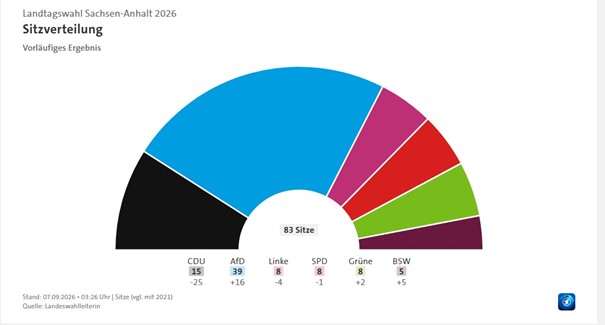
The result of the Saxony-Anhalt state election should not be dismissed as a temporary protest vote or an isolated eastern German phenomenon. The Alternative for Germany (AfD) won 43.8 percent of the vote and 39 of the 83 seats in the state parliament, more than doubling its result from 2021. The Christian Democratic Union (CDU), which had governed the state for 24 years, collapsed to 17.2 percent and 15 seats. The AfD fell just three seats short of an outright majority.
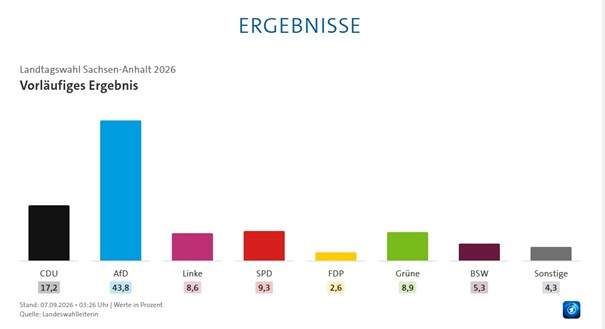
There is, however, a striking irony in these numbers. In a post that later became one of his most quoted statements on the AfD, Friedrich Merz wrote: “Wir können wieder bis zu 40 % erzielen und die AfD halbieren. Das geht!” — “We can get back to 40 percent and halve the AfD. It can be done.” The political arithmetic has now turned almost completely upside down. The party Merz once said could be halved has instead reached 43.8 percent, while his own CDU has been reduced to less than half of its previous support. The old post has since disappeared from Merz's social-media account, adding another layer of irony to an already extraordinary result.

But the immediate reaction in Berlin may be to describe the result simply as a triumph of the far right. That would be too easy. The more uncomfortable question is why almost half of the electorate chose the AfD.
One answer is frustration. Another is economic insecurity. Another is migration. And, perhaps most importantly, there is a growing belief among voters that established parties no longer understand or adequately address the problems they face.
Extremism feeds on frustration
The figures from Saxony-Anhalt are revealing. Among voters who described their own financial situation as poor, 65 percent voted for the AfD. By contrast, only 8 percent of those who considered themselves financially disadvantaged voted for either the CDU or Die Linke. Even among voters who considered their financial situation good, the AfD remained the strongest party, receiving 37 percent.
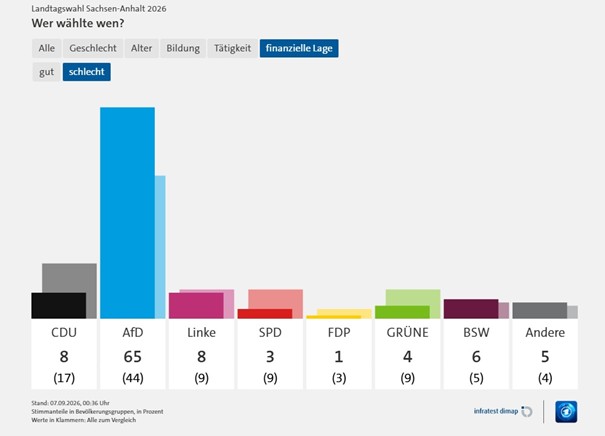
These figures do not mean that economic hardship automatically produces far-right voters. They do, however, demonstrate how closely economic insecurity and AfD support have become connected.
Germany has struggled with weak economic growth, high energy costs, inflation and growing concerns about the future of the welfare state. The war in Ukraine and Germany's decision to maintain strong support for Kyiv have added another layer of uncertainty. For many voters, these issues are not separate. They form one broader narrative: the country is becoming less secure, less prosperous and less predictable, while politicians seem unable to offer convincing solutions.
Migration has become equally central to this narrative. The AfD is, above all, known for its opposition to immigration and asylum. For a substantial part of the electorate, however, the issue is not simply hostility towards foreigners. It is the perception that irregular migration has placed additional pressure on housing, schools, social services and local administrations, while the state is struggling to control its borders and enforce its own rules.
Whether every element of this perception is empirically justified is a separate question. Politically, the perception itself matters. The AfD has understood this better than its competitors. It has turned migration into a symbol of a broader loss of control and positioned itself as the party willing to say things that other parties are reluctant to say. This is where the failure of Germany's established parties becomes particularly important.
For years, questions surrounding immigration, national identity, security and the limits of integration were often treated as politically dangerous territory. Mainstream parties frequently either tried to avoid the subject or addressed it in language that appeared detached from voters' everyday concerns. In doing so, they left a political vacuum.
The AfD moved into that vacuum. But the party did not simply sit back and wait for voters to become angry. It ran an increasingly sophisticated campaign designed to broaden its electoral base. Its lead candidate, Ulrich Siegmund, conducted a highly personalized and active campaign, and the party succeeded in mobilizing roughly 170,000 people who had not voted in 2021. It also attracted around 82,000 former CDU voters. Perhaps even more significantly, 35 percent of voters considered the AfD the party best equipped to deal with the state's most pressing problems, compared with only 9 percent in 2021.
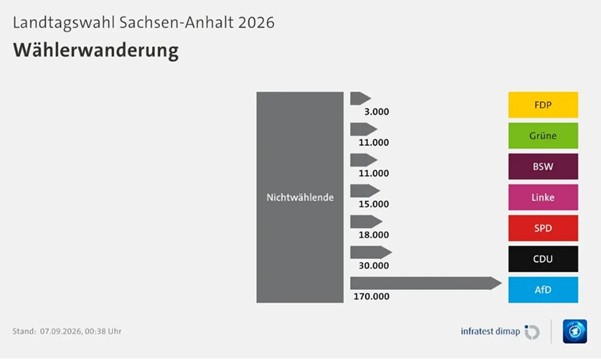
This is an important distinction. The AfD is no longer simply a protest party for voters who already identify with the radical right. It is increasingly presenting itself as a party of government.
Its campaign strategy also shows an awareness that Germany's electorate is not homogeneous. Although the AfD is widely associated with anti-immigration politics, it has attempted to communicate with communities that might not traditionally be regarded as part of its natural constituency. In its outreach to voters of Turkish origin, for example, AfD figures have used deliberately provocative cultural references, including the claim that “Atatürk would vote for the AfD.” The message is less about historical accuracy than about political appropriation: the party is attempting to tell migrant-background voters that its nationalism, emphasis on state authority and criticism of established political elites can also speak to them.

This is a paradox worth considering. A party frequently accused of being hostile to immigrants is nevertheless learning how to communicate with citizens whose families have immigrant backgrounds. That does not necessarily mean that these voters are becoming AfD supporters. But it demonstrates that the party understands a basic rule of modern electoral politics: to win, you cannot speak only to your ideological base. You have to persuade people who are simply dissatisfied with everyone else.
The same frustration can be seen in attitudes toward foreign and security policy. The AfD's opposition to continued German military support for Ukraine and its call for a fundamentally different relationship with Russia resonate particularly strongly among parts of the electorate that question Germany's current foreign-policy direction. This does not mean that every AfD voter is pro-Russian, nor that the Ukraine war alone explains the result. Rather, the war has become part of a wider dissatisfaction with the political establishment: voters who already feel economically insecure or politically ignored may interpret Germany's foreign-policy commitments as another example of a government making decisions without sufficiently considering their domestic consequences.
East Germany vs. West Germany
There is also a distinctly eastern German dimension. More than three decades after reunification, the political and psychological divide between eastern and western Germany has never completely disappeared. Economic disparities, demographic decline, the departure of younger generations and a lingering sense that eastern Germans were politically and culturally absorbed rather than genuinely integrated into the Federal Republic have left a powerful legacy.
This sense of decline extends beyond economics. Education, once regarded as one of the foundations of Germany's economic strength, is increasingly becoming another source of frustration. The latest PISA results show that German students have reached their worst-ever performance in reading, mathematics and science, with around one in three failing to reach basic competency in reading and mathematics. For some voters in the east, such developments reinforce the feeling that the promise of prosperity, stability and opportunity after reunification has not been fully delivered.
This can also feed a selective nostalgia for the GDR, often described as Ostalgie. It would be misleading to portray the GDR as a model of freedom or prosperity. Yet nostalgia does not always operate through an objective comparison of political systems. For some former East Germans, the past is remembered as a time of greater social order, employment security and predictability. In a present marked by demographic decline, economic uncertainty, struggling public services and deteriorating educational performance, that selective memory can become politically meaningful.
The AfD has been particularly effective at transforming this resentment into political identity. Saxony-Anhalt is not simply a place where the far right happens to be strong. It is a region where economic insecurity, distrust of institutions and dissatisfaction with the political establishment have accumulated over decades. In that sense, the AfD did not create the anger. It learned how to organize it.
Comparison with the Weimar Republic
And this brings us to the uncomfortable historical comparison. Germany has seen before how economic crisis and political paralysis can destroy confidence in established democratic parties. During the Great Depression, mass unemployment and economic collapse severely weakened the Weimar Republic. The Nazis began gaining substantial electoral support from 1930 onwards, exploiting economic misery, political fragmentation and growing distrust in the established political order.
The comparison must be made carefully. Germany in 2026 is not Germany in 1932. The Federal Republic has strong democratic institutions, a functioning constitutional order and a political culture shaped profoundly by the experience of National Socialism. The AfD is not the Nazi Party, and today's economic difficulties cannot be equated with the catastrophe of the Great Depression. But history does not have to repeat itself literally to offer a warning.
The parallel lies in a political mechanism: when people feel economically insecure, politically ignored and unconvinced by the promises of established parties, they become more willing to gamble on alternatives that were previously considered unacceptable. This is perhaps the most important lesson of Saxony-Anhalt.
Voters do not necessarily move towards radical parties because they have suddenly embraced every element of their ideology. Sometimes they move because they no longer believe the alternatives can change anything.
And this is where the mainstream parties have a problem. Telling voters that the AfD is dangerous may be necessary, but it is not sufficient. A democratic party cannot defeat an anti-establishment movement simply by telling people not to vote for it. It has to give them a reason to vote for something else.
If voters see high energy prices, weak economic growth, migration pressures, overstretched public services, insecurity and political paralysis and hear little beyond promises of more of the same, then frustration will inevitably find a political outlet. The AfD has become that outlet. This does not make the party's rise inevitable. Nor does it make its policies correct. But it does make the result understandable.
Years of Accumulated Dissatisfaction
The AfD's victory in Saxony-Anhalt was therefore not simply an electoral accident, nor merely a sudden protest against Friedrich Merz. It was the product of years of accumulated dissatisfaction: economic insecurity, migration, the East-West divide, distrust in government, frustration with foreign and security policy, educational decline and the perception that established parties had stopped offering convincing answers.
The AfD did not create these problems. It capitalized on them. And that may be the most important warning of all. The real danger to German democracy is not simply that the AfD has won 43.8 percent in Saxony-Anhalt. It is that an increasing number of voters may come to believe that the only way to make the political system listen is to vote for its most radical challenger.
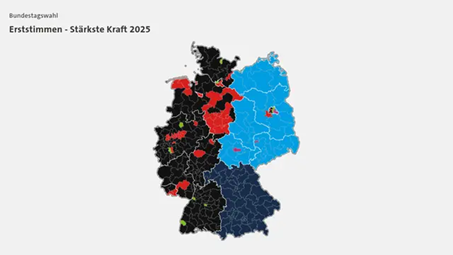
Given the AfD’s strong performance in the 2025 federal election and its landslide result in Saxony-Anhalt in 2026, similarly strong gains could be expected in other eastern states such as Saxony, Thuringia, Brandenburg and Mecklenburg-Western Pomerania.
If Germany's established parties want to reverse this trend, condemning the AfD will not be enough. They will have to demonstrate that democratic politics can still deliver economic security, effective government, controlled migration, public safety and a credible foreign policy. Otherwise, Saxony-Anhalt may prove to be less the climax of an AfD protest vote than the beginning of a much larger political transformation.




.svg.avif)