Turkish foreign policy has undergone constant transformation under President Erdoğan’s rule since 2002. Zero problem with neighbors, trading state, neo-Ottomanism, and precious loneliness are some well-known terms coined to symbolize the periods of this transformation. President Erdoğan and his close circle lead this change in interaction with global developments and domestic politics. In order to understand contemporary Turkish foreign policy, it is important to understand this change.
Diplomacy- and trade-based restraint foreign policy of early AKP years yielded a more self-confident regional actor in the late 2000s. The insurrections of the Arab Spring years revealed the guilty ambitions in Ankara which aimed to be the regional leader with Islamist tones. The second half of the 2010s were the years of crises with the US, EU, and regional partners. Turkey was isolated but also more ambitious, expansionist, and militarist than ever.
After 2020, however, the Turkish foreign policy has taken a different turn. This article aims to explain this transformation through three concepts: status quoism, activism, and authoritarian insulation. The wars in Ukraine, Gaza, Syria, and Iran have accelerated Turkey’s change around these three concepts.
From Revisionism to the Status Quo
The revisionism of the 2010s brought Turkey and Qatar into a kind of regional cold war with status quo powers, namely Saudi Arabia, the United Arab Emirates, Egypt, and Bahrain. Turkey’s ties with its traditional allies, namely the US, NATO, and Europe, severed significantly. The term strategic autonomy gained currency in this era. Ankara grew closer to Russia, Iran, and China, as well as other revisionist actors around the world, such as Venezuela. Three factors have led Turkey to status quoism: the cost of revisionism, threats of revisionism by Russia and Israel, and the benefits of status quoism.
By 2020, however, the cost of revisionism had risen significantly for Turkey. Diplomatically, it was alone. All its neighbors had come together in anti-Turkish alliances. Its economy was in bad shape, desperately in need of Gulf money. More importantly, revisionist policies did not yield any positive results for Turkey. Strongmen of the Middle East continued to sit in their seats, whereas the groups that were supposed to topple them were mostly defeated. So, instead of seeking regional transformation, Ankara chose to operate within the existing order.
In the Middle East, the rivalry between two groups of countries (Turkey and Qatar vs. Saudi Arabia, the UAE, Egypt, and Bahrain) came to a halt. Regional actors initiated a new era of diplomatic normalization. Ankara’s diplomatic contacts with Riyadh, Cairo, and Abu Dhabi became more frequent. President Erdoğan even met with Israeli Prime Minister Netanyahu in New York. They have not resolved all issues, but they have learned to talk, and they have learned each other’s red lines. They have compartmentalized issues. Although conflicts persist, they have not caused escalation or halted cooperation in other areas.
Two sources of instability have further increased Turkey’s resolve to protect the status quo. The Ukraine war in Turkey’s north and the Gaza war in its south have posed significant challenges for Ankara. They have complicated Turkey’s economic and political interests. Furthermore, Ankara sees Russia’s desire to redraw borders and Israel’s increasingly bold military campaigns as threats to its own national security.
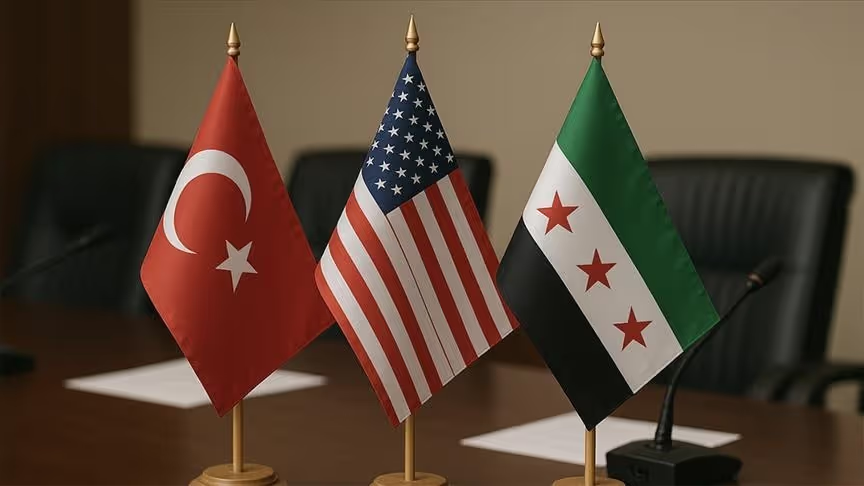
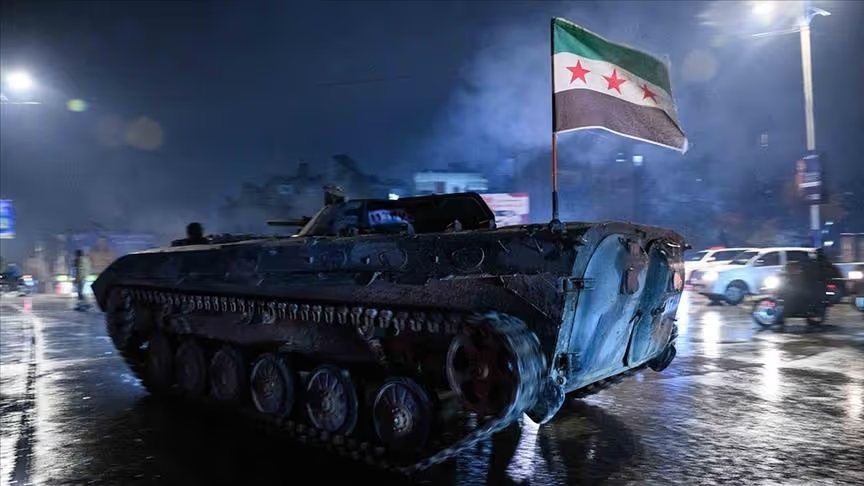
On top of that, ironically, the fall of the Assad regime, the central goal of Turkey’s old revisionist policies, furthered Turkey’s desire to maintain the status quo. Syria was the centerpiece of Turkey’s revisionism in the 2010s. Ankara never stopped supporting the Syrian opposition, which ultimately overthrew Assad in December 2024. It was a big win for Turkey. Yet, in order to consolidate its unexpected victory in Syria, Ankara needed to maintain the status quo in the region.
Today, Turkey’s policy regarding the war in Iran is oriented toward maintaining this status quo. The recent war between US and Iran also tested Ankara’s resolve for the status quo. Turkey has benefited greatly from a weakened Iran, its geopolitical rival. Yet, Ankara does not want to see the disintegration of Iran, which would cause new waves of refugees and other sources of threat, such as a new Kurdish entity.
Besides, for Ankara, Iran is a balancing actor vis-à-vis another revisionist actor, Israel. If Israel were to defeat Iran through regime change or collapse, this would significantly change the regional balance of power in favor of Israel. Indeed, Israeli leaders frequently mention Turkey as “the new Iran.”
Turkey has also learned to benefit from the status quo. Why did Ankara need Islamists in power? Ankara does not need regime changes or regional transformations to thrive. It could do business with anyone. Direct investments from Gulf countries could be quite helpful for the Turkish economy. It could sell weapons to Saudi Arabia, UAE, as well as its former foe Khalifa Haftar. In Sudan, the Turkish defense manufacturers sold drones and missiles to both warring parties of the civil war. The Turkish defense industry, which is in control of families close to Erdoğan, prioritized economic benefits and does not seek any political change. They thrive in this regional and global order. And they want its continuation and preservation.
Foreign Policy Activism
Turkey has turned from revisionism to status quoism, but this does not mean pacifism. Although Ankara prioritizes protecting the existing order, it aims to benefit from this order. Turkey has still been a significant player in Libya, the Horn of Africa, the Gulf, Syria, Lebanon, Iraq, and the Caucasus.
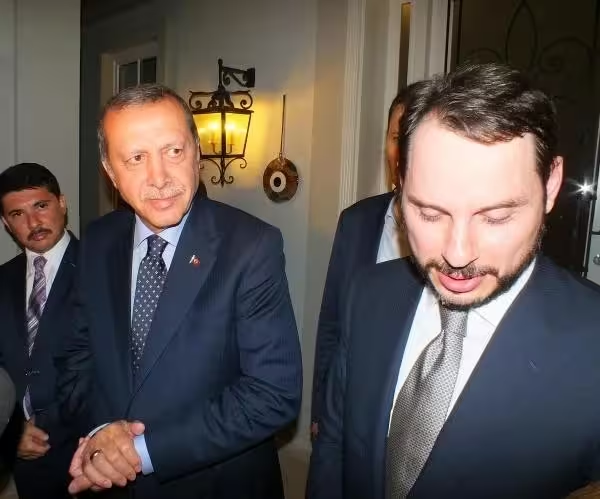
In recent years, Turkey’s defense industry has been the main driver of its foreign policy activism. Promoting its defense products and finding new markets have been Ankara’s primary goals. Bayraktar drones, which belong to Erdoğan’s son-in-law, have so far achieved great success with their battleground effectiveness and reasonable price. Thanks to this increasing global interest, Ankara has been able to use its drones as leverage in its foreign policy dealings with potential buyer countries. Apart from drones, Turkey promotes its armored vehicles, helicopters, and the Kaan fighter jet project, particularly to the Gulf countries.
Turkey’s foreign policy activism is not limited to the defense industry. Most recently, Turkey has made a massive increase in its military imprint in Somalia. As it is beginning oil exploration in Somalia’s territorial waters, Turkey deployed helicopters, tanks, and three F-16s in Mogadishu, thousands of kilometers away from Ankara.
Syria, Iraq, and the South Caucasus are the main theatres of Turkey’s foreign policy activism. Turkey has military deployments in Syria and Iraq. It is contemplating deploying more troops. It also aims for more investments and economic projects, such as the Iraq Development Road. Turkey has been one of the major power brokers in these regions.
It is possible to see the impact of this foreign policy activism in the Iran war too. Turkey has been a forefront actor in mediation attempts between the US and Iran. The Turkish Foreign Minister, Hakan Fidan, has been a frequent visitor to Gulf countries. He also participated in a quadrilateral meeting between Turkey, Saudi Arabia, Egypt, and Pakistan in Islamabad.
Authoritarian Insulation
Domestic politics has always been an important driver of Turkey’s foreign policy. In the face of corruption scandals, economic crises, and other political crises, Erdoğan used foreign policy to divert attention and create a rally-around-the-flag effect. Yet, as Erdoğan has consolidated his authoritarian rule, domestic drivers of foreign policy have lost part of their previous significance. Thus, Erdoğan can act today more independently from domestic expectations.
In his efforts to consolidate power, Erdoğan has benefited greatly from the grandiose image of Turkey in domestic politics. Voting for Erdoğan was presented as supporting the Syrian opposition’s struggle against the Assad regime or the Muslim Brotherhood against Egyptian President Sisi. Thus, protecting this image was an important goal for Erdoğan.
In his foreign policy decisions, Erdoğan has been open to inputs from domestic politics. Increasing anti-American, anti-Western, and anti-Gulf sentiments within Turkish society have significantly influenced Turkey’s foreign relations. Erdoğan attached importance to emphasizing Turkey’s autonomy from NATO, the US, and the EU. This also led to Erdoğan’s diplomatic escalations with Trump, Merkel, Mohammed bin Zayed, and many other leaders.
However, as Erdoğan consolidated his own rule, the value of inputs coming from domestic politics has been decreasing. Today, Erdoğan exercises control over all levels and sectors of the state, the business world, the media, and civil society. His power relies less on his popularity and more on his security apparatus and the judiciary. This allows Erdoğan to pursue unpopular foreign policies.
The most striking example of this change is Turkey’s ongoing trade with Israel. Israel’s military operations against Gaza following the October 7, 2023 attacks caused widespread public outrage in Turkey. Erdoğan and his government went along with this outrage with their harsh rhetoric against the Netanyahu government. Despite mounting Islamist protests, Erdoğan took no steps for months to stop Turkey’s trade with Israel. Turkish companies, including Erdoğan’s family’s companies, continued to trade with Israel. Turkey has also carried Azerbaijani oil to Israel. Only in May 2024, Turkey introduced a so-called trade embargo against Israel. Nevertheless, the trade continues through indirect channels. According to Israeli official data, Turkey has still been among the top five trade partners. Indeed, Turkey continues to sell Azerbaijani oil to Israel.
Ankara has also recently allowed NATO to establish a multinational corps on its territory. In other words, thousands of foreign soldiers with their armored vehicles may be stationed on Turkish soil. Likewise, Ankara accepted the establishment of the Maritime Component Command for the Multinational Force Ukraine in Istanbul. These are incredible developments in a country where NATO, the US, and Western countries are often presented as threats to national sovereignty. Just a few years ago, the Turkish government questioned NATO’s value and intentions. Today, it did not even bother to provide an explanation to the Turkish public for these international installations. These cases show how Erdoğan now acts in his foreign policy insulated from domestic pressures and demands
The Turkish foreign policy is in constant change. Today Turkey fears revisionism of Russia and Israel while it thrives in current regional order. It pursues a proactive foreign policy to maintain and benefit from this status quo as much as possible. More importantly, Turkish foreign policy is now shaped by a small circle around President Erdoğan. While domestic politics is less of a concern today, Turkey’s interests are increasingly conflated with the interests of this narrow group.




.svg.avif)