Opinions - Middle East and North Africa

What the SDF’s Miscalculations Meant for Turkey and Syria

What the SDF’s Miscalculations Meant for Turkey and Syria

by Mustafa Enes Esen, published on 19 January 2026
The ceasefire signed on January 18 between Damascus and the SDF was not the product of prolonged bargaining or mutual compromise. It was imposed by developments on the ground that had already stripped the SDF of its bargaining power. As such, the ceasefire agreement formalizes the collapse of the March 10 deal and largely marks the end of the SDF’s ability to shape outcomes in Syria.
An Iranian Collapse Would Pose Security Risks for Azerbaijan

An Iranian Collapse Would Pose Security Risks for Azerbaijan

by Rufat Ahmadzada, published on 14 January 2026
The protests in Iran are continuing to escalate. What started as a protest by traders against the fall in the value of the local currency, rising prices, economic mismanagement and worsening economic conditions in the country has quickly transformed into a growing movement for political change. This is evident from the chants of protestors and is threatening the legitimacy of the ruling clerical regime.
Syria’s Fate Still Hinges on Trump

Syria’s Fate Still Hinges on Trump

by Haşim Tekineş, published on 13 January 2026
Videos showed fighting erupting in residential areas as civilians fled en masse, while green buses later transported defeated fighters out of the city under a mediated evacuation arrangement. The Aleppo clashes in early January 2026 brought back grim memories of Syria's civil war, even as the new government in Damascus, led by President Ahmad al-Sharaa, claimed another military win against the Syrian Democratic Forces (SDF) in Aleppo.
The Role of Ideas in Turkey's Syria Policy: Disillusionment with Ideology or Transformation?

The Role of Ideas in Turkey's Syria Policy: Disillusionment with Ideology or Transformation?

by Haşim Tekineş, published on 7 January 2026
Turkey’s Syria policy is often portrayed as a case of foreign policy failure driven by ideology. According to this view, Ankara abandoned realism in favor of Islamist enthusiasm during the Arab Spring and later returned to pragmatism after paying significant political and strategic costs. While this narrative highlights an important shift, it relies on a simplified understanding of the relationship between ideas and foreign policy.
How Syria and Gaza Affect the Divide Between Israel and Turkey

How Syria and Gaza Affect the Divide Between Israel and Turkey

by Servet Akman, published on 6 January 2026
The fall of the Assad regime in Syria has opened a new chapter in Turkish–Israeli relations. For a long time, the Assad regime was a major security concern for Turkey. For Israel, it was “the devil they knew.” Israel focused on containing the Assad regime and Iran’s proxies, while Turkey’s military presence in Syria remained a secondary issue.
Syria’s Way Ahead: Prospects for a Ruined Economy

Syria’s Way Ahead: Prospects for a Ruined Economy

by Mehmet Demirbaş, published on 5 January 2025
On the eve of the civil war, Syria was a lower-middle-income country with steady growth and relatively stable macroeconomic indicators. Between 2000 and 2010, real GDP grew by an average of 4.8 percent annually, inflation averaged 4.9 percent. Trade accounted for 64 percent of GDP, and GDP per capita stood at 2,731 dollars in 2010.

Reports - Middle East and North Africa

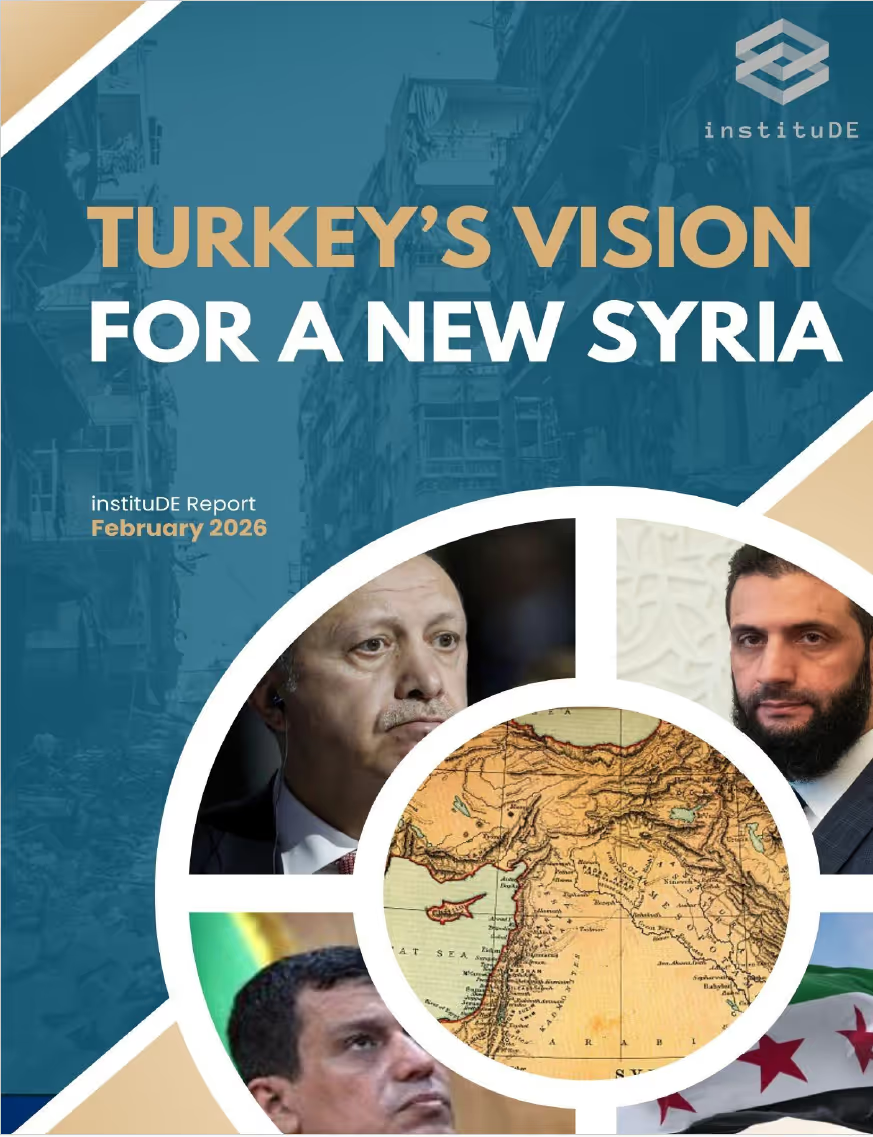
Turkey's Vision For a New Syria

Turkey's Vision For a New Syria

by Mustafa Enes Esen, Haşim Tekineş, Mehmet Demirbaş and Servet Akman, published on 14 February 2026
This report analyzes Turkey’s vision for Syria following the fall of the Assad family and the rise of the HTS under the leadership of Ahmad al-Sharaa. In this regard, it focuses on the foreign actors that, alongside Turkey, now have the greatest ability to shape Syria’s future: namely the United States and Israel.

Videos - Middle East and North Africa

Moskova ile Ankara’nın Ortak Zaafı

March 25, 2024
by Haşim Tekineş, published on 25 March 2024
instituDE Dış Politika Analisti Haşim Tekineş katıldığı programda Moskova'da IŞiD tarafından 22 Mart'ta düzenlenen terör saldırısını Türkiye'yi ilgilendiren boyutlarıyla anlattı.

Moskova Saldırısı ve IŞID'in Horasan Kolu

March 25, 2024
Moskova saldırısının arkasındaki Isis-K, yani Işid Horasan grubu kim? Saldırının arkasındaki motivasyon ne? Neden Moskova? Saldırganların Türkiye bağlantısı ne anlama geliyor? instituDE politika analisti Haşim Tekineş tüm bu soruların cevaplarını ele aldı.

Rough Peace in Libya - Interview with Dr. Jalel Harchaoui

March 6, 2024
by Hasim Tekines, published on 6 March 2024
Hasim Tekines discussed the situation in Libya, its local and regional dynamics, and Turkey's role with Dr. Jalel Harchaoui. Join us in our interview with Dr. Harchaoui, an Associate Fellow at the Royal United Services Institute renowned for his insights on North Africa, including Libya. His expertise has been featured in top-tier publications such as Foreign Policy, Foreign Affairs, Lawfare, Small Arms Survey, and War on the Rocks. Don't miss this insightful discussion that offers invaluable perspectives on one of the most pressing geopolitical issues of our time.

Erdoğan Kahire'ye, F16'lar Türkiye'ye, F35'ler Yunanistan'a

February 18, 2024
by Ömer Güler and Haşim Tekineş, published on 18 February 2024
Ömer Güler ve Haşim Tekineş Erdoğan'ın Mısır ziyaretini, Bilal Erdoğan'ın ziyarette protokolde yer almasını, F-16 alımına dair ABD Senatosu'nun onayını, Yunanistan'ın F-35 alımını ve Ege'de hava gücü üstünlüğünde Yunaninstan'ın avantajlı hale gelmesini ele aldılar.

İsrail Uluslararası Adalet Divanı’nda

January 31, 2024
by Harun Reşit Halisoğlu and Haşim Tekineş, published on 31 January 2024
Adalet Divanı'nın son İsrail kararını hukukçu Harun Reşit Halisoğlu değerlendirdi.

İsrail Lahey Adalet Divanı Önünde

January 19, 2024
by Hakan Kaplankaya, published on 19 January 2024
Hukuk Günlüğü'nde Hakan Kaplankaya Güney Afrika tarafından İsrail aleyhinde Uluslararası Adalet Dİvanı'nda açılan soykırım davasını anlattı.