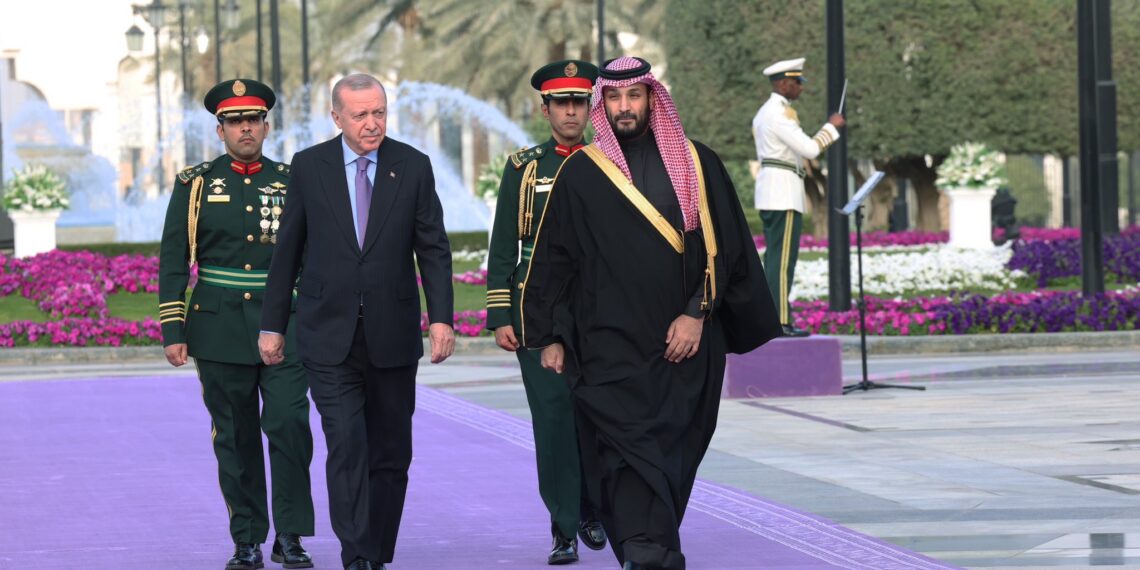
Over the weekend of September 11–13, Yemen's Houthis captured the Red Sea port of Mocha and the island of Perim, completing their takeover of Yemen's Red Sea coast and increasing their control over the Bab al-Mandeb strait. Saudi Arabia was forced to shut down a critical oil pipeline that had become one of the kingdom's principal outlets to the sea after Iran's closure of the Strait of Hormuz.
States have fought wars over far less, and there is growing unease about another international ground war in Yemen. Since the Mecca Joint Defense Agreement was signed on August 7, a concern is that the pact could draw Turkey and other countries into the conflict should Riyadh feel compelled to intervene. A Saudi campaign is in any case far from assured. The coalition that fought the last Yemen war has dissolved, and Riyadh's recourse to Washington rather than to its Mecca partners is telling.
Even were such a Saudi campaign to begin, Turkey has little enthusiasm for going to war in Yemen.
1- Yemen is not a primary theater for Turkey
In the current crisis, Turkey's attention is not on Yemen but mostly on Iran. Ankara is almost 3,000 km away from Sana'a, Yemen's capital, and the war does not pose a direct threat to any immediate Turkish interests. The interruption of the Saudi oil flow to the world markets and higher energy prices cause problems, but they are not peculiar to Turkey.
The war in Iran, and the danger of destabilization in the Gulf, weigh far more heavily on Ankara than events on the Red Sea. The Yemen escalation is partly an extension of the Iran war. Despite their rivalry, Tehran does not treat Turkey as a hostile party in the current conflict, and the two maintain a tacit understanding of Turkey's position. Ankara judged early that the Iranian regime would survive the war, and it has positioned itself to preserve relations with the government it expects to endure. For Turkey to enter the war on the Saudi side would introduce lasting friction with Iran and could open it to Iranian reprisals.
2- Turkey is not likely to blindly follow Saudi Arabia
Even though the Saudis may invoke the Mecca agreement to ask for military help, it does not really compel Turkey to fight a war. To begin with, the Mecca agreement is no iron-clad, NATO-style treaty but, as I have argued previously, an expression of goodwill.
Whether or not the document is legally binding is, in any event, beside the point for Ankara. No government in Turkey, or anywhere else for that matter, dispatches troops thousands of kilometers beyond its borders merely because a treaty invites it to. Turkey's current leadership is known for its pragmatism, not for a readiness to honor the letter of an international commitment at the expense of its own interests.
Not surprisingly, Crown Prince Mohammed bin Salman was reported to be pressing President Donald Trump — not his allies in the Mecca agreement or the other Gulf states — for U.S. military action against the group, which Trump declined, offering intelligence and targeting support instead.
3- Even if involved, Turkey's role would be limited to technical support
Were Ankara to involve itself, its contribution would mostly be confined to technical support. Turkey shows little inclination to deploy combat troops other than along its immediate borders, in Syria, Iraq, or Cyprus. Its overseas deployments have generally taken the form of advice and training rather than combat. In Afghanistan, Turkish troops held a non-combat role in Kabul. In Libya, Ankara furnished advisory and technical assistance to the Tripoli government. In Somalia, home to its largest overseas military base, its combat contribution was limited to aerial strikes. In the Karabakh war, it provided technical assistance to Azerbaijan. Where direct fighting was required, Turkey relied on Syrian fighters recruited by SADAT, a Turkish private security company comparable to Russia's infamous Wagner Group, to fight in Libya and Karabakh on its behalf.
If needed, Turkey would likely follow a similar pattern in Yemen. Turkey is already a substantial arms supplier to Saudi Arabia. The roughly $3 billion Akıncı contract Riyadh signed in 2023 included training, technical support, and joint production, and Saudi crews now operate the aircraft themselves. In this vein, the Houthis shot down one such Turkish-produced, Saudi-operated Akıncı over al-Jawf in late July. Ankara could provide more advanced systems, dispatch advisers, and assist in operating its drones. Yet it is unlikely to send combat troops.
4- Most Turks, and the AKP's base especially, would oppose involvement in Yemen
Domestic politics in Turkey would be another obstacle, though not an insurmountable one. The AKP government would have difficulty selling a distant war to its domestic constituency. A war in Yemen would be deeply unpopular among the governing AKP's base, who would regard such a Turkish military deployment as taking up arms against fellow Muslims. The Houthis are Zaydis, doctrinally the closest of the Shia branches to Sunni Islam, while the movement's professed opposition to Israel resonates with the AKP's constituency.
While fighting fellow Muslims in another country may not pose a major problem for the AKP leadership, it would take a great effort, with the next presidential election approaching in 2028, to persuade Turkish citizens to fight 'somebody else's war.'
The Mecca agreement has caused more alarm than it warrants for Turkey. It changes neither what Turkey pursues nor what it is prepared to do. It would not be wise for the Saudis to count on the Turks to fight a war in Yemen. If a Saudi campaign comes at all, it will mainly be Riyadh's to wage and Washington's to enable. A shift in the war, such as a direct threat to Turkish interests or pressure Ankara cannot deflect, could still change Ankara's calculus. Yet under the current circumstances, Turkey will likely provide technical support, arms, and mercenaries, but otherwise keep out of the fighting.




.svg.avif)