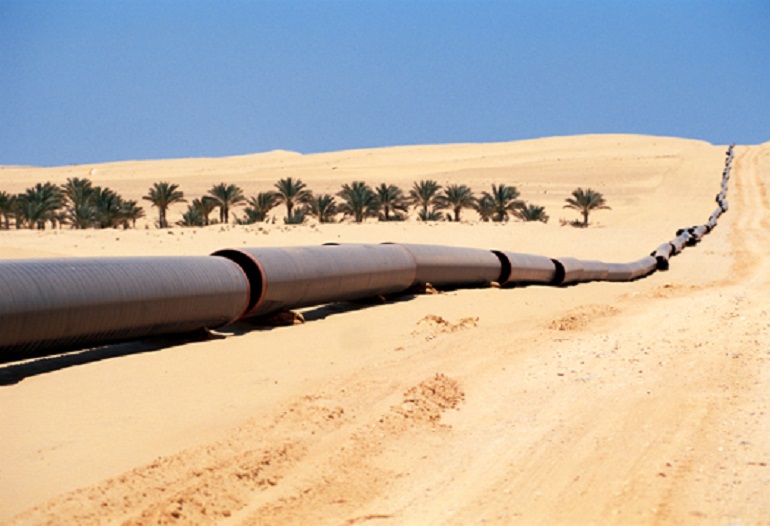
Iran's closure of the Strait of Hormuz may ultimately prove more consequential than its military campaign in reshaping the region's energy landscape. Saudi Arabia is operating its pipeline to the Red Sea at capacity and evaluating an expansion. The United Arab Emirates is constructing a second line to bypass Hormuz. Iraq is negotiating with its neighbors, including Turkey, for viable routes. None of these had featured as urgent policy priorities before the war.
This reaction has not taken Tehran by surprise. Mohammad Javad Zarif, Iran's former foreign minister, has warned that repeated threats to shipping would turn much of the world against Iran, and that a sustained closure would drive investment into pipelines, ports, and land corridors constructed to avoid the waterway altogether.
Iran has nonetheless not altered its policy, because it possesses few comparable instruments. The strait remains the only asset capable of imposing serious costs on its enemies. Leverage that erodes through use nevertheless remains leverage, and a government preoccupied with its immediate survival attaches limited weight to longer-term consequences.
The Haves and Have-Nots of Alternative Routes
Saudi Arabia and the United Arab Emirates, which possessed alternatives to Hormuz before the war, acted first. Saudi Arabia raised throughput on its East-West pipeline, which runs from Abqaiq to the Red Sea port of Yanbu, to its full capacity of 7 million barrels per day, of which approximately 2 million feed domestic refineries. Riyadh is evaluating a further expansion of one to two million barrels per day. The United Arab Emirates moves 1.5 to 1.8 million barrels per day through the Habshan-Fujairah line and is constructing a parallel pipeline intended to double its bypass capacity to 3.6 million by mid-2027.
The states without alternatives have absorbed the losses. Iraqi production fell from 4.3 million barrels per day to approximately 1.4 million in May, a 66 percent contraction and the steepest among OPEC+ members. Kuwait declared force majeure. Qatar, whose exports consist predominantly of liquefied natural gas, faces the most substantial technical obstacles to rerouting any volume at all.
Rushing Pipelines to the Mediterranean
One option for the northern Gulf states is to pursue more costly westward routes, building new pipelines and expanding the capacity of existing ones in order to bypass the strait. For Iraq in particular, the only remaining avenue lies to the west, toward the Mediterranean.
The most immediate option for Iraq is to increase throughput on the Kirkuk-Ceyhan pipeline. The pipeline agreement between Turkey and Iraq expires on July 27, and the two governments are expected to conclude a twelve-month interim arrangement under which the Turkish state operator would transport Iraqi crude. Baghdad has requested 750,000 barrels per day of reserved capacity against current flows of 180,000 to 200,000, and Ankara has agreed to allocate it. Turkish Energy Minister Alparslan Bayraktar has additionally raised the prospect of extending the line south to Basra and increasing capacity to 2.5 million barrels per day, opening it to Kuwaiti and other Gulf crude, and laying a natural gas pipeline alongside it to carry Qatari or other regional supply.
The Syrian Corridor and Turkey's Silence on the Matter
The second initiative for Iraq is the Syrian route. On July 18, in Washington, the Syrian Petroleum Company and Iraq's Basra Oil Company signed a memorandum on the rehabilitation of the Haditha-Baniyas pipeline, a component of the Kirkuk-Baniyas corridor that opened in 1952 and fell out of service after 2003. A second memorandum engaged a consortium of Chevron, UCC Holding, and TI Capital to conduct technical and financial studies. The stated initial capacity is approximately 2 million barrels per day, substantially above what the original line ever carried.
Ankara would previously have objected to a project competing directly with the Kirkuk-Ceyhan pipeline, but it has not done so. Two considerations may account for this acquiescence. The first concerns Syria. Ankara has heavily invested in the survival of the new authorities in Damascus, whose durability depends on economic recovery. Transit revenue would serve that objective directly while giving Baghdad a material stake in Syrian stability. This may also help reduce Iraqi hostility toward Syrian President al-Sharaa, who served a prison sentence in Iraq for his jihadist activities.
The second consideration is commercial. Turkey is a heavy purchaser of oil rather than a supplier. It imports the overwhelming share of its crude and natural gas, and the price shock has added an estimated $14 billion to its energy bill for 2026, of which roughly $8 billion is attributable to oil and $6 billion to gas. Bayraktar has estimated the sensitivity at approximately $400 million a year for every dollar per barrel. Any additional volume reaching international markets reduces what Ankara pays, and the anticipation of new capacity exerts downward pressure on prices in advance of any physical delivery.
How Many of These Projects Will Materialize?
Many energy projects never advance beyond declarations of intent. Studies must be completed, financing arranged, and construction carried out in countries where security cannot be assumed. That is precisely why they do not constitute an immediate concern for Tehran.
Iran's efforts to extend the war to the Red Sea could nonetheless accelerate the realization of some of them. This week the Houthis, Iran's local allies in Yemen, declared a maritime embargo against Saudi Arabia. An oil tanker was struck and set alight off the Saudi Red Sea coast on July 22, and the Houthis claimed responsibility. A blockade at Bab al-Mandab, at the southern end of the Red Sea, would primarily affect the Asia-bound share of Saudi Red Sea exports, leaving those cargoes either to exit north through Suez and sell into European markets instead, or to make the full detour around Africa to reach Asian buyers.
Some of these energy projects will be completed and others probably will not. The Emirati line to Fujairah is under construction against a stated target date, and debottlenecking the Saudi system is an incremental upgrade to existing infrastructure, or at most a second, smaller line. The Baniyas corridor rests on two memoranda and a study not yet commissioned, while the Basra extension and the Qatari gas line remain ministerial statements. Even if navigation through Hormuz is eventually restored, the crisis has exposed a structural vulnerability. For many of the states affected, the objective is no longer simply to manage the present disruption but to reduce the cost of any future closure.




.svg.avif)