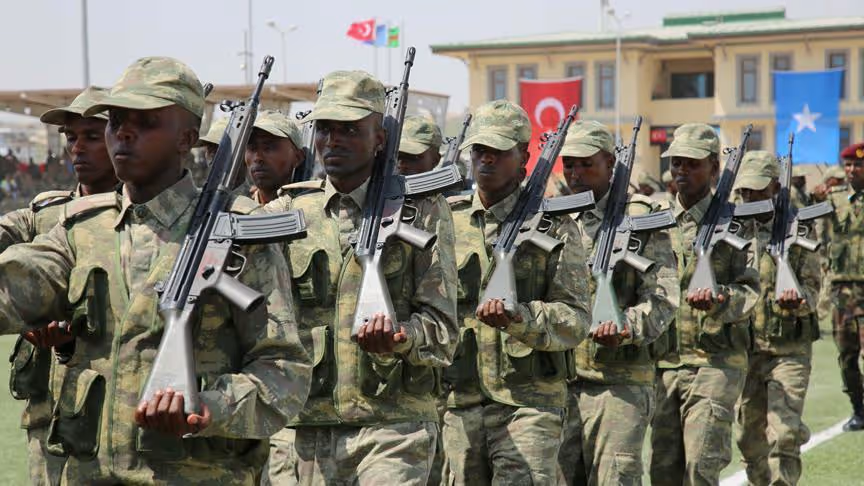
Turkey crossed another threshold in Africa this week. On June 30, Turkish F-16 fighter jets struck Al-Shabaab positions in Somalia in the first publicly acknowledged combat use of Turkish warplanes in the country. According to Somalia's Ministry of Defense, the strikes, conducted in support of the Somali National Army, targeted caves, weapons depots, and hideouts, killing approximately 35 militants and seriously wounding more than 20 others. The ministry credited the Turkish armed forces by name and thanked Ankara for its support. A later version of the statement, as reported by regional media, replaced the reference to Turkey with a broader acknowledgment of "international partners," a wording that suggests other foreign actors may also be involved in the operation.
The strikes mark a major escalation of Turkey's role in Somalia. By conducting airstrikes with its own jets and pilots, Ankara has moved beyond training and equipping the Somali army to fighting its war. Turkey has invested heavily in the Mogadishu government for well over a decade, and the message of this week's operation is unambiguous: it will do whatever is necessary to keep the Somali government in place.
A war neither side can win
The escalation comes in the context of a conflict that remains fundamentally deadlocked. As the International Crisis Group assesses in a recent report, the military situation in Somalia is fluid, with neither the government nor Al-Shabaab able to gain a lasting upper hand. The government recaptured large parts of central Somalia in 2022 and 2023, only to lose most of that territory back to the insurgents in 2025. Since then, its efforts have concentrated on securing an arc around the capital, while vast stretches of the countryside remain outside its control.
The Somali government's survival, meanwhile, depends heavily on foreign support: African Union forces, which still form the backbone of Somalia's security architecture, American airpower, and, increasingly, Turkey. The location of this week's strikes illustrates how close the front line runs to the seat of government. The Turkish warplanes struck Godey, which lies just over 100 kilometers from Mogadishu.
From trainer to combatant
Turkey's involvement in Somalia has deepened steadily since the last famine in 2011. In 2017, Turkey opened its largest overseas military base, TURKSOM, in the capital, where it has since trained thousands of Somali soldiers. The bilateral defense framework agreement signed in February 2024 tasked the Turkish navy with protecting Somali territorial waters for ten years, and energy cooperation agreements concluded the same year opened the door for Turkish drilling in three offshore blocks. Turkey will also build its first overseas spaceport on Somalia's Indian Ocean coast. Mogadishu has procured Bayraktar TB2 armed drones, which have supported operations against Al-Shabaab. The F-16 deployment in Mogadishu at the beginning of this year capped this progression. In February, Somalia's defense minister confirmed their arrival, and in April three of the aircraft participated in a flyby marking the anniversary of the Somali armed forces. The June 30 strikes converted a symbolic presence into an operational one.
Why Turkey stepped up
Three developments overlap with Ankara's increasing military deployment in Somalia. First, Israel's recognition of Somaliland in December upended the regional status quo. The breakaway region has functioned autonomously since 1991, but no state had recognized it. The deployment of Turkish troops and fighter jets followed within weeks, a signal that Turkey would underwrite the unity of the Somali state against secession as well as insurgency.
Second, the African Union is preparing to wind down its support mission, which Crisis Group describes as the backbone of Somalia's security architecture, amid chronic funding shortfalls and donor fatigue. The prospective drawdown threatens to remove one of the pillars of Somalia's defense. Turkey evidently feels compelled to bolster Somalia's defense.
Third, it is almost certain that the Turkish bombardment was coordinated with the United States. AFRICOM has carried out 68 airstrikes in Somalia this year against Al-Shabaab and Islamic State targets, after 126 in 2025, and operates in the same airspace where Turkish jets now fly. Given the density of foreign military activity over southern Somalia, simultaneous operations without coordination would carry an unacceptable risk. The Somali ministry's reference to "international partners" points in the same direction. More Turkish strikes coordinated with the US in the Horn of Africa may be expected.
The company Turkey keeps
With this escalation, Turkey joins a field of external powers propping up fragile African governments. Several states on the continent rely on foreign backing to survive against insurgencies. Some leaned on Western powers, including their former colonizers. Chad depended on French protection for six decades, and although it ended its defense pact with Paris in 2024, military ties with France have not been severed entirely. Others expelled Western forces after coups. Mali pushed out the French mission that began in 2013 and turned to Russia's Wagner mercenaries, since rebranded as the Africa Corps, yet the junta in Bamako is still struggling to fend off JNIM, the local Al-Qaeda affiliate. In Niger, Syrian fighters recruited by SADAT, a private military company close to the Turkish government, have reportedly been deployed to guard strategic sites, as I wrote in 2024. And now Turkey has found it necessary to show muscle on behalf of another friendly government in Africa, after its Libyan intervention in 2019.
What these countries need, ultimately, is to stand on their own feet through civilian and military capacity building. Helping Somalia exploit its natural resources would serve that goal, and Turkey's offshore drilling could pave the way, provided the proceeds strengthen the Somali state rather than merely servicing a few at the top.
The risk of a bottomless well
Turkey's Somalia policy illustrates how external assistance can gradually evolve into direct military responsibility as the partner government's dependence deepens. There is a real risk that Somalia becomes a bottomless well that will drain Turkish resources. Without a political and diplomatic resolution, military power alone cannot sustain a friendly government that is unable to control much beyond its capital or exert authority over vast swaths of its territory. The financial burden of sustaining underperforming partners is one reason Western militaries have been forced to disengage from Africa since decolonization. From Vietnam to Afghanistan, and to Mali such ventures have rarely ended well for the foreign powers.
It is understandable for Turkey to help a friendly government and nation in Africa. Ankara wants to project power and exert influence in the Horn of Africa, and Somalia has been the focus of that ambition. But firepower is not a substitute for state building. Without sufficient capacity building by the Somalis themselves, civilian and military, this journey may not end well for Turkey.




.svg.avif)