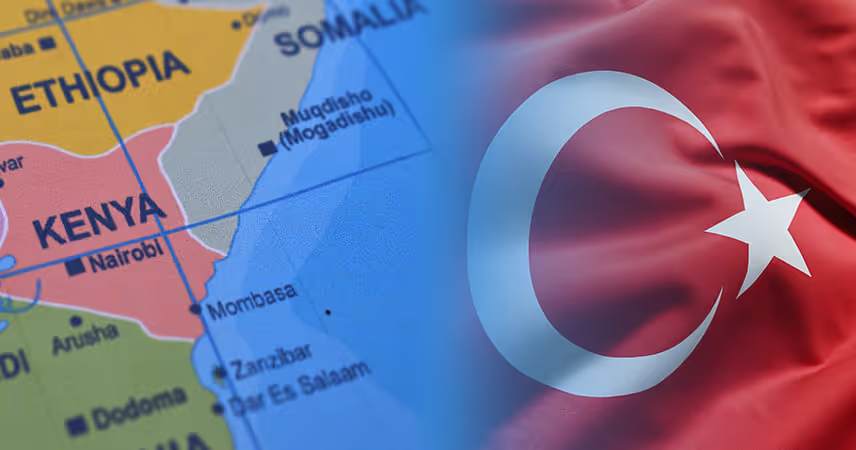
Turkey’s expanding role in the Horn of Africa is no longer limited to diplomacy or development assistance. It has become a security actor in the region’s civil wars. The United Arab Emirates, Saudi Arabia, and Israel are also taking more active positions in these conflicts.
In Africa—and in many regions for that matter—internal conflicts attract foreign sponsors who pursue strategic objectives through local proxies. This is dangerous for three reasons. First, it prolongs wars by reducing incentives for compromise, as external support gives parties confidence that they can achieve military advantage. Second, it increases the lethality of conflicts. The introduction of advanced drones and heavy equipment increases the scale of violence. Third, it raises the risk of escalation, as miscalculation can turn proxy wars into direct confrontations.
Overall, this foreign involvement, including that of Turkey, makes the conflicts harder to resolve. In the Horn of Africa, this dynamic has transformed fragile domestic conflicts into arenas of geopolitical competition.
Ethiopia: Access to the Sea
Any assessment of the Horn — and of Turkey’s role within it — must take into account Ethiopia’s position. As a landlocked country, Ethiopia wants to secure direct maritime access. In January 2024, Addis Ababa signed a bilateral agreement with Somaliland to secure direct port access without Mogadishu’s consent. As this agreement would undermine Somalia’s territorial integrity, Mogadishu reacted strongly. Turkey mediated between Ethiopia and Somalia in February 2024 to defuse tensions.
Israel’s recognition of Somaliland on 26 December 2025 has added a new dimension to the issue. The following day, most regional governments issued a joint statement condemning the decision, but two were notably absent: the United Arab Emirates and Ethiopia. If Addis Ababa supports Somaliland’s independence, this will alter the balance of power in Somalia. A similar divergence is visible in Sudan, where Turkey supports one side of the conflict, while the UAE and Ethiopia support another.
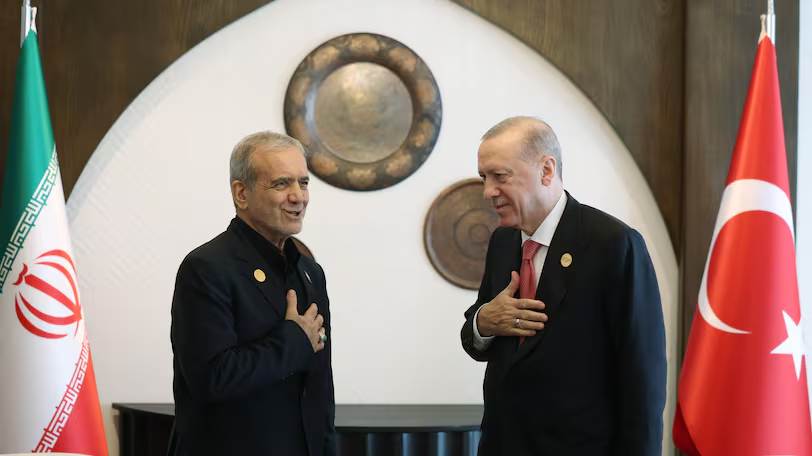
President Recep Tayyip Erdoğan’s visit to Ethiopia in February reflected this tension. His tour normally would include the United Arab Emirates, which was cancelled at the last minute due to the reported health condition of Mohammed bin Zayed. Ethiopia and the UAE cooperate in Sudan and have overlapping interests in Somaliland. In both arenas, Turkey’s position differs from that of Abu Dhabi and Ethiopia.
In Addis Ababa, Erdoğan stated that the two sides discussed steps to reach a $1 billion trade volume target and expand Turkish investments. He also underlined Ethiopia’s position in the Horn and its role as host of the African Union and other international institutions. While he did not mention Somaliland, he recalled Turkey’s mediation between Somalia and Ethiopia in 2024.
On the other hand, reports suggest that Ethiopia’s Tigray region may be sliding toward renewed conflict. This could overlap with the conflict in Sudan and could pull in Turkey, Egypt and Gulf rivals. During Ethiopia’s war against Tigrayan forces in 2023, Turkish drones played a decisive role in altering the balance of power.
The Regionalization of Civil Wars in Sudan
Sudan’s ongoing conflict follows the same pattern of foreign involvement. This civil war has increasingly drawn in neighboring states and Gulf countries. Turkey has recently deepened its involvement in Sudan’s civil war. Turkish armed drones reportedly deployed from Egypt have struck RSF targets deep inside Sudan, likely operated by Turkish technicians. In this regard, Egypt and Turkey are aligned with Saudi Arabia in supporting the Sudanese Armed Forces.
The Rapid Support Forces (RSF), by contrast, have allegedly received support from the United Arab Emirates, Ethiopia, and Chad. After the tumultuous breakup between Saudi Arabia and the UAE, supply flights departing from the UAE reportedly began using alternative routes to support the RSF in Sudan. In the meantime, a Reuters investigation revealed that Ethiopia has been hosting a secret training camp near its border with Sudan to prepare fighters for RSF. After the story was published, Ethiopian authorities revoked the accreditation of three Reuters reporters.
Turkey’s Military Buildup in Somalia
This shift is also clear in Somalia, where Turkey has moved from institutional support to a direct security role. Turkey’s engagement in Somalia began with humanitarian assistance in 2011. It later expanded into infrastructure, economic development, and even the planned construction of a spaceport. The establishment of Turkey’s largest overseas military base in Mogadishu strengthened defense cooperation between the two countries.
The Turkish military buildup in Somalia followed Israel’s recognition of Somaliland in December. A few days later, Erdoğan met Somali President Hassan Sheikh Mohamud in Istanbul. He reaffirmed Turkey’s commitment to Somalia’s unity and territorial integrity. In this context, Turkey’s deployment of tanks and F-16 fighter jets to Mogadishu in February signals a willingness to act, rather than remain confined to training and capacity-building.
Foreign Interventions Complicate Conflict Resolution
The Horn of Africa has long been fragile, and foreign involvement in its conflicts is not new. During the 1977–1978 war between Somalia and Ethiopia, foreign powers — most notably the Soviet Union and Cuba — provided military assistance and deployed combat units. In the Cold War context, such involvement was largely shaped by bloc solidarity and ideological alignment.
What differs today is not the existence of foreign involvement, but its configuration. Instead of superpower competition structured around ideological blocs, current interventions are driven largely by regional actors seeking to advance their own agendas.
This expanding regional involvement makes conflicts more difficult to resolve. When one local actor gains the upper hand, the opposing side increases its support in order to level the playing field. This dynamic creates a vicious cycle that accelerates the escalation of violence. The settlement of these proxy wars may therefore require a regional diplomatic framework that safeguards the interests of foreign sponsors and manages the distribution of wartime gains, such as access to natural resources or spheres of influence.
While foreign involvement in African civil wars is longstanding, Turkey’s move from development assistance to security engagement in the Horn of Africa is a recent shift. In this endeavor, Ankara pursues its own priorities, even when it aligns tactically with other regional powers.




.svg.avif)