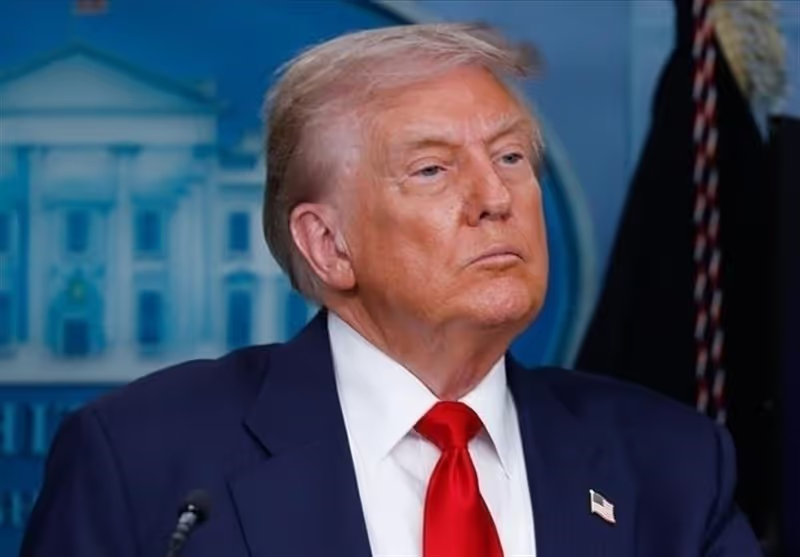
President Donald Trump has issued an executive order to designate several chapters of the Muslim Brotherhood as terrorist organizations. The order is a reflection of sustained lobbying by the United Arab Emirates and Israel, with support from other Arab governments. While the designation reflects regional geopolitical pressures more than U.S. domestic concerns, it will nevertheless create complications for Turkey and Qatar, both of which maintain close ties with the movement.
The Brotherhood’s Designation and Lobbying by Regional Powers
The Brotherhood is not a hierarchical or centrally run organization. It is a loosely connected, transnational movement whose followers share certain core ideas but operate through locally organized chapters. This lack of a central authority makes any blanket counterterrorism designation difficult to apply and limits how coherent such a measure can be across different countries. At this stage, the U.S. designation covers only the Brotherhood’s branches in Egypt, Jordan and Lebanon. The movement’s activities in other countries remain outside the scope of the decision, though this could change.
Earlier attempts in Washington to designate the Brotherhood failed because the State Department and the Pentagon opposed the idea, arguing it would be counterproductive. Under Trump’s new presidential term, however, bureaucratic resistance carried far less weight, and the administration was more willing to disregard institutional objections.
Granted that domestic concerns exist, the main push for the designation nonetheless came from outside the United States. The UAE, Israel and Saudi Arabia have long portrayed the Brotherhood as a destabilizing force and urged Washington to adopt a similar stance. The UAE, in particular, has built much of its regional foreign policy around containing and rolling back the Brotherhood’s influence across the Middle East and North Africa.
Ankara Is Unlikely to Change Course
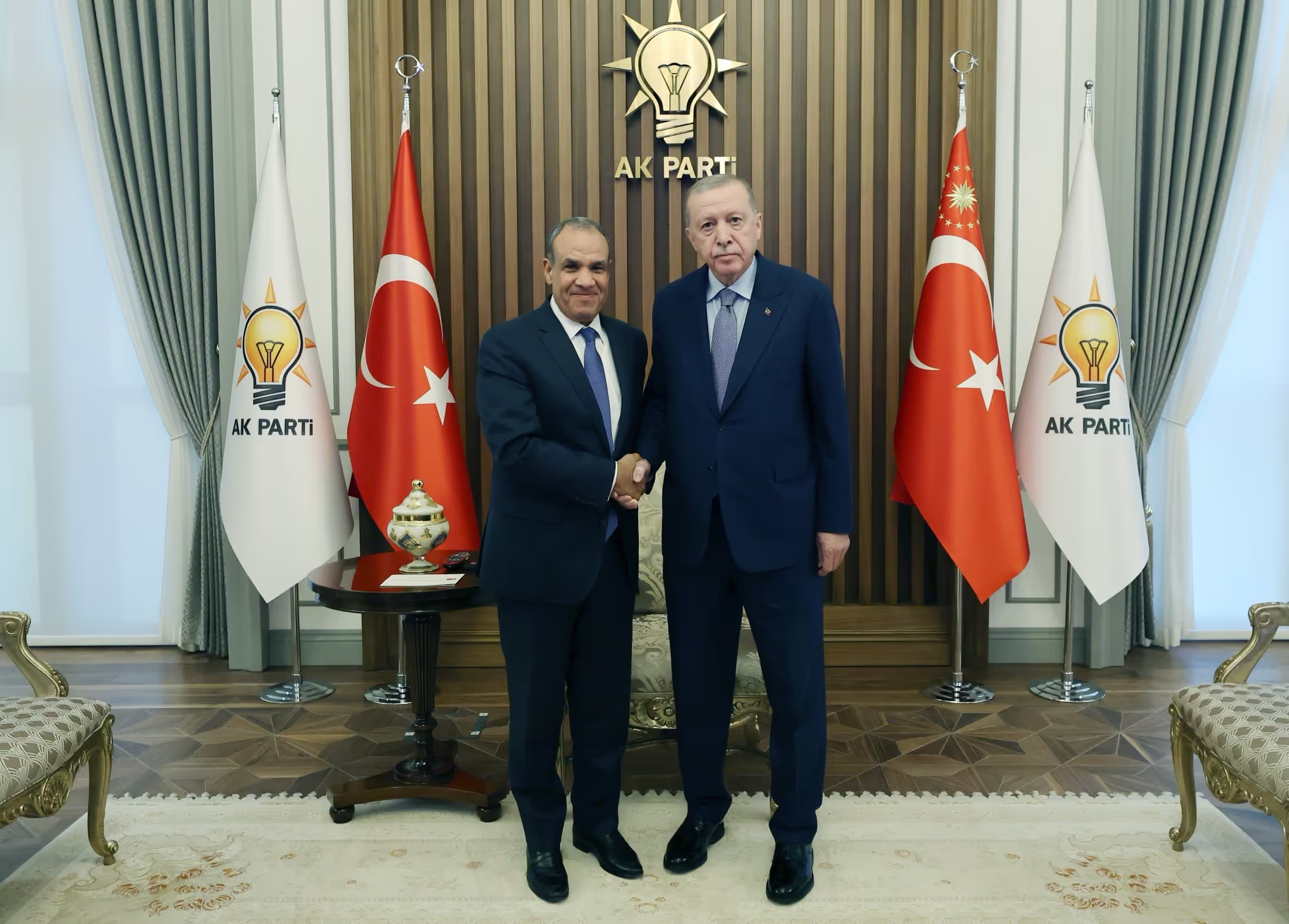
The new U.S. designation is unlikely to alter Turkey’s political stance toward the Brotherhood. The AKP government in Turkey has been a major supporter of the Brotherhood, even after the rapprochement with the Arab countries. After the 2013 crackdown, much of the Egyptian Brotherhood’s leadership relocated to Turkey and the United Kingdom. Ankara continues to host members of the Egyptian Brotherhood, some of whom have been naturalized. Although Ankara later barred the Brotherhood from criticizing Egypt and other Gulf countries, these organizations continue to operate within defined boundaries.
From a U.S. policy perspective, Ankara’s commitment to the Brotherhood may reinforce the perception that Turkey is hosting yet another actor Washington designates as a terrorist organization, following longstanding disputes over Hamas. Although this development is unlikely to produce a rupture in U.S.–Turkish relations, it will strengthen the narrative—especially within the Republican Party—that Turkey employs a divergent and selective counterterrorism framework.
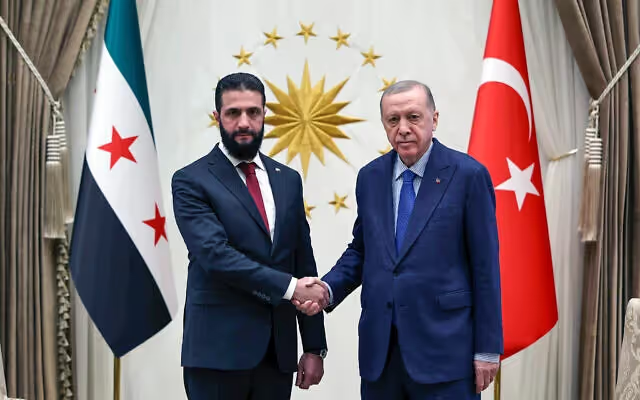
From Ankara’s perspective, however, maintaining ties with the Brotherhood may again retain strategic value over the long term. Turkey has previously adopted pragmatic approaches toward more questionable actors. Turkey engaged with Syria’s al-Qaeda branch and later backed its successors, including HTS under al-Sharaa, despite formally recognizing them as terrorist organizations. This Turkish support helped bring about the downfall of the Assad regime, after which the new Syrian leadership secured legitimacy in the Trump administration. Similarly, Turkey’s longstanding relationship with Hamas has generated sustained criticism from Israel and several Western governments. Although the U.S. ambassador to Turkey, Tom Barrack, later argued that Ankara’s engagement with Hamas facilitated a ceasefire in Gaza, the relationship required Turkey to keep walking a tightrope for years. On the other hand, Hamas, an offshoot of the Brotherhood in Palestine, is not officially designated as a terrorist organization in either Egypt and Jordan.
Nonetheless, Trump’s designation of the Brotherhood as a foreign terrorist organization could complicate the financial operations of Brotherhood-linked companies, foundations and associations based in Turkey. Should secondary sanctions be applied, Turkish banks and firms interacting with these entities may face compliance risks. In this regard, Turkey and Qatar can be expected to intensify lobbying efforts in Washington aimed at limiting the designation’s scope.
The designation of select Brotherhood chapters is not a game changer in the region. It is primarily a politically motivated decision aimed at meeting the preferences of Israel and the UAE. Nonetheless, the designation will constrain the Brotherhood’s ability to claim political legitimacy and complicate its international operations. It will also place Turkey and Qatar in a more challenging position, forcing both to adjust to new legal, financial and diplomatic pressures.




.svg.avif)