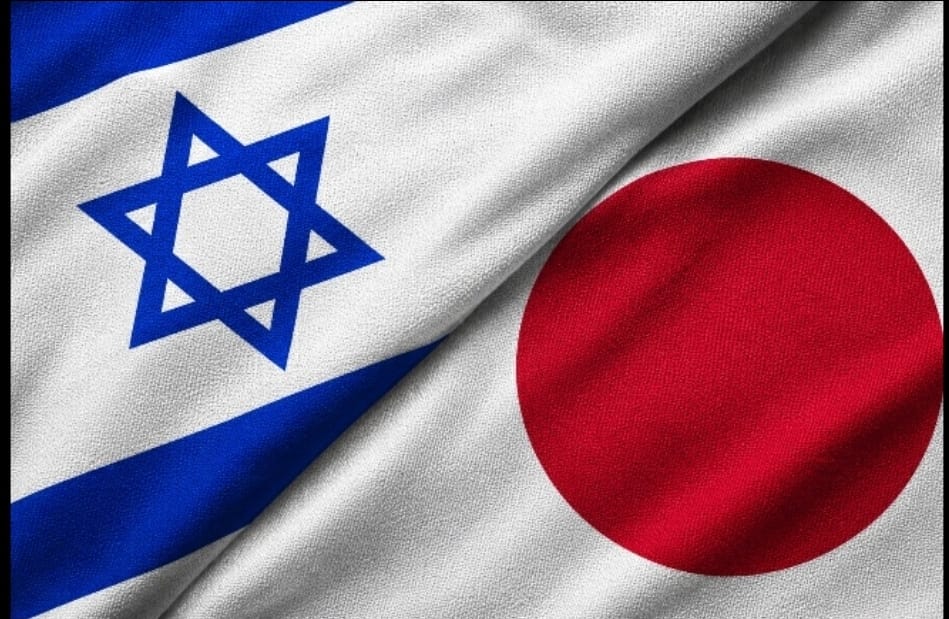
The Israeli government is exploring closer cooperation with Japan on semiconductor technology, and Tokyo has already approved subsidies for an Israeli chip investment in Japan. The investment's importance, however, extends beyond commerce, reflecting an intent to deepen ties between the two countries.
This intent was articulated on June 27th, 2026, when the Jerusalem Post published an op-ed by Emmanuel Navon, Israel's ambassador-designate to Tokyo, entitled "Israel must seize the opportunities created by Japan's strategic awakening." Navon set out the potential scope of cooperation:
Israel brings unique experience in missile defense, counter-drone warfare, cybersecurity, intelligence integration, and national resilience. Japan brings technological sophistication, industrial capacity, economic strength, and a growing ability to contribute to regional security. Together, Japan and Israel can cooperate on issues that will define the 21st century: critical infrastructure, cyber resilience, maritime security, supply-chain protection, critical minerals, and defense innovation.
The first concrete step came not in defense but in semiconductors. On July 14th, opening a press conference at Japan's Ministry of Economy, Trade and Industry (METI), Minister Akazawa announced that the ministry would subsidize Tower Semiconductor Japan G.K., a subsidiary of the Israeli foundry Tower Semiconductor, to strengthen the resilience of Japan's AI and semiconductor supply chains. METI pledged up to one billion dollars in support. The same day, Tower Semiconductor's CEO, Russell Ellwanger, set out the details of a three-billion-dollar investment plan. According to the company's press release, Tower will convert the Arai facility in Niigata Prefecture, formerly Fab 6, into 300mm silicon photonics and advanced packaging capacity in 2027, and then maximize the 300mm output of its Fab 7 in Uozu in 2028, Toyama Prefecture. The company expects the expanded operation to generate $3.6 billion in revenue and $1.2 billion in net profit by 2028.
Semiconductor manufacturing carries clear economic value, but this cooperation also entails risks for both countries. Assessing these risks requires first understanding the technology involved.
The Problems with the Current AI Data Center Boom
When the Nasdaq reached a record high in early June 2026, the technology sector, particularly AI and data centers, was the principal driver of economic growth. That growth has also drawn criticism, much of it centered on electricity consumption. A single ChatGPT query consumes roughly ten times the electricity of an average Google search, and NVIDIA's DGX B200, a high-end AI GPU server, draws 14.3 kilowatts, fifteen to thirty times more than a conventional server. According to a Gartner report, worldwide data center power demand is expected to rise 27% in 2026, reaching 132 gigawatts (GW), up from 104 GW in 2025.
Much of this demand stems from a physical limitation: the difficulty of delivering power and transmitting signals through metal wiring. Copper, valued for its low resistivity, is the dominant material both for the interconnects inside a chip and for the wiring between chips and servers. Copper nonetheless has inherent constraints. First, copper cabling requires more energy for high-frequency, high-volume data transmission, because part of that electricity is lost as heat. Second, copper wires suffer signal loss and degradation, requiring additional power and repeater devices to restore the signal.
Why Silicon Photonics Can Solve These Problems
These constraints ultimately derive from the vibration of metal atoms: as electricity or signals pass through a wire, its atoms vibrate and generate heat. Silicon photonics, also known as Co-Packaged Optics (CPO), constitutes part of this wiring, inside and between servers, with light, achieving both energy efficiency and high-volume data transmission with minimal latency. Earlier optical technologies relied on several specialized materials and were costly to produce.
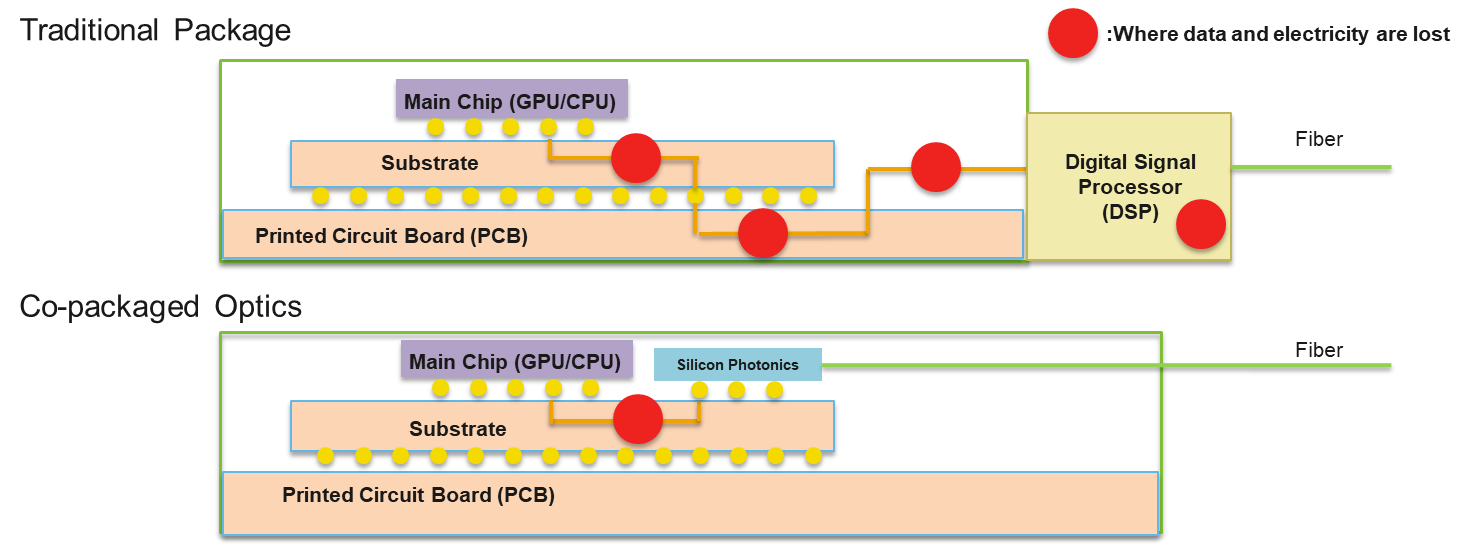
Silicon photonics instead uses silicon, a material with a long history in semiconductors and well-established fabrication methods, which makes optical data transmission commercially viable. NVIDIA estimates that its CPO delivers 3.5 times the power efficiency, 1.3 times faster time-to-operation, and 10 times the resiliency of conventional interconnects. With opposition to data centers rising sharply, partly driven by concerns about its electricity consumption, such efficiency is increasingly a requirement for AI hardware.
Why Israel and Japan
Aside from Tower Semiconductor, the principal manufacturers in the silicon photonics market are STMicroelectronics (Switzerland) and GlobalFoundries (United States). For both Israel and Japan, establishing large-scale production in Japan, an economy with strong access to the Asia-Pacific market, helps secure a resilient supply chain for a technology central to AI and data centers. Taiwan's and South Korea's fabrication capacity is largely absorbed by advanced logic and memory chips, and both are more exposed to regional tensions involving China and North Korea. Japan, by contrast, already possesses facilities for niche chip manufacturing and a pool of experienced engineers, with comparatively lower geopolitical exposure.
For METI, the investment fits within an ongoing series of supply-chain resilience policies. While Rapidus in Hokkaido and TSMC in Kumamoto anchor logic-chip production, a CPO manufacturing base in Niigata and Toyama, located between the two, adds a further layer to the domestic supply chain and creates employment.
Beyond lower geopolitical exposure and available expertise, Japan also offers an established base of silicon photonics end users. NTT, a major Japanese telecommunications company, is pursuing IOWN (the Innovative Optical and Wireless Network), a large-scale next-generation information and communications infrastructure project.
For Japan's domestic CPO sector, subsidizing Tower Semiconductor could provide a division of labor in which the core technology remains Israeli while Japan provides only the end users. The reputational dimension is also relevant. Government funding for an Israeli company carries political sensitivity, particularly while Israel is engaged in ongoing military operations in several countries.
Outlook
The arrangement carries risks for both sides. For Israel, locating production facilities abroad stays as a supply-chain vulnerability. For Japan, the corresponding concern is a strategically significant facility under foreign ownership. In addition, while Japan offers considerable industrial capacity and technological sophistication, its bureaucratic procedures and consensus-driven, bottom-up decision-making may prove difficult for a partner such as Israel, which operates in a rapidly changing security environment.
It remains unclear whether AI and data centers will ultimately define the 21st century. However, the Israel-Japan partnership on silicon photonics could help overcome one of the key physical bottlenecks currently facing data centers. Should the two governments overcome these hurdles, an agreement that began with a subsidy commitment announced at a METI press conference may become an early instance of broader cooperation. Israel's ambassador-designate to Japan has already arrived in Tokyo and visited one of the prestigious think tanks. Tel Aviv might already be looking ahead beyond semiconductor cooperation.



.svg.avif)