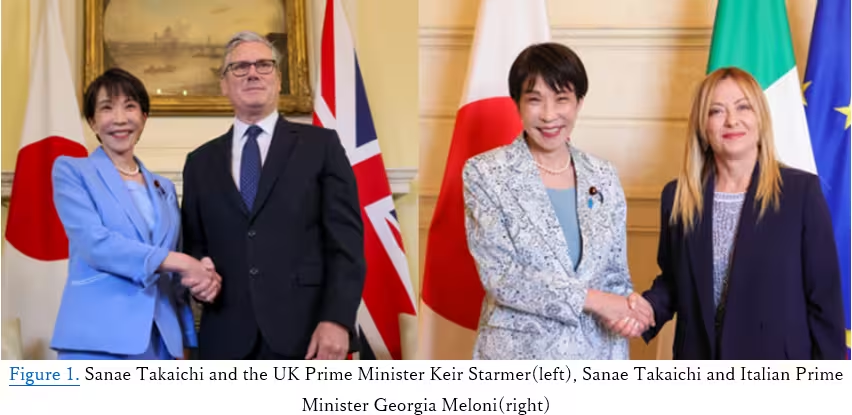
On June 14–15, 2026, Japan's Prime Minister Sanae Takaichi visited London and Rome signed a range of agreements on defense, clean energy, and technology with her British and Italian counterparts. The biggest news to supply chain watchers was a pair of memorandum of understanding (MoU) signed by Rapidus — Japan's state-backed advanced semiconductor foundry — with the UK Semiconductor Centre and Italy's Chips-IT. Although some manner of expression of each MoU is different, both promises to initiate cooperation in semiconductor field including facilitation of Rapidus’ customer acquisition.
Prior these series of MoU, just a month ago, EU’s Chips act 2.0 emphasized the importance of supply chain and effectively addressing “disruption and crises”. As geopolitical tension around Taiwan strait ―the narrow corridor every policy makers are worried about the future crises― goes up and European leaders are worried about semiconductor chip supplies from this tiny island, a friendly Japanese foundry targeting 2nm-class chip production can offer Europe an alternative to the Taiwan-monopoly situation. Since the announcement of ambitious European Chips Act in 2023, Europe has tried to strengthen its presence in the semiconductor industry.
However, fixing this structural problem is likely going to be tough for some deep-rooted reasons, first, many indispensable elements are still located in the East Asia; second, building a mass-production factory in Europe is a whole different challenge than in Asia; third, the weak demands for chips in Europe will not attract chips manufacturer.
The Geography Problem
The logic of Japan-Europe semiconductor cooperation is based on the assumption that chips manufactured in Hokkaido are geopolitically safer than chips manufactured in Taiwan. But this premise misreads the geographic risk. Although these MoU―starting solid cooperation of democratic-allies in an era of uncertainty―are meaningful and will surely strengthen Europe and Japan’s economical resiliency, there are several physical and financial problems the MoU solely cannot overcome.
The Taiwan Strait is not merely a risk to Taiwan-based production. It is a critical chokepoint for the entire East Asian Sea Lane — including Japan. According to CSIS, a conflict involving Taiwan would likely compel shipping companies to avoid routes around the island entirely, forcing vessels heading to and from Japan to add 800–1,000 miles to any journey. Plus, the materials flowing into Rapidus's Chitose fab (silicon wafers, industrial gases, manufacturing equipments etc) and the product chips flowing out would transit the same corridors as TSMC's output. Just as the blockade of the strait of Hormuz has been a big topic of newspapers for months, Japan’s energy supply chain depends on a maritime corridor and a semiconductor factory consumes more electricity than a small country does. All of these factors would cause a huge cost increase to Rapidus which could be a deadly problem to the industry whose running cost is extremely high, especially for a company which was founded a few years ago and cash flow is expected to be in the black in 2029.
The Fab-Building and Skilled Worker Problem
Hypothetically, suppose Europe decided to stop relying on Japan and build its own advanced fab instead inside Europe or invite a factory from another continent: Asia or the US. The evidence suggests it’s likely going to be difficult— at least not within any timeframe relevant to current policymakers.
The European Court of Auditors delivered its verdict in April 2025: it is "very unlikely" the EU will meet the 20% global market share target set by the 2022 Chips Act. The Commission's own July 2024 internal forecast projects Europe's semiconductor value-chain share rising only from 9.8% in 2022 to 11.7% by 2030 — barely two percentage points despite the most ambitious industrial policy intervention in EU history.
For Asian semiconductor giants like TSMC, Samsung, SK Hynix and Kioxia, Europe is one of the most troublesome places to invest. The semiconductor industry is the place where both capital size and speedy decision are required. Imagine a huge ship like the Titanic needing to turn nimbly rapidly in quick succession to avoid catastrophes, being a decision maker in this industry is like being in a high-pressure place as the captain in that ship. Places with high labor cost (more investment is required) and complicated regulation (obstacle for the timely decision) like Europe are a nightmare for an industry like semiconductors.
The human capital problem compounds the financial one. Historycally, the European chips makers like STMicroelectronics, NXP, Infineon are legacy node semiconductor chips company focusing on older than 28 nm node. Although these legacy chips are essential for the automobile industry, manufacturing these old nodes cannot compare with manufacturing the single-digit nm top-notch chips Asian companies are working on. A manufacturing factory needs at least one thousand skilled engineers. Some skills are overlapping but the skills required vary from role to role. The skilled engineer shortage is a problem even in Taiwan, it’s likely a bigger problem in Europe. TSMC itself has encountered significant yield ramp delays at its Arizona facility in the US― even where the first semiconductor was invented―attributing them to the difficulty of replicating its Taiwanese workforce culture in a different labor market. Europe is likely going to face that challenge at an even more serious level.
The most indicative single incident is Intel's Magdeburg cancellation. In 2022, Intel announced a €17 billion investment for two leading-edge fab facilities in Germany. By July 2025, Intel had cancelled the project. CEO Lip-Bu Tan cited insufficient customer commitments as a primary factor. If a company with Intel's experience, brand, and capital access cannot make an advanced European fab work commercially, the barriers are genuinely structural.
The Demand Problem
The Intel cancellation points to the most fundamental issue: Europe does not have the end-user demand that makes leading-edge fab economics viable.
The clearest articulation of this problem comes from an unexpected source. Christophe Fouquet, CEO of ASML — the Dutch company that makes all the EUV lithography tools used to manufacture advanced chips, including in Rapidus — put it directly: "If you had a fab like this in Europe, all the wafers manufactured would be exported to the United States. So, then you'll be in a situation where Europe subsidizes a big project, and the output of this project goes somewhere else."
Fouquet's observation reflects a market reality. Demand for sub-5nm chips is overwhelmingly driven by AI training and inference workloads — and the companies running those workloads are American hyperscalers: Google, Amazon, Microsoft, Meta. European semiconductor demand, by contrast, as mentioned before, is concentrated in the automotive and industrial sectors, which rely on 28/22nm chips — legacy-node applications that do not require leading-edge fabs. A modern car contains thousands of chips, but none of them need to be manufactured at 2nm. Car manufacturing companies even choose to derivatively keep using old legacy chips for reliability reasons.
AI data centers have now become the dominant demand driver for advanced semiconductors globally, with hyperscale operators expanding rapidly and purchasing large quantities of cutting-edge chips at premium prices. Europe has no hyperscaler. There are European AI companies like France's Mistral AI, Germany's Aleph Alpha but none of them can replace American customers in terms of chip consumption. They cannot anchor the European leading edge chip factory inside Europe.
The MOUs between Rapidus and UK Semiconductor Centre and Italy's Chips-IT establish frameworks for information exchange and research collaboration, not mass production. The most plausible European customers — research institutions like IMEC, niche AI chip startups emerging from the UK's investment environment, perhaps Arm Holdings for evaluation purposes — represent sample level, a thin commercial pipeline, not a market.
Political Signaling vs. Industrial Strategy
None of this means the June 2026 agreements are worthless. Diplomatic signaling has genuine value: the MOUs strengthen the architecture of democratic technology cooperation, demonstrate that supply chain diversification is being actively pursued, and embed Rapidus within a network of allied relationships. For Rapidus, the future customer diversification is nothing but positive.
But geopolitical signaling and industrial strategy are different things. The Bruegel think tank's May 2026 analysis of what Chips Act 2.0 must address frames the alternative well: rather than chasing manufacturing autonomy that the market has repeatedly shown it cannot sustain in Europe, the better bet is to deepen Europe's positions of genuine strategic strength — in semiconductor equipment (ASML), in IP-rich chip design — and use them as leverage for preferential access to global foundry capacity. Strategic indispensability, not manufacturing self-sufficiency which has also been Japan’s strategy to survive in the industry during their long economical stagnation.
Europe is desperate for chips. That desperation has generated a tendency to reach for diplomatic signaling that satisfy the political need for visible action without resolving the underlying structural problems. Policy makers should cope with these problems with patience simultaneously, signaling like MoU sometime plays a big role when it is backed by actual technological, industrial and educational foundations.
And also, there seems to be some low-hanging fruits to take some crucial positions in this complicated semiconductor ecosystem. Working on an ambitious project might make sense after strengthening what Europe has now.



.svg.avif)