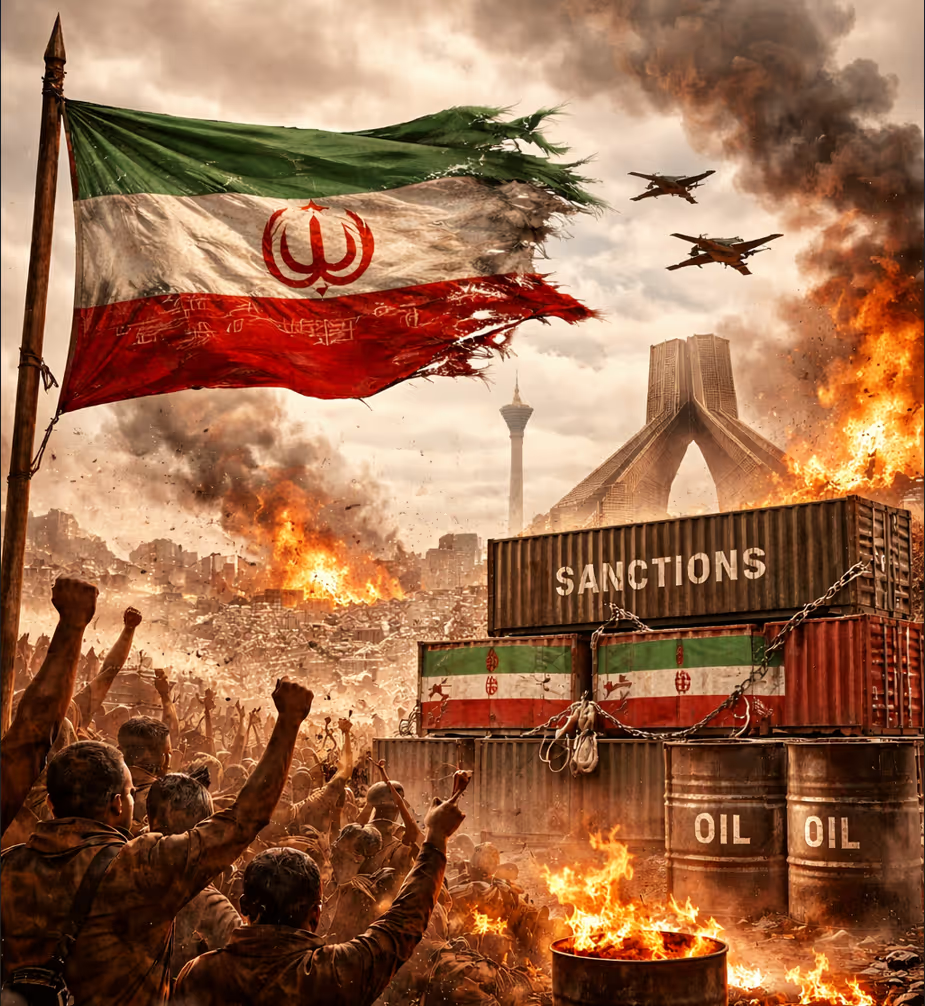
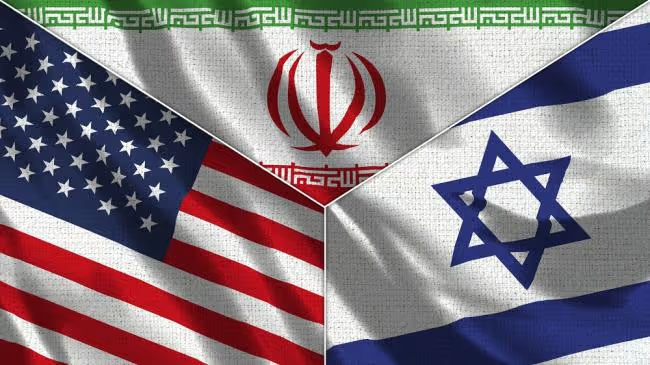
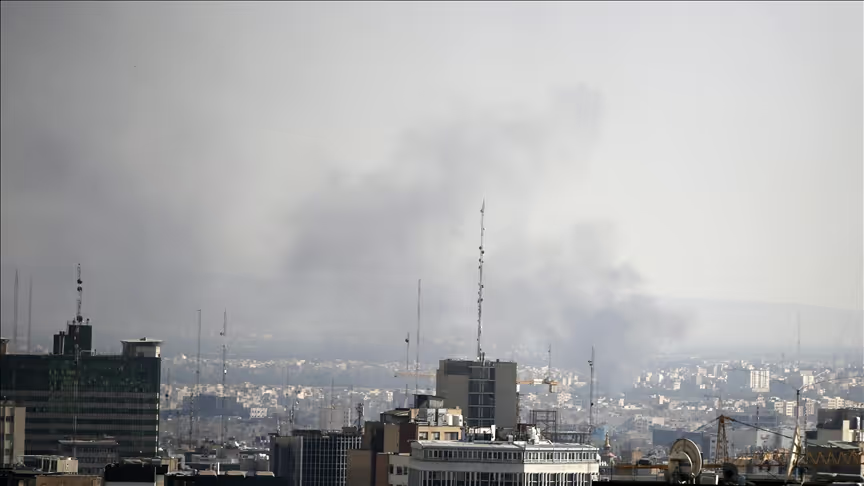
Israel’s superior air power and strike capabilities during the 12-Day War exposed Iran’s structural weaknesses. Yet the consequences of this confrontation extend well beyond the battlefield. The war has acted as a catalyst, accelerating trends already present inside Iran and pushing the political system into a phase of recalibration.
The changes currently unfolding inside Iran cannot be explained solely by internal dynamics. Rather, they are the product of two intersecting forces: domestic pressures and external constraints. Historically, transformations within Iran have largely been driven by internal developments. This time, however, external dynamics—sanctions, military confrontation, and sustained pressure—have played an increasing role. Over roughly the past five to six years, beginning with the killing of Qassem Soleimani, Iran has been compelled to adapt primarily in response to outside forces. This distinction is important because transformations imposed from outside tend to be more contingent and less durable than those that emerge organically from within society.
War as a Catalyst and Recalibration
At the domestic level, Iran has long been experiencing deep economic problems. These pressures did not begin recently; they intensified over the past fifteen years but were already present immediately after the revolution, particularly following the seizure of the U.S. embassy and the imposition of sanctions on the Islamic Republic. Over time, sanctions on Iran became progressively more severe, especially after the failure to resolve the nuclear file. The Obama administration imposed heavy sanctions on Iran, which later escalated dramatically under Donald Trump. The result has been a sustained state of economic paralysis.
Despite possessing vast oil and gas reserves and ranking among the world’s leading countries in terms of energy resources, Iran has been unable to fully exploit these assets. Sanctions have prevented sufficient investment in capital-intensive sectors such as oil and gas, where efficiency depends directly on sustained financial input. Without access to capital, technology, and foreign partnerships, Iran’s energy sector has struggled to modernize.
Iranian society is acutely aware of these shortcomings. Import-substitution policies in Iran allow for domestic production of cars, fuel, and consumer goods, but these products remain inferior to their international equivalents. While self-sufficiency is technically achievable, quality and efficiency suffer without competition, investment, and market openness. For example, while geography and topography play a role, the poor quality of domestically produced gasoline remains a central factor in severe air pollution in Tehran.
As these economic pressures accumulate, they generate political consequences. A growing segment of Iranian society openly questions the state’s regional priorities, arguing that resources spent in Lebanon, Syria, Iraq, and elsewhere could have been used to improve living conditions at home. When foreign policy choices begin to produce sustained domestic resentment, the political system enters a zone of structural risk. Such tensions are difficult to contain indefinitely, especially in closed or semi-closed political systems. The latest protests against inflation and currency collapse illustrate the severity of the economic downturn.
Iranian Nationalism versus Persian Nationalism
Under these conditions, identity narratives have gained renewed importance. Symbols, slogans, and imagery referencing Iran’s pre-Islamic past, including Persian and Sasanian elements long sidelined after the revolution, have become more visible. This has often been interpreted externally as a shift from Islamism toward nationalism. However, such a reading oversimplifies a far more complex reality.
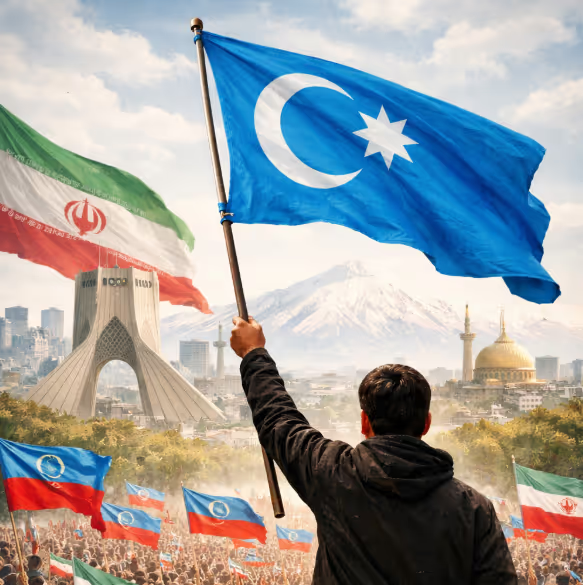
A key distinction must be made between Iranian nationalism and Persian nationalism. These two concepts are frequently conflated, particularly outside Iran, but they are not identical. Iranian nationalism refers to a broader civilizational and territorial identity rooted in geography, strategic culture, and centuries of coexistence among diverse peoples. Persian nationalism, by contrast, emphasizes linguistic and ethnic homogenization and seeks to impose Persian identity across the country.
Iranian nationalism has deep historical roots. It is shaped by repeated invasions, prolonged defense, and periods of imperial expansion, all of which contributed to the Iranian culture. Crucially, this form of nationalism has historically accommodated diversity. Iran’s administrative structure reflects this: provinces carry the names of ethnic and regional identities, including East and West Azerbaijan, Kurdistan, Baluchistan, Golestan (often associated with the Turkmen Sahra), Gilan, Mazandaran, and others. These are not symbolic labels but institutional acknowledgments of Iran’s plural composition.
Persian nationalism, on the other hand, became particularly pronounced during the Pahlavi period under Reza Shah. It promoted linguistic centralization, restricted minority languages, and pursued policies of forced cultural assimilation. This approach differed fundamentally from the more inclusive Iranian identity that allowed multiple ethnic groups to see themselves as stakeholders in the state.
The Islamic Republic did not abolish Iranian nationalism. Contrary to common assumptions, Ayatollah Khomeini himself embodied a form of Iranian nationalism. While the revolutionary ideology emphasized Shiism, it did not erase territorial identity or the state’s civilizational self-understanding. The post-revolutionary period saw internal debates reminiscent of earlier ideological disputes elsewhere: whether to prioritize revolution at home or export it abroad.
Conflating the two types of nationalism in Iran obscures why many non-Persian communities—particularly Turkic-speaking populations—have historically remained attached to the Iranian state and its institutions. Over time, the more state-centered and conservative approach prevailed, focusing first on consolidating power internally before projecting influence externally.
Regional Strategy and Domestic Costs
This logic shaped Iran’s regional strategy, particularly after the Arab uprisings. Tehran sought to mobilize long-standing Shiite and allied population networks in Iraq, Syria, Lebanon, Yemen, and Palestine, integrating them into a broader security doctrine. However, this strategy carried high economic and social costs domestically. These costs, combined with sanctions and war, have intensified internal tensions.
In times of external threat, states often revert to nationalism as a mechanism of consolidation. This pattern is not unique to Iran. During crises, ideological rigidity gives way to pragmatic appeals to unity. In Iran’s case, the recent war reinforced Iranian nationalism as a unifying framework, cutting across regime supporters and critics alike. This was less an ideological revival than a defensive reflex—a suspension of internal disputes in the face of external danger.
At the same time, internal political dynamics have entered a new phase. The death of President Ebrahim Raisi removed a figure closely associated with hardline governance. His absence created space for a more moderate figure, Masoud Pezeshkian, whose political profile appealed both to conservatives seeking stability and to reform-minded constituencies, particularly women. His rise reflected a recognition within the system that continued repression risked further destabilization.
However, power within Iran remains fragmented. While the presidency has powers, real authority remains dispersed across entrenched institutions. This imbalance limits the scope of reform and intensifies internal friction between hardliners and more pragmatic conservatives. These tensions run through the state apparatus itself, including the Revolutionary Guards, intelligence services, economic institutions, and foreign policy circles.
Future Confrontations and Cycles of Change
The drivers of the 12-Day War remain unresolved. The factors that led to war—Iran’s nuclear posture, its regional influence, and its demographic and strategic weight—have not disappeared. As a result, further confrontations remain possible. However, the limits of military escalation have also become clear. Without a direct ground invasion, regime change through aerial bombardment remains unrealistic. Repeated strikes are more likely to strengthen internal consolidation than produce collapse.
Iran’s political trajectory remains cyclical rather than linear. Periods of repression and openness have alternated repeatedly over the past four decades. The current phase reflects another turn in this cycle, shaped by war, sanctions, and internal pressure. Whether this recalibration leads to sustainable adjustment or renewed instability will depend not only on domestic choices, but on the evolution of external conditions.



.svg.avif)