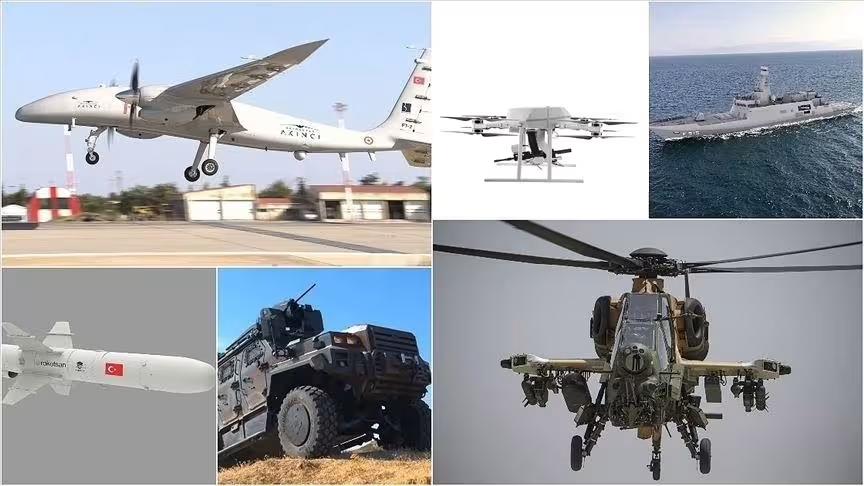
Turkey's defense industry has grown substantially over the past decade, and recent weeks have brought fresh evidence of its expanding reach with weapons revealed at a defense exhibition, new arms contracts and the use of its weapons on the battlefield. This is not coincidental. The expansion of Turkey's defense industry is a deliberate government policy, pursued through state-owned companies and private firms with direct ties to President Erdoğan and his inner circle. This growing arms export business also reinforces an expanding military footprint across multiple regions.
The SAHA 2026 Exhibition and the Turkish Arms Companies
The SAHA 2026 International Defense, Aerospace and Space Industry Exhibition was held at the Istanbul Expo Centre from 5 to 9 May. The fair brought together 1,700 companies from over 120 countries. It was the occasion for a series of significant new weapons unveilings. The most prominent unveiling at the SAHA defense exhibition was the Yıldırımhan, Turkey's first intercontinental ballistic missile, developed by the Ministry of National Defense's R&D Center.
President Erdoğan stated in January 2025 that Turkey had decided to boost stocks of missiles with a range of 800 kilometers and above and accelerate the program to develop a missile with a range of 2,000 kilometers and above. The Yıldırımhan system revealed at the SAHA 2026 fair has a declared range of 6,000 kilometers, a top speed of Mach 25, liquid nitrogen tetroxide fuel, four rocket propulsion engines and a 3,000-kilogram conventional warhead. What was displayed at SAHA 2026 is a prototype and no confirmed flight tests have been publicly disclosed.
A recent IISS report on Turkey's missile developments argues that four elements have driven Turkey's missile ambitions: regional threat perceptions, developments in missile technology, the operational lessons of recent wars, and Ankara's exclusion from the F-35 program. In this regard, Turkey has accelerated its missile program following the twelve-day US-Israeli war on Iran in June 2025, and the Yıldırımhan fits within a longer trajectory of expanding long-range strike ambitions.
Baykar, another leading Turkish arms company, showcased three new platforms at the SAHA 2026 fair for the first time. The K2 Kamikaze UAV is designed for swarm operations with a payload exceeding 200 kilograms. The Mızrak is a long-range loitering munition with a range exceeding 1,000 kilometers and AI-powered autonomous navigation without GPS. The Sivrisinek is a smaller system combining reconnaissance and strike capabilities.
It is worth noting that Baykar is chaired by Selçuk Bayraktar, the son-in-law of President Erdoğan, with his brother Haluk Bayraktar serving as chief executive. The company gained worldwide prominence following the highly publicized use of its Bayraktar TB2 drone in the early stages of the Russia-Ukraine war, when the platform demonstrated its effectiveness against Russian armored vehicles and air defense systems. Selçuk Bayraktar topped Turkey's income tax rankings for the fourth consecutive year, and his brother Haluk Bayraktar ranked second, according to Revenue Administration data for the 2024 fiscal year, released in 2025. Selçuk Bayraktar has held the top position every year since 2021. Both brothers are likely to feature again in the rankings to be published in the summer of 2026.
State-owned ASELSAN, Turkey's largest defense electronics company, introduced KILIÇ, the country’s first kamikaze autonomous underwater vehicle, and the TUFAN kamikaze unmanned surface vehicle at SAHA 2026. ASELSAN has recently become Turkey's most valuable publicly traded company, with a market capitalization exceeding $44 billion. The company reported revenues of $4 billion in 2025, a 15 percent real increase, and an order backlog of $20.4 billion. It signed 272 export contracts worth over $2 billion in 2025, more than double the previous year's total, covering 58 countries including three new markets.
Recent Turkish Armed Export Developments
These Turkish weapons have been exported to several countries, especially in the greater Middle East and Africa. A Turkish private company, Pasifik Technology, has reportedly agreed to supply 100,000 Mürküt short-range kamikaze drones to an undisclosed country. Pasifik Technology is owned by Fatih Erdoğan, who shares the same hometown of Güneysu, Rize as the president and has close ties to the AK Party. His wife Asuman Erdoğan served as an AKP member of parliament and party board member. (Fatih Erdoğan also owns the holding that built the Next Level mall in Ankara, located at a key intersection in the capital, which generated significant controversy at the time of its construction.)
The Mürküt has a range of approximately 8 kilometers and a maximum flight time of 20 minutes. The recipient has not been identified publicly, though the scale of the order suggests a buyer that might be preparing for high-intensity conflict. Pakistan, one of Turkey's largest arms customers, is a plausible candidate. According to SIPRI, Turkey is Pakistan's second-largest arms supplier after China, accounting for 10 percent of Pakistan's weapons imports between 2020 and 2024. India's Ministry of External Affairs stated that Pakistan deployed up to 400 Turkish-made Asisguard Songar drones during the India-Pakistan war in May 2025. India suspected that Turkish-supplied drones were operated by Turkish personnel, a claim that has not been independently verified.
Iraq is also finalizing the purchase of 20 air defense systems from Turkey, following drone and missile strikes on its territory during the US-Israeli war on Iran. Iraq's Deputy Army Chief of Staff for Operations, Lieutenant General Saad Harbiye, described Turkish systems as "top notch and low cost." The contract was signed on the margins of the SAHA 2026 exhibition. The Iraqi deal can be considered part of a broader regional shift in which neighboring and Gulf states are seeking to broaden their security arrangements, with Turkey emerging as an increasingly attractive partner owing to its military capacity, alliance with NATO and growing arms industry, as described by Crisis Group.
In Libya, Turkish Akıncı drones participated in the US-led Flintlock military exercises in Sirte with the participation of the armed forces of the West and East Libya governments. Turkey had militarily intervened in the civil war in Libya in 2019 in favor of the Tripoli government, which then pushed back the Benghazi government to a line near Sirte. Since then, Turkey has also dramatically increased its relations with Benghazi. Turkey has reportedly supplied armed drones to the Haftar forces, despite the alleged involvement of the latter in the Sudanese conflict. This latest exercise in Libya coincides with US efforts to broker a power-sharing agreement between Libya's two dominant families, the Dbeibeh family in the west and the Haftar family in the east.
In Sudan, a Bayraktar AKINCI drone operated by Sudan's armed forces shot down another AKINCI operated by the UAE, using a Roketsan-produced EREN loitering munition. The AKINCI is produced by Baykar, the Erdoğan family-linked company.
It should be noted that the Turkish military's increasing emphasis on armed drones and ballistic missiles runs parallel to its inability to compete with the growing air capabilities of its neighbors, including Israel and Greece, as well as its exclusion from the F-35 program.
It should also be stressed that armed drones and fighter jets do not serve the same purpose within an air force: drones excel at surveillance, attrition warfare and low-cost strike missions, but cannot replace manned aircraft in air superiority, electronic warfare or high-end combat roles yet. Turkey does have an indigenous fifth-generation fighter program, the KAAN, developed by Turkish Aerospace Industries, whose first prototype flew in February 2024. However, the program faces a significant bottleneck: its current prototypes rely on US-made General Electric F110 engines, the export licenses for which have been stalled in the US Congress, partly as a consequence of sanctions imposed after Turkey's purchase of the Russian S-400 air defense system. Turkey is developing an indigenous engine, the TF35000, though its integration into the KAAN is not expected before 2032.
Turkey's Military Presence Abroad
Turkey's military expenditure reached $30 billion in 2025, up 7.2 percent from 2024 and 94 percent from 2016, placing the country 18th globally, according to the Stockholm International Peace Research Institute. According to the report, the increase was driven primarily by allocations to the government-controlled Defense Industry Support Fund, an off-budget mechanism for domestic arms production and procurement.
These commercial and operational developments are part of a broader pattern. According to Turkish Ministry of National Defense sources, cited by Yetkin Report, Turkish Armed Forces are deployed across 13 countries with more than 70,000 personnel, approximately one-eighth of the total active force of 550,000. The deployments span Cyprus, Azerbaijan, Libya, Qatar, Somalia, Lebanon, the Balkans and elsewhere. Eleven of these deployments operate under bilateral or multilateral agreements, while forces in Syria and Iraq function under temporary counter-terrorism operational base frameworks.
Turkey's defense sector has grown substantially over the past decade in spending, industrial output, exports and overseas deployments. The SAHA 2026 fair, the SIPRI data and the recent export transactions reflect a sustained and coherent policy of building indigenous defense capability. A defining feature of this policy is the degree to which the Turkish arms companies are intertwined with the Turkish presidency.
With a military presence in 13 countries and arms exports reaching an expanding list of conflict theaters, Turkey has become a growing military actor across multiple regions. The use of Turkish weapons on multiple war theaters is likely to attract increasing scrutiny from governments and international institutions.




.svg.avif)