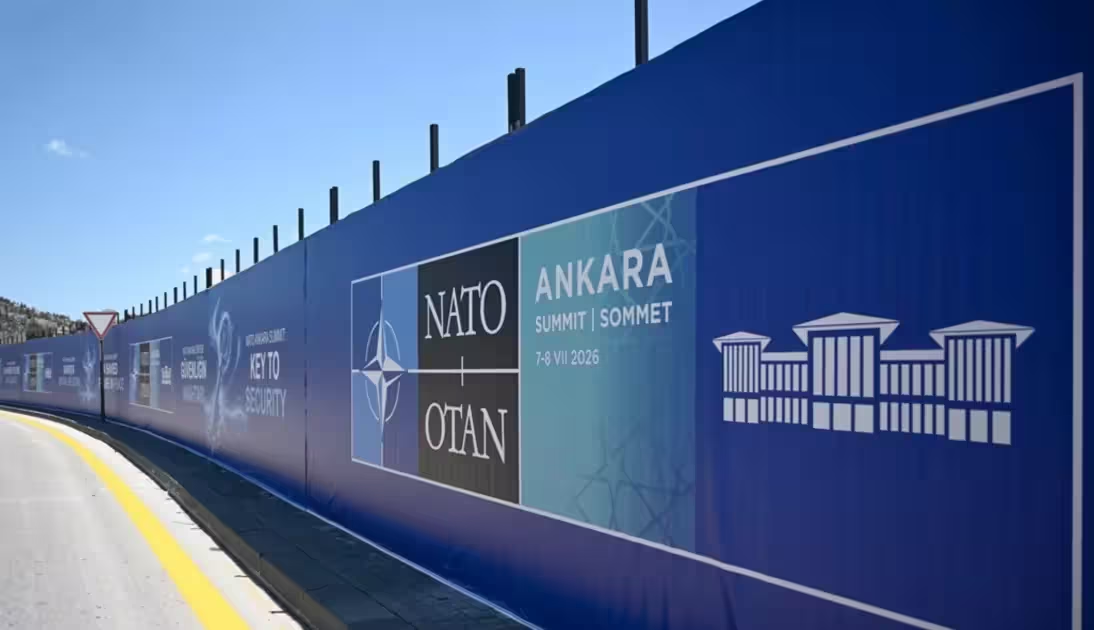
The story is well known. When the Russian Empress Catherine the Great wanted to tour the recently invaded Crimea in 1787, the Russian nobleman Grigory Potemkin wanted to impress her. As there was little prosperity to show, he decided to build fake villages with only façades along the banks of the Dnieper River. Once the empress had passed through these pasteboard villages, the structures would be quickly dismantled and rushed ahead to her next stop before her arrival. And so the phrase "Potemkin village" entered Western languages. Whether this story is true or not is debated among historians, but it is certain that Turkey is building a modern "Potemkin city" for the upcoming NATO Summit in Ankara on July 7 and 8.
The NATO Summit will be attended by the heads of government, among them U.S. President Donald Trump, French President Emmanuel Macron, and German Chancellor Friedrich Merz, along with other guests such as Syrian President Ahmad al-Shaara. These are the busiest days for Western diplomats posted in Turkey, who are scrambling to prepare for their leaders' arrivals.
They are not the only ones being kept busy. The Turkish government, naturally, attaches the utmost importance to the summit and has undertaken extensive preparations, repurposing an airport, dressing up the city, locking it down, and taking a range of other measures.
Turkey has renovated a military airport in the middle of Ankara at a cost of $200 million, to be used by visiting leaders, allowing them to bypass the outskirts of the city. Nonetheless, the other delegations and visitors attending the summit will have to use the civilian Esenboğa Airport. Unfortunately, this long commute of 28 kilometers from the airport to the city center passes through residential areas, and the road is lined with unsightly buildings and structures, to say the least. So the Turkish government has begun painting buildings along the route — and in some cases even the roads themselves. Footage has been circulating widely showing authorities putting up façades to conceal ugly structures along the main route. These façades, which will be used for just two days, reportedly cost up to 4 million dollars. The Turkish Presidency denied that the facades were put up to conceal the buildings, insisting they were part of standard security measures.
The Turkish government may line up "happy Turkish citizens" to greet passing world leaders, but there are also countless unfortunate souls in Ankara who could spoil this carefully staged moment. For this reason, the governor of Ankara has banned all protests, including hunger strikes, in the city for 13 days starting on June 22. As part of the security measures, Ankara will be in lockdown. Across large parts of the city, all gatherings — even private celebrations — are forbidden, including those held indoors.
Nonetheless, there are still several "potential troublemakers" in Ankara who may not stay at home despite the ban while the world's attention is on the summit. Turkish authorities therefore ordered the detention of 244 people in Ankara, and arrested 102 of them who might not watch their manners. The official charge is literally that they "could carry out terrorist acts in an effort to make Turkey a country associated with terrorism." Among those arrested were also 14 members of TEMA, one of Turkey's most well-known environmental organizations with 1.25 million members, including its Ankara provincial representative.
Troublemakers, however, are not limited to protesters. Alongside thousands of foreign journalists, Turkish journalists also want to cover this important summit. As a precaution, the Turkish government did not accredit Turkey's few remaining independent and opposition outlets.
While NATO has always been, of course, a defense organization and nothing else, it nonetheless felt the urge to weigh in on this widespread media ban in Turkey. A NATO spokesperson stated on social media that they are in contact with Turkish authorities on accreditation for the NATO Summit in Ankara. Thanks to this foreign intervention, more Turkish journalists will now cover the summit, alongside their foreign counterparts.
Turkish authorities have reportedly considered shutting down two of the city's major parks — and there are very few of them in Ankara — so that French President Macron can jog early in the morning undisturbed. Turkish authorities denied that any decision has yet been made to close the parks for Macron.
Turkey continues its relentless efforts to round up other dissidents as well. The Ministry of Interior stated that out of 237 people detained in operations targeting the Gülen movement over the past two weeks, 128 were formally arrested, while 61 were placed under judicial supervision. To be fair, this last point is not directly related to the NATO summit. It is part of Turkey’s daily life.
Turkish citizens are joking that they will be exiled to other cities or confined to their homes, as in the Covid days, so that foreign participants can enjoy the summit in a sterile environment.
This is how you build a "Potemkin city" in the modern world.



.svg.avif)