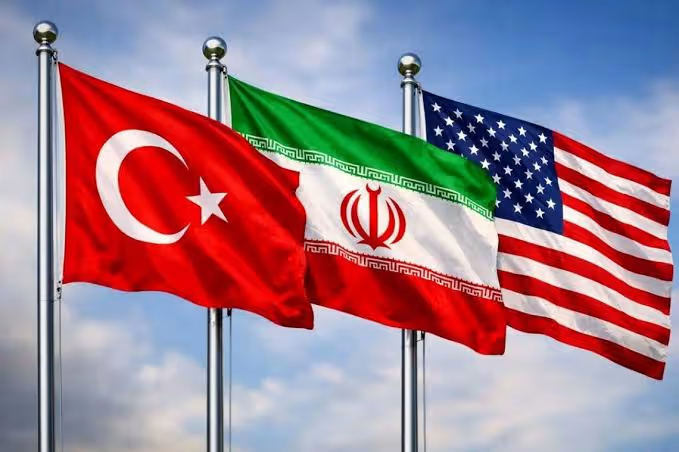
The deal reached between Washington and Tehran on June 14 validates Ankara's assessment from the early stages of the war that the Iranian regime would survive the conflict. The agreement provides Iran with substantial gains, including sanctions relief, an end to hostilities extending to Lebanon, and tacit acceptance of its ballistic missile program. The two sides also retain a 60-day window to negotiate a final settlement on the nuclear file. From Ankara's perspective, a settlement preserving the Iranian state was always more likely than the regime change pursued by Washington and Israel.
For Turkey, Washington's decision to end the war rather than sustain a campaign yielding limited results removes a key source of regional instability. In the short term, the most immediate concern is the reopening of the Strait of Hormuz, given Turkey's dependence on imported energy.
President Recep Tayyip Erdoğan described the agreement as a critical threshold in a war that had unsettled the wider region. He credited Turkey's "prudent, level-headed, and diplomacy-focused policy" throughout the conflict and noted that no Turkish citizens were harmed. Foreign Minister Hakan Fidan echoed this assessment, calling the agreement an important step toward regional stability while stressing continued vigilance ahead of formal signing. Turkish leaders also warned against potential provocations or sabotage attempts, a veiled reference to concerns over possible Israeli disruption.
Turkey's perspective on the agreement rests on several considerations: the early calculus that the Iranian regime would survive, the domestic economic costs of the conflict, the potential commercial opportunities from sanctions relief, and the implications for the regional balance of power.
Ankara's Wartime Calculus
First, Turkey's posture throughout the conflict reflected an early assessment that the Iranian state would endure. This assessment was shaped less by political alignment than by considerations in Iran's domestic balance of power. Indeed, despite sustained external pressure, Iranian state institutions, security services, and elite cohesion did not exhibit signs of collapse, confirming Ankara's early expectation of regime continuity.
This helps explain why Turkey did not align itself with the United States and Israel in adopting a more confrontational stance toward Tehran. While Ankara condemned Iranian strikes on Gulf states, it also criticized the U.S.-Israeli campaign against Iran, and President Erdoğan extended condolences to Tehran following the killing of Supreme Leader Ali Khamenei.
Turkey's Energy Bill
Second, the conflict has carried measurable economic costs for Turkey. The closure of the Strait of Hormuz has directly affected Turkey's inflation outlook, which the government has already revised upward once this year. As a major importer of oil and gas, Turkey absorbed a severe energy price shock affecting other importing economies, complicating its disinflation trajectory.
Treasury and Finance Minister Mehmet Şimşek stated that the war's direct and indirect effects had added at least five percentage points to the inflation outlook, based on prevailing oil price assumptions. "If inflation was initially going to be 21 percent," he noted, "it is now rising to 26 percent." The Central Bank of the Republic of Turkey has similarly revised its year-end forecast to 26 percent, citing geopolitical pressures.
Sanctions Relief and the Trade Dimension
Third, a durable settlement between the U.S. and Iran could open channels that extend beyond sanction relief, particularly in investment linked to energy and reconstruction. Turkish exports to Iran have been constrained by sanctions for nearly a decade, falling from $5.5 billion in 2016 to $2.74 billion in 2019, and stabilizing at just over $3 billion annually since 2022.
Exports are concentrated in machinery, plastics, food-industry residues and animal fodder, electrical equipment, and manmade staple fibers, segments that could expand if payment and logistics constraints ease. Turkish imports from Iran remain dominated by oil and natural gas. In this regard, Iran accounts for roughly 14 percent of Turkey's natural gas imports, making Iran its third-largest supplier after Russia and Azerbaijan. This flow has remained resilient despite sanctions, rising from approximately 7.04 billion cubic meters in 2024 to 8.17 billion cubic meters in 2025.
If sanctions relief proves durable, Iran's damaged infrastructure could generate additional opportunities in construction and energy rehabilitation, where Turkish firms are already positioned due to geographic proximity and established trade networks. In the energy sector, normalization could enable Turkey to effectively use the existing Turkmenistan-Iran-Turkey swap arrangement established in 2025.
A Regional Rebalancing, With Limits
Fourth, Ankara has grown increasingly concerned about Israel's expanding military footprint across the region. Over the past two years, Israeli operations have extended across Syria, Gaza, Lebanon, Yemen, Iraq, Qatar, and Iran. These strikes were viewed in Ankara with growing unease.
Israeli officials, for their part, argue that ongoing operations are driven by persistent security threats and the need to prevent hostile capabilities from consolidating across multiple theatres. This underscores a fundamental divergence in threat perception that can generate tensions in the future.
Erdoğan has framed Turkey's concerns over Israel several times, rejecting what he describes as a "Greater Israel" project and stating that Turkey's security extends to Aleppo, Damascus, and Beirut. This framing extends Turkey's security perimeter into areas where Israeli forces remain active, increasing the potential for future friction.
The agreement between the U.S. and Iran constrains Israel's operational latitude against Iran and may introduce a more bounded regional military environment, which will be welcomed by Turkey.
It is noteworthy that Iran's weakening over the past two years has provided opportunities for Turkey. Tehran's declining capacity facilitated the collapse of Bashar al-Assad's regime in Syria by Turkish-backed groups, and similarly gave Ankara more room to deepen ties with Baghdad. A settlement that leaves Iran's regime intact and better resourced raises the question of whether the two countries will compete again for influence in the region.
What Remains Unresolved
Several risks persist. More fundamentally, the agreement leaves unaddressed the structural drivers of the conflict, Iran's nuclear and missile programs and the broader regional rivalry in which they are embedded. Israeli officials have responded critically to the agreement. The negotiation period remains vulnerable to disruption attempts, consistent with recent patterns.
The durability of the agreement is also uncertain in Lebanon, where Israel's National Security Minister Itamar Ben-Gvir has said the agreement does not bind Israel, and where Israeli forces still occupy southern Lebanon. This is a point Tehran views as inconsistent with the spirit of the agreement.
With regime continuity no longer in question, Tehran may have stronger incentives to adhere to commitments than in earlier negotiation rounds. Nonetheless, the risk of renewed confrontation in the Gulf remains present. For Turkey, the value of the agreement lies less in its formal conclusion than in its durability.




.svg.avif)