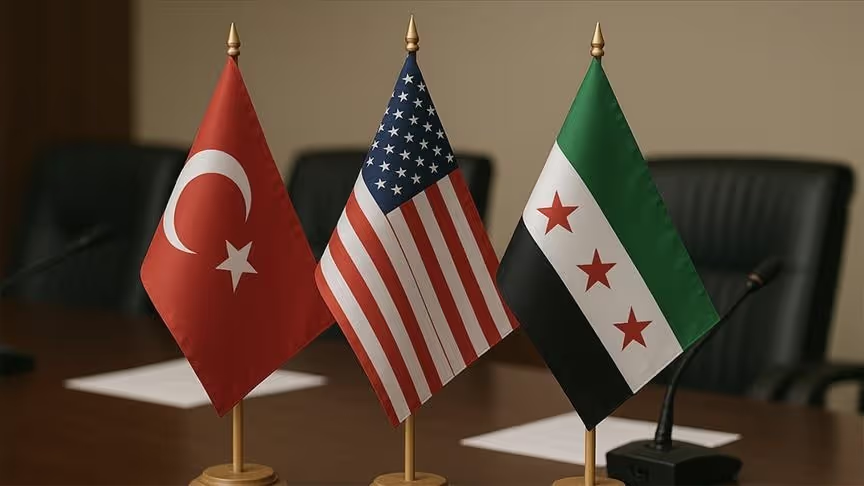
The Syrian civil war has had a major impact on relations between Turkey and the United States. Syria has created both areas of cooperation and sources of tension between the two countries. As interests and the regional balance of power shifted, the nature of the relationship also changed.
Viewed through the lens of the Syrian crisis, Turkish–American relations can be divided into three phases. In the first phase, from 2011 to 2014, relations improved around a shared objective: political change in Syria. Between 2014 and 2024, relations became increasingly strained as the two countries pursued diverging interests. Since the fall of Bashar al-Assad in December 2024, Ankara and Washington have focused on managing and resolving their disputes.
Benefits of a Shared Enemy: Assad
When the Arab Spring began, Turkish–American relations were already deteriorating, if not in open crisis.50 Ankara had experienced several diplomatic confrontations with Israel, which raised concerns in Washington and European capitals. An Israeli commando raid on a Turkish flotilla led both countries to withdraw their ambassadors. At the same time, Turkey maintained cordial relations with Hamas, which the United States designates as a terrorist organization.
Turkey’s improving ties with Middle Eastern countries (especially Iran and Syria) fueled debates51 about a possible shift in its foreign policy orientation from West to East.52 Most notably, Ankara’s vote against UN Security Council sanctions on Iran in 2010 generated deep anger and disappointment in Washington.53
The Syrian crisis, however, altered this trajectory.54 It reshaped Ankara’s interests. Before the Arab Spring, Turkey had invested in stable relations55 with existing regimes and largely acted as a status quo power.56 Following the fall of Zine el Abidine Ben Ali in Tunisia, however, Ankara began to see its interests aligned with political change rather than stability.
In Washington, the spread of popular protests and revolutionary enthusiasm revived long-standing hopes of democratizing the Middle East. President Obama called on Hosni Mubarak in Egypt, Muammar Qaddafi in Libya, and Bashar al-Assad in Syria to step aside. He also authorized a military operation against Qaddafi’s forces in Libya.
These shifts in Ankara and Washington brought their interests closer together.57 President Obama viewed Erdoğan as a key regional partner. Following his “leading from behind” approach,58 Obama expected Turkey to play a central role in shaping regional change – as a Muslim-majority country with a democratic system.59 Although rarely stated explicitly, Turkey was at times seen as a potential model for the region.
Ankara, meanwhile, needed American military power. Turkey’s political and economic influence was growing, as were its ambitions, but it lacked sufficient hard power. Moreover, Erdoğan’s control over the military (which viewed armed involvement in Syria as highly risky) was still limited. As a result, the Turkish government depended on U.S. military leadership to advance proposals such as a safe zone or a no-fly zone.
This convergence created a positive atmosphere in Ankara–Washington relations.60 Leader-to-leader diplomacy intensified during this period. Most notably, Ankara approved the establishment of a NATO radar facility on its territory, part of a system aimed at Iran. At the same time, the CIA and Turkish intelligence cooperated in training and arming Syrian opposition groups fighting against Assad.61
As Assad managed to remain in power, however, the initial momentum in Turkish–American relations began to fade. The Turkish government’s crackdown on opposition protests in 2013, followed by corruption investigations later that year, raised questions about Ankara’s democratic credentials.62 In addition, Turkey’s support for radical jihadist groups in Syria increasingly alarmed Washington.63
Ankara expected64 Washington to assume greater responsibility.65 While the Obama administration used harsh rhetoric against Assad, it offered little support on the ground. Washington avoided direct military action against the regime. The CIA did not provide shoulder-fired anti-aircraft weapons that could have helped opposition forces defend themselves against regime air attacks. Although these developments strained bilateral relations, the real turning point came in the summer of 2014.
Diverging Interests
Radical groups operating in Syria had concerned the United States since 2012. Although Washington took some limited steps, these concerns did not lead to a major policy shift for some time. The fall of Mosul to ISIS fighters in June 2014, followed by the killing of American citizens, however, alarmed the Obama administration. Until then, the United States had been only partially committed to removing Assad. From June 2014 onward, defeating ISIS became Obama’s primary policy objective.66 This shift inevitably led to a divergence of interests with Ankara.
The Turkish government initially believed it could benefit67 from Washington’s growing urgency over ISIS. The United States needed a reliable partner on the ground, and Ankara assumed that its NATO ally would naturally fill this role. Turkey, however, demanded a broader strategy: the target should be not only ISIS but also what it saw as the root cause of the conflict—the Assad regime.
When Obama rejected this bargain, Erdoğan chose to drag his feet.68 He believed Turkey held strong leverage. The United States needed Turkish cooperation in the fight against ISIS, and the Incirlik air base was the closest major facility for air operations.69 Ankara, however, overplayed its hand. The Obama administration instead turned to another ground partner: the YPG, a Kurdish group affiliated with the Kurdistan Workers’ Party (PKK), which had been fighting the Turkish state for decades.70
The U.S.–YPG partnership caused deep anger and disappointment in Ankara.71 Although Turkey increased its own involvement in the fight against ISIS, this did not reverse Washington’s policy. U.S. forces armed, trained, equipped, and protected YPG fighters operating along Turkey’s border.
At the same time, Turkish–American relations faced additional crises, including the 2016 coup attempt in Turkey, the detention of an American pastor, and Ankara’s purchase of Russian air defense systems. President Trump’s “don’t be stupid” letter marked a low point in the relationship. By then, the idea of a strategic partnership had largely collapsed. What remained was a narrow, transactional relationship.
Despite these tensions, Ankara and Washington gradually learned to manage their disagreements.72 U.S. officials sought to reassure Turkey by describing cooperation with the YPG as temporary and non-political. Under the Biden administration, leader-to-leader diplomacy weakened, but institutional channels improved. Still, the decisive shift in the relationship came only in December 2024.
Turkey’s Unexpected Victory
The fall of the Assad regime once again reshaped Turkish–American relations in Syria. For years, Ankara carved out areas of control in northern Syria. Its influence, however, depended on the rivalry between the United States and Russia. By playing these two powers against each other, Turkey sought to expand its room for maneuver. Even so, its influence remained limited and conditional. Assad’s forces and the U.S.-backed Syrian Democratic Forces (SDF), led by the YPG, blocked Turkish advances to the west and east. Assad’s fall altered this balance by turning Turkey into the main external patron of the new Syrian regime. Under these new conditions, Washington and Ankara are likely to seek ways to manage and overcome their differences.
Turkey wants the new Syrian government, led by Ahmad al-Sharaa, to establish full control over the country. Ankara believes its interests align closely with al-Sharaa. There are significant opportunities for cooperation between Turkey and the new regime. Syria will need large-scale reconstruction, and Turkey is well positioned to play a major role in this process.
A strong, centralized Syrian state would also eliminate the possibility of a Kurdish statelet in northeastern Syria. For this reason, Ankara strongly supports the new regime’s efforts to assert authority over the entire country.
The United States has also established working relations with al-Sharaa’s government. Although doubts remain in Washington, al-Sharaa offers several advantages. First, he promises stability and a political reset. For fourteen years, Syria has been a source of conflict, terrorism, and displacement. If al-Sharaa succeeds in restoring order, this could help reduce regional tensions.
Second, al-Sharaa is well positioned to fight ISIS and contain other Islamist groups. Given his al-Qaeda background, his Islamist credentials are difficult to challenge. He founded Jabhat al-Nusra as al-Qaeda’s Syrian affiliate and survived the brutal conditions of the civil war. ISIS partly emerged from this organizational environment, and al-Sharaa later fought ISIS and rival Islamist groups for territorial control. After nearly fourteen years of conflict, he emerged victorious and entered Damascus. Few actors in Syria are better placed to combat ISIS and discipline other armed Islamist factions.
Al-Sharaa has also sought to present himself as a statesman. He appears open to compromise and political adaptation. Most strikingly, he has shown willingness to explore an agreement with Israel—an extraordinary step for a former al-Qaeda figure.
Syria has never been a top priority for the United States. President Trump appears particularly reluctant to become deeply involved in Middle Eastern conflicts. As long as Syria under al-Sharaa does not generate new crises, Washington is unlikely to care deeply about who governs from Damascus. After all, the United States withdrew from Afghanistan and left the Taliban in power only a few years ago.
So indeed, between its former ally Mazlum Abdi’s SDF and its long-standing adversary Ahmad al-Sharaa, Washington appeared to side with the latter during the clashes in January 2026. Backed by Ankara, Damascus suspended U.S.-led mediation talks with the SDF and launched military operations that resulted in the Syrian government gaining control over most of northern Syria.73 When a new ceasefire entered into force on February 2, the Syrian map had changed significantly. The Arab components of the SDF shifted their allegiance to Damascus, leaving the PKK-affiliated YPG increasingly isolated.
Beyond diplomatic contacts and efforts to facilitate a ceasefire, the United States did not take any military steps to protect its Kurdish partners.74 Isolated in a hostile regional environment, the YPG was ultimately compelled to accept Damascus’s full sovereignty and its integration into the Syrian military.
The new agreement, however, does not outline a clear pathway for the YPG’s integration into the new political order.75 The ambiguity of its language and the existing balance of power provide Damascus with a wide range of options, while leaving the YPG with limited leverage. As a result, the implementation of the agreement may not lead to meaningful integration in practice.
Nevertheless, regardless of how the agreement is implemented, Syria has shifted from an arena of conflict to one of cooperation between Turkey and the United States. Trump, who tends to view international politics as a division of spheres of influence among powerful actors, appears to see Syria as falling76 within Erdoğan’s domain.77 Although his interest in Syria has never been strong, he views Erdoğan as a partner with whom he can cooperate if necessary.
From Ankara’s perspective, Trump also represents a key partner in efforts to restrain Israel. Israel’s contacts with Damascus have so far produced a relatively constructive atmosphere of dialogue and compromise. Yet the highly volatile dynamics of the region could revive earlier hostilities. In such a scenario, Ankara would once again rely on Trump, given his influence over Tel Aviv.
The Syrian civil war has transformed Turkish–American relations from a brief period of strategic convergence into a long phase of tension, followed by a cautious form of cooperation. Initial alignment around regime change gave way to deep disagreements over priorities, partners, and methods, particularly after the rise of ISIS and the U.S. partnership with the YPG. The fall of the Assad regime in late 2024 marked a new turning point by reshaping the balance of power on the ground and redefining the interests of both Ankara and Washington. While fundamental differences remain, especially regarding governance and long-term regional stability, Syria has ceased to be a primary source of confrontation. Instead, it has become an area where Turkey and the United States pragmatically manage their interests, reflecting a broader shift from strategic partnership to transactional cooperation.
*This article was firstly published in our report entitled 'Turkey's Vision For a New Syria'.




.svg.avif)