In August 1914, Germany executed the Schlieffen Plan with a clear strategic logic: swiftly defeating France on the Western Front and turning east to confront Russia. The plan was based on tempo, sequence, and the assumption that one front could be neutralized before Russia could fully mobilize. However, the plan was unsuccessful—not simply due to tactical mistakes, but because its fundamental assumptions collapsed under the weight of reality: France did not collapse quickly, leaving Germany to fight a two-front war against France in the west and Russia in the east. What was meant to be a war-winning maneuver became a strategic trap. More than a century later, the logic of the Schlieffen Plan is reemerging—not in Europe, but in East Asia.
Today, the United States and its allies in East Asia often implicitly assume that a Taiwan contingency could be managed as the primary theater, while the Korean Peninsula could be dealt with as a secondary matter. This assumption, however, is increasingly difficult to sustain. If a dual contingency—China attempting an invasion of Taiwan while North Korea escalates tensions by exploiting the situation at the same time—materializes, the United States, Japan, and South Korea would face a contemporary equivalent of the Schlieffen dilemma: two simultaneous theaters that could shape each other’s outcomes.
A wargame conducted by the Center for Strategic and International Studies (CSIS) illustrate the seriousness of the challenge. In most scenarios run by CSIS, the United States, Japan, and Taiwan successfully repel China’s amphibious assault. Nonetheless, victory comes at a staggering price: dozens of naval vessels are sunk, hundreds of aircraft are destroyed, and tens of thousands of casualties are suffered. Taiwan’s economy is devastated, while U.S. global military credibility is notably weakened. Other wargames conducted by the Pentagon and various think tanks — including RAND, and CNAS — suggest that the United States, Japan, and Taiwan struggle to stop a Chinese amphibious assault, with several simulations resulting in outright U.S. defeat and most others producing only pyrrhic victories.
Another lesson from the Schlieffen Plan in particular, and from the First World War more broadly, is that wars seldom unfold according to plan and often last far longer than either military planners or the public initially expect. There is little reason to assume that a future war in the Pacific would produce a swift outcome. Despite the vast disparity in military capabilities between the United States and Iran, the latest conflict in the Gulf has continued for more than two months. A conflict with China would be far more destructive, consume tremendous amounts of ammunition in a prolonged war of attrition, and carry a significant risk of spillover into other theaters.
Here, the Schlieffen analogy has its most relevant implication. The biggest risk is not just defeat, but a limited victory achieved through excessive depletion of resources in one theater that could leave the broader strategic position dangerously exposed.
The Structural Risk of Sequential Thinking
The Schlieffen Plan failed because it relied on a rigid sequence: first France, then Russia. In East Asia, a similar logic would suggest managing Taiwan first and then the Korean Peninsula. However, as several wargames on the war in the Pacific demonstrate, a Taiwan conflict would immediately consume an enormous amount of U.S. resources—including naval, air, logistical, and political assets. Aircraft losses would be especially severe on the ground, while naval assets, including high-end surface vessels, would also experience significant attrition. Long-range strike capabilities would be rapidly depleted as well.
Under such circumstances, it is questionable whether the United States could subsequently transfer sufficient forces to deter or respond to North Korean provocations.
To exploit the opportunity, North Korea does not even need to initiate an all-out war. Limited activities—including missile tests, artillery demonstrations, cyberattacks, and naval provocations—would be sufficient to divert allied resources, create political uncertainty, and undermine deterrence. The objective is disruption rather than conquest—forcing Washington to divide its attention and complicating allied decision-making at the decisive moment.
This is the modern version of the Schlieffen trap. A strategy designed to manage one major conflict creates vulnerabilities that invite opportunism in a different theater.
Lessons for the United States
The most urgent task for Washington is to abandon sequential war planning. Taiwan and the Korean Peninsula should be treated as an integrated operational issue.
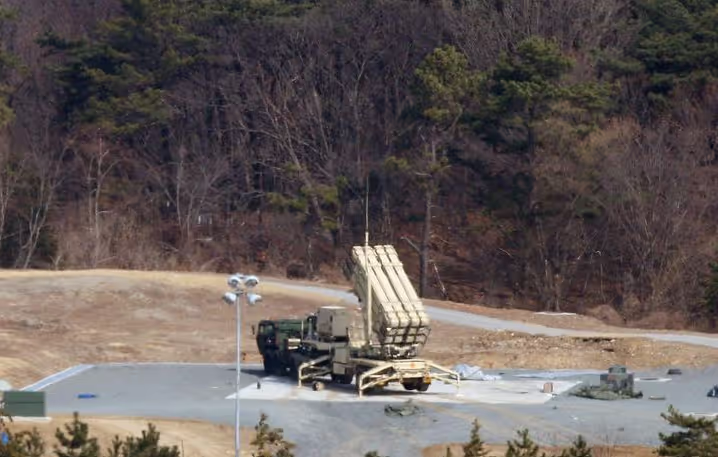
First, in the initial stages of a Taiwan conflict, certain United States Forces Korea (USFK) assets should be designated as non-transferable from the outset. Missile defense systems, counter-battery systems, intelligence assets, and command-and-control infrastructure should be preserved in order to prevent deterrence on the Korean Peninsula from collapsing.
Second, the United States should expand its long-range anti-ship missile inventory and bomber-based strike capabilities. The CSIS wargame demonstrates that swift and massive strikes are imperative to repel China’s amphibious forces. However, such capabilities remain somewhat limited and could be rapidly depleted in high-intensity warfare. In that sense, munitions stockpiles at UNC-Rear bases should be substantially increased.
Third, strengthening base survivability should become a priority. Although U.S. Air Force operations in Japan are necessary, they are also highly vulnerable. Runway hardening, distributed aircraft deployment, stockpiling of repair equipment, and investment in passive defense systems are no longer optional but necessary.
Lastly, the United States should structure an ammunition stockpiling system prepared for a dual contingency and ensure that resource allocation to Taiwan would not weaken the overall preparedness for the Korean Peninsula.
Japan as the Linchpin
Although Japan’s role is already well known, its importance would further increase under a dual contingency scenario. Without access to U.S. bases in Japan, effective air operations over Taiwanese airspace would be nearly impossible. At the same time, Japan would also serve as a rear-area base in a Korean contingency in accordance with OPLAN 5055.
Therefore, Japan should prepare for simultaneous demands. This includes pre-authorizing U.S. use of bases under clear crisis conditions, making large-scale investments in base reinforcement and dispersal, and expanding anti-submarine warfare and maritime security capabilities.
Integrating planning for Taiwan and the Korean Peninsula is also essential. Japan cannot treat these as separate crises. Safeguarding maritime routes, logistics, and rear-area support should be designed to operate under simultaneous Chinese and North Korean pressure.
South Korea’s Adjustment
For South Korea, the implications are especially significant. U.S. reinforcement could be delayed, reduced, or redirected. Therefore, Seoul should be prepared to manage the early stages of a crisis with a greater degree of strategic autonomy.
This does not imply unilateral action. Instead, it means robust independent deterrence. Strengthening counter-artillery capabilities, reinforcing missile defense, enhancing ISR networks, and expanding precision-strike capabilities are all necessary.
At the same time, South Korea should institutionalize consultations with the United States regarding the possibility of the redeployment of USFK assets. The goal would not be to prevent such redeployment, but to ensure that it would not create vulnerabilities.
Even if it does not directly engage in combat, South Korea can play a meaningful supporting role during a Taiwan contingency. Sea lines of communication (SLOC) protection, contributions to ammunition production, and support for U.S. logistics could all strengthen the overall allied position.
Toward a Trilateral Solution
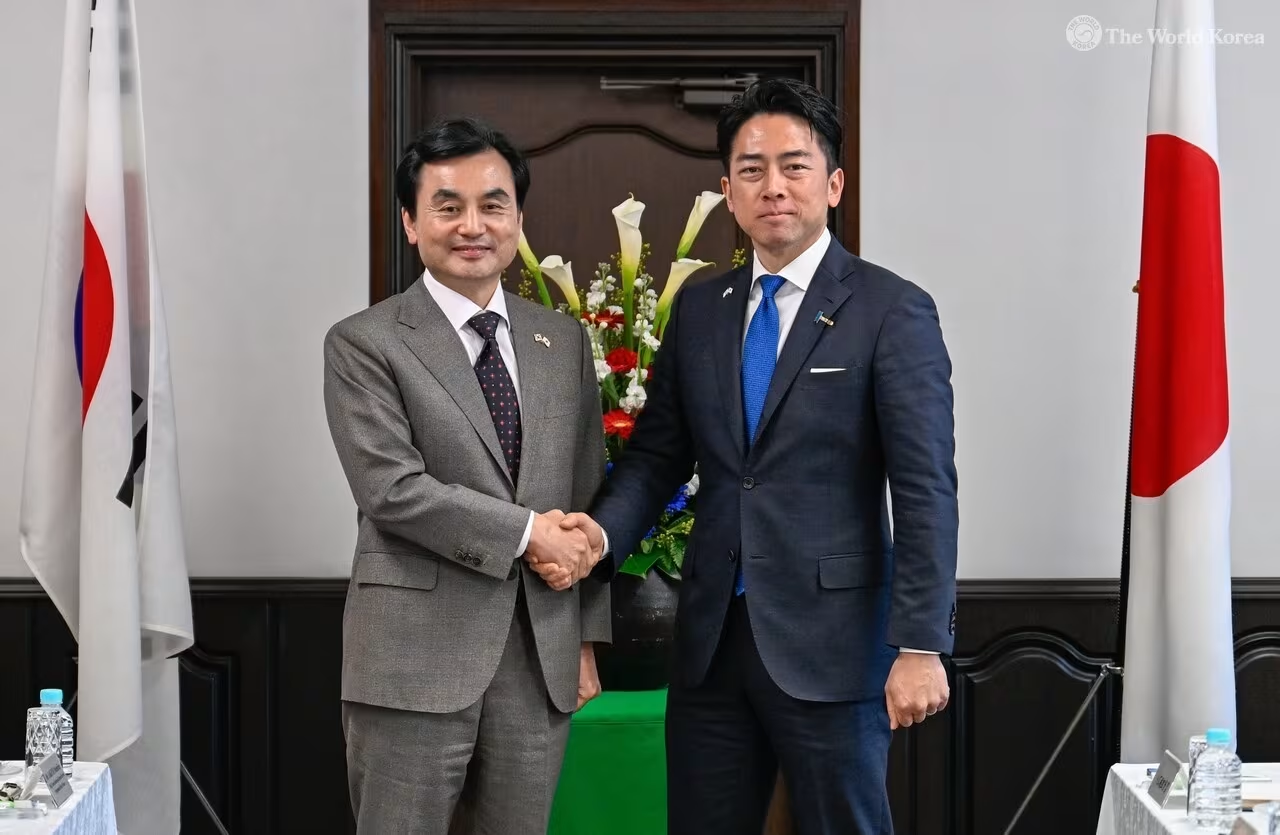
Ultimately, the dual contingency challenge cannot be solved by a single country. A coordinated response by the United States, Japan, and South Korea is required.
An integrated operational concept should be developed by establishing a trilateral dual contingency planning group. Through regular joint exercises, dual contingency scenarios involving Taiwan and the Korean Peninsula should be tested. Meanwhile, defense industrial cooperation should center on munitions production and the capacity to sustain prolonged, high-intensity operations. Japan’s recent decision to relax restrictions on its arms exports should be coordinated with South Korea’s arms exports, allowing the two countries to create a division of labor, rather than compete with one another.
Perhaps most importantly, a common understanding of political signaling must be developed. During a crisis, ambiguity can be as dangerous as material weakness. A clear and coordinated message would be indispensable to deter North Korea’s opportunistic provocations while maintaining focus on the Taiwan Strait.
Avoiding the Schlieffen Trap
The Schlieffen Plan was unsuccessful because it underestimated complexity. It assumed that war could be managed sequentially, expected opponents to act as predicted, and believed that tempo could compensate for structural weakness. Nonetheless, reality proved otherwise.
A similar risk exists in the contemporary era. A Taiwan contingency is unlikely to occur in isolation. Instead, it may unfold within a broader strategic environment involving multiple actors, overlapping crises, and competing priorities. The Korean Peninsula could also become engulfed in the conflict, as Pyongyang might seek to exploit the broader regional crisis.
The lesson for the United States, Japan, and South Korea is clear: they should not treat a single-theater, swiftly concluded war as the default scenario, but should instead develop plans that account for the possibility of a wider and more prolonged conflict.




.svg.avif)