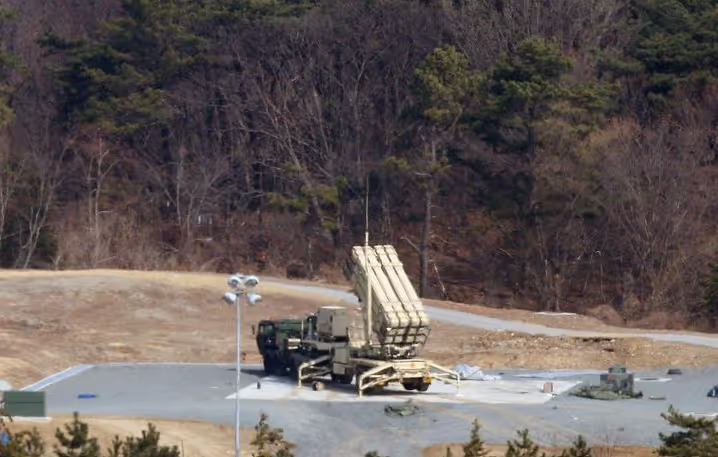
The redeployment of U.S. missile defense assets, including Terminal High Altitude Area Defense (THAAD) batteries and Patriot systems from South Korea to the Middle East has triggered understandable concern in Seoul. While the media reports that the South Korean government acknowledged that Washington has shifted some air defense assets, President Lee Jae-myung asserted that such measures would not undermine deterrence against North Korea. Although it is still uncertain precisely which THAAD components are being transferred and for how long, even partial redeployment has significant implications since THAAD is not merely another interceptor. THAAD comprises the upper tier of the U.S. ballistic missile defense system, and its value lies in both military function and political signaling.
The immediate question is whether this would create a major security vacuum. The answer is: not a collapse, but a meaningful degradation. Partial hollowing out of the THAAD system would not make South Korea defenseless. It retains one of the most advanced conventional military powers in the region and operates its own Patriot units, M-SAM II (Cheongung-II), Aegis-equipped destroyers, and a broader Korean Air and Missile Defense (KAMD) architecture. Some argue that South Korea’s Patriot and M-SAM II systems could partially compensate for the withdrawn U.S. Patriot units. Nevertheless, “partially” is the key word. THAAD operates at different engagement altitudes than Patriot and M-SAM II, offering the capability to intercept ballistic missiles in the upper tier over a broad defense area. According to publicly available technological descriptions, THAAD is designed to intercept ballistic missiles at ranges of roughly 150 to 200 kilometers, at a much higher altitude than the Patriot systems. This means that even a partial loss would reduce engagement depth, a narrower tactical margin for shoot-look-shoot, and increased burden on lower-tier defense systems.
This issue is becoming increasingly important as North Korea’s threat continues to evolve. North Korea has been continuously emphasizing its nuclear delivery systems and publicly touted its hypersonic missile test in January 2026. Although experts are still cautiously evaluating the technological maturity of hypersonic missiles, the operational problem for the defender is real. A maneuvering reentry vehicle paired with an unpredictable flight trajectory compresses reaction time and complicates intercept geometry. At the same time, North Korea is expanding its defense cooperation with Russia and becoming familiar with modern drone tactics thanks to the experience gained in Ukraine. Simply put, North Korea is incrementally learning about reconnaissance drones, attack drones, and counter-drone tactics.
The combination of such elements is the reason why the current missile deployment cannot be simply dismissed as a symbolic controversy. The task for South Korean air defense is no longer confined to salvo launches of traditional Scud- or Nodong-style ballistic missiles. It is increasingly turning into a mixed-salvo problem: ballistic missiles, cruise missiles, low-cost drones, and decoys arriving together. Under such circumstances, partial reduction of upper-tier defense does not simply mean fewer interceptors. Rather, it indicates that North Korea could saturate the South Korean defense system, force expensive interception decisions, and create greater opportunities to exploit the gap between upper- and lower-tier defense. The Russo–Ukrainian war has showcased that the massive deployment of relatively inexpensive drones could notably pressure even sophisticated air-defense systems, while the recent conflict in the Middle East has renewed concern about the stockpile depletion of missile defense interceptors. That broader concept illustrates well why the United States is moving finite defense systems across multiple theaters.
To be sure, the security vacuum should not be exaggerated. South Korea’s own alternatives do exist. First, as noted earlier, South Korea already operates the Patriot and M-SAM II systems that could strengthen point and mid-tier defense for critical military facilities, populated areas, and air bases. M-SAM II’s recent combat use in the UAE against Iranian attacks has reinforced confidence that this system has demonstrated its operational value. Second, Seoul has completed the development and production authorization of L-SAM—an upper-tier defense interceptor system—which is expected to be deployed within the next few years, albeit not enough immediately to solve the short-term security vacuum of 2026. Third, South Korean Aegis destroyers and air assets contribute to missile alert and tracking capabilities, more so when aligned with U.S. and Japanese systems. In other words, South Korea could absorb the impact to some extent. Nonetheless, at least in the short term—especially if redeployment is prolonged—it could not fully replace the upper-tier defense capability that the U.S. THAAD batteries offer.
Therefore, policy recommendations should be based on gap management instead of complacency.
As for the United States, any redeployment of THAAD and Patriot should be explicitly announced as temporary, described as a backfilled deployment, while avoiding presenting the event as an indefinite reduction within the context of the Indo-Pacific force posture. Washington should publicly clarify the scope and duration of redeployment as much as operational security permits, while accelerating the resupply of interceptor missiles and prioritizing alternative security capabilities for South Korean defense. Second, if THAAD elements are vacant for a long period of time, other sensors and missile defense enablers should be rotationally deployed. Third, it should aggressively use the existing trilateral real-time DPRK missile-warning data-sharing mechanism—operated since late 2023 and reconfirmed by a number of trilateral joint statements—with Japan and South Korea, not as a diplomatic talking point but as an operational hedge that complements the thinning out of the missile defense posture.
For South Korea, reinforcing and accelerating the buildup of its indigenous multilayered defense architecture is the priority task. Seoul needs to rapidly proceed with fielding L-SAM, acknowledging it as an urgent operational requirement rather than a long-term prestige program. In addition, M-SAM II deployment for key bases should be expanded, reload capability and stockpile depth enhanced, and investment increased in low-cost counter-drone systems, electronic warfare, and directed-energy options. While maintaining investments in upper-tier defense is necessary against the hypersonic threat, affordability and mass are required for threats originating from drones. Meanwhile, South Korea needs a clearer defense doctrine against mixed-salvo attacks that combines missile defense, dispersion, electronic warfare, camouflage, and swift runway repair. Last but not least, Seoul should strengthen offensive counterforce options vis-à-vis North Korean TELs, drone launch sites, and command nodes, since active defense alone could exponentially increase the cost.
In the case of Japan, the major contribution would be reducing the hollowing out of regional sensors and warning capabilities, instead of “directly” protecting South Korea, which could be politically sensitive. Japan already operates substantial Aegis anti-ballistic missile defense capabilities—specifically eight Aegis destroyers with ballistic missile defense capabilities. Tokyo should reinforce trilateral ISR, tracking, and missile alert cooperation, expand joint exercises that postulate simultaneous missile-and-drone attacks, and strive to integrate its maritime-based BMD assets into the Northeast Asian early warning architecture. Japan’s role is crucial since a future contingency on the Korean Peninsula would very likely unfold as part of a wider regional crisis, not in isolation.
The most important lesson lies not in the fate of missile batteries in Seongju, but in the broader structural realities. The United States is faced with a situation that necessitates distributing finite high-end air and missile defense assets across multiple theaters simultaneously. South Korea might be able to withstand a partial and temporary withdrawal of THAAD batteries. Nevertheless, if Washington, Tokyo, and Seoul fail to build a dense, interoperable multilayered defense system, the real problem would not be this week’s redeployment; it would instead be the next crisis on the Korean Peninsula. In a future contingency, North Korea might test a more complex mixed-salvo attack using missiles and drones at the exact moment the United States’ resources are once again stretched elsewhere.




.svg.avif)