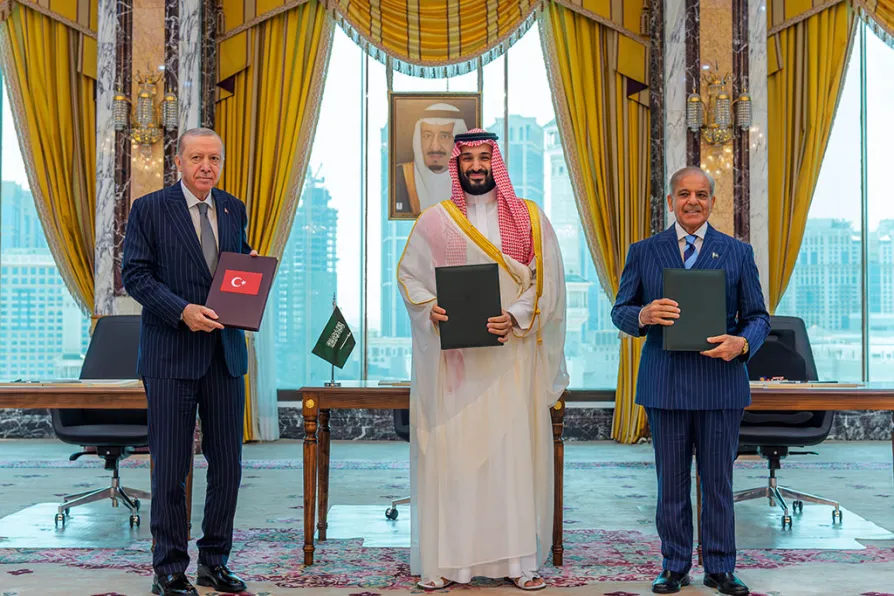
The leaders of Turkey, Saudi Arabia and Pakistan signed the Mecca Joint Defense Agreement on August 7, declaring that an armed attack on any one of the three countries would be treated as an attack on all. The agreement is open to other countries, with Egypt and Qatar among the states that could potentially join. The language immediately invited comparisons with NATO, prompting a wave of commentary about the emergence of a "Muslim NATO" and the beginning of a new regional order less dependent on Washington.
That interpretation is understandable, but it gives the agreement more weight than it can currently bear. The Mecca agreement should be better understood as a political signal than as a military alliance. Its immediate purpose appears to be deterrence, particularly a warning to Tehran against further escalation, rather than a commitment by Turkey, Saudi Arabia and Pakistan to fight a common war. The agreement may eventually have consequences for regional security, but it is unlikely to become the collective-defense mechanism that its most enthusiastic interpreters imagine.
Three countries, no common enemy
The first problem is the absence of a common enemy. Alliances endure because their members share a common understanding of the threats they face. The Soviet threat was the glue that held NATO together during the Cold War. When that threat disappeared after the Cold War, NATO entered an identity crisis. Russia's invasion of Ukraine in 2022 eventually helped it regain its raison d'être.
The three signatories of the Mecca agreement have no equivalent common existential threat. They have their enemies, but their enemies are different. The agreement therefore brings together states that cooperate in some areas without sharing the kind of threat perception that normally sustains a military alliance.
Neither Turkey’s Erdoğan nor Pakistan’s Sharif regards Iran as an enemy. Ankara in particular has maintained a working relationship with Tehran despite their rivalry. Turkey and Iran have learned to manage their competition across Syria, Iraq and the South Caucasus rather than allowing it to turn into confrontation. Turkey, having calculated early in the current war that the Iranian regime would survive the blows it was taking, adopted a conciliatory posture toward Tehran almost from the outset.
That does not mean Ankara is comfortable with Iranian conduct. Turkey has strongly condemned attacks on the Gulf states and, above all, the closure of the Strait of Hormuz, which threatens to raise an energy import bill that is already high. But opposition to Iranian policies is not the same thing as treating Iran as an enemy.
The same problem appears elsewhere in the triangle. Turkey and Saudi Arabia both lean toward Pakistan, but neither has any real hostility toward India. Nor are the three countries prepared to fight Israel, despite their lack of sympathy for Tel Aviv.
Not a defense treaty, but a declaration
There is also a more basic problem. The Mecca agreement is not a fully-fledged defense treaty. NATO's Article 5 provides the famous principle that an attack on one member is considered an attack on all. Erdoğan himself has drawn the comparison directly, saying that "what NATO's Article 5 contains applies in a similar way to the concept of mutual defense established here," so that if an attack occurs against any one of the three, "the three countries will be able to defend one another against any kind of attack." Yet analysts were right to wait for the actual text before assessing what the three governments had committed themselves to. The Pakistani ambassador to Turkey, Yusuf Junaid, has since said that there is no separate agreement beyond the one-page declaration already made public.
If the declaration is indeed the complete instrument, its significance appears to be primarily symbolic. Legally speaking, it is closer to a goodwill declaration issued after a high-level meeting than to the kind of institutionalized collective-defense arrangement represented by NATO. In other words, it is an expression of intent rather than a well-established mechanism that would compel any of the three governments to go to war.
The problem of will
That brings us to the most important weakness of the agreement: none of its signatories is eager to fight. For now, Saudi Arabia is likelier to ignore the attacks than to initiate a devastating war. Even as Iranian attacks hit critical energy infrastructure and threaten the economic model on which the Gulf depends, Riyadh and its neighbors have remained reluctant to escalate to the point of no return. Their evident preference is to wait for the storm to pass rather than enter a war whose consequences would be difficult to control.
If Saudi Arabia itself has no intention of fighting, it is difficult to see why Pakistan or Turkey would volunteer to fight on its behalf. The problem, therefore, is not simply military capability. Governments that can plausibly avoid being dragged into a devastating war have little incentive to enter one. No declaration signed in Mecca changes that.
What the agreement is really about
If the agreement is unlikely to function as a NATO-style alliance, what is it for? Several American commentators have interpreted the agreement as evidence of declining confidence in Washington. Former Secretary of State Antony Blinken warned that when America becomes unreliable, its allies hedge, adapt and look elsewhere. Steven Cook similarly argued that the agreement's significance lies less in its military weight than in what it says about Saudi Arabia's growing desire for partners and a regional order in which Washington no longer sets all the terms. Fareed Zakaria has likewise argued that the loss of American credibility is pushing US allies to seek alternatives.
Yet this reading may capture the motives of only one of the three signatories. Anxiety about Washington may explain Saudi behavior well, but it explains the other two poorly. For Saudi Arabia, the agreement may function as a hedge against an unreliable Washington. Riyadh has long depended on the American security umbrella, has no comparable alternative, and has watched that umbrella become less reliable.
Whatever draws Ankara and Islamabad to the agreement, however, is not a search for protection against a fading United States. Pakistan is a nuclear-armed state whose ultimate security rests on its own deterrent rather than on any external guarantee. Turkey is a NATO member, already covered by the strongest collective-defense guarantee in the world.
That hedging interpretation also overlooks an important fact. Over the past six months, the United States has been the only power actually willing to put itself on the line in defense of the Gulf. Surely, Washington's decision to defend its Gulf allies cannot be separated from the fact that the war itself owed a great deal to an American strategic miscalculation.
It is worth mentioning that other states had also pledged to respond to an attack on the Gulf using much the same language now being celebrated in Mecca. Pakistan signed a mutual-defense agreement with Saudi Arabia in 2025. Yet when Iranian attacks came, the agreement did little of substance. The Gulf Cooperation Council has also had a collective-defense agreement, which stipulates in its Article 2 that “Member States consider that any attack on any of them is an attack on all of them and any threat to one of them is a threat to all of them.” When the crisis came, it was only Washington that provided the hard security guarantee. This is why the Mecca agreement should not be mistaken for evidence that the United States has already been displaced as the region's indispensable security provider.
The agreement also has the blessing of the Trump administration, which, among other things, does not regard it as an American failure. Trump posted on his Truth Social account that "Very happy to see that Saudi Arabia, Türkiye, and Pakistan have recently, and finally, signed the Mecca Joint Defence Agreement. It shows how the Middle East is coming together, and how Countries will finally be able to defend themselves in a more meaningful way. Congratulations to the Great Leadership of the three Nations mentioned. THIS IS A BIG, BOLD, AND IMPORTANT FIRST STEP — WOW!"
Hedging against American Disengagement
The pundits do, nonetheless, have a point. The security environment may change fundamentally if the US withdraws from the Gulf. An eventual deal with Iran could accelerate American disengagement from the Middle East. Washington has already withdrawn forces from Syria and is about to complete its withdrawal from Iraq, while there is now open discussion of reducing or ending the US military presence in other Gulf states such as Kuwait and Bahrain.
If that trend continues, Saudi Arabia would then have a much stronger incentive to build relationships with other powers and to develop regional mechanisms that could eventually compensate, at least partially, for the reduced American presence.
That may explain why Riyadh is willing to invest in arrangements that are currently more symbolic than operational. A symbolic commitment today can become a more substantial security relationship tomorrow. Defense-industrial cooperation, intelligence sharing, joint exercises and eventually joint operations could give the Mecca arrangement greater substance over time.
Goodwill, not a shield
Turkey, Saudi Arabia and Pakistan have an interest in appearing united. The Mecca agreement tells Iran that the three countries are prepared to stand together, while leaving enough room for each government to maneuver.
That does not make the agreement meaningless. It is likely to encourage closer defense-industrial cooperation, greater security coordination and perhaps, over time, joint operations in the Red Sea alongside other willing states.
The Mecca agreement is also politically useful precisely because it allows three states with different strategic interests to signal unity without creating a mechanism that forces them into a war. Its importance could increase if American disengagement leaves a growing security vacuum.
For now, the United States remains indispensable for the Gulf countries. If that changes, the symbolic commitments being assembled today may become much more consequential. Until then, the Mecca agreement should be better understood as an expression of goodwill than as a shield.




.svg.avif)