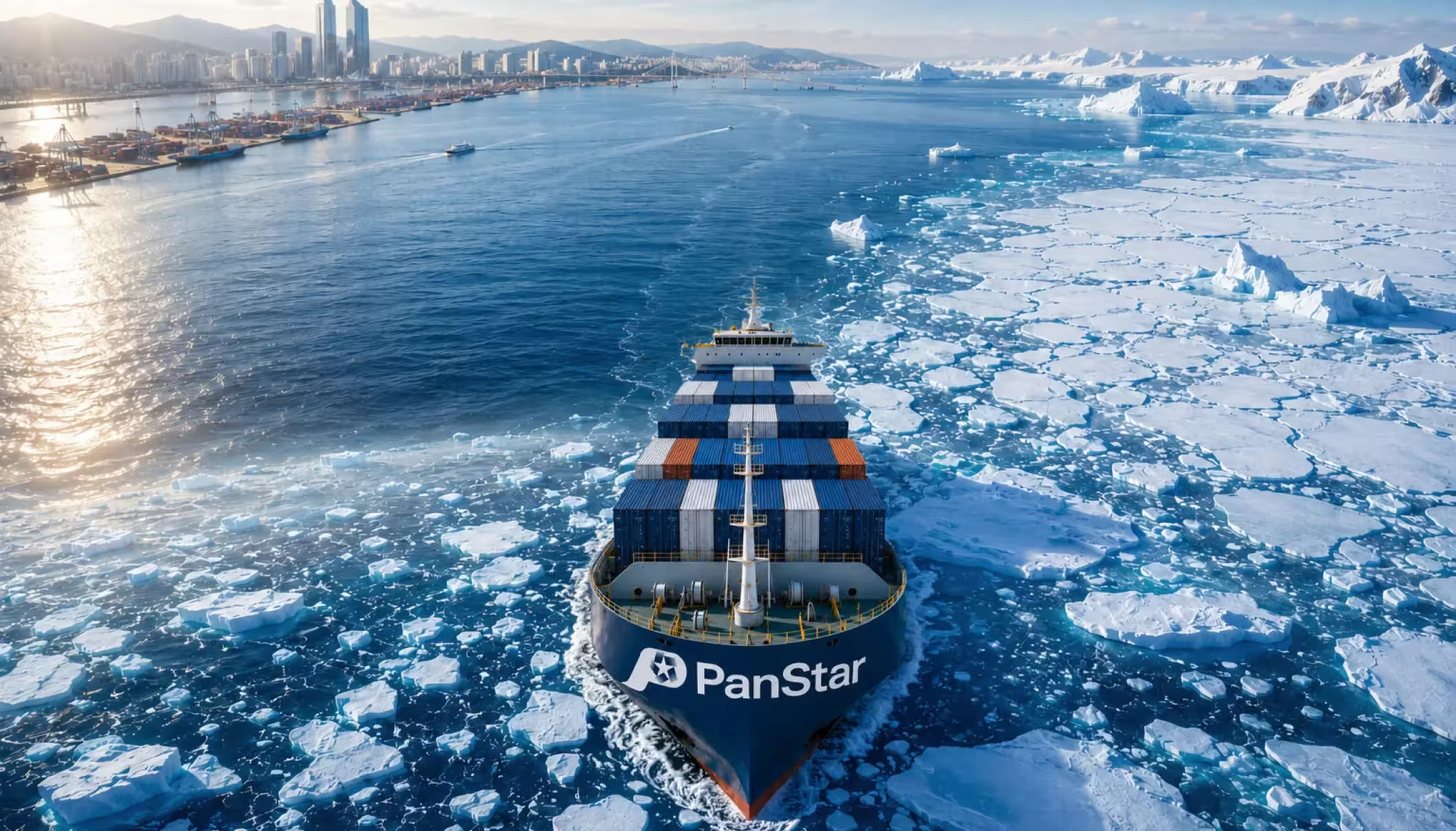
South Korea’s first trial container voyage via the Arctic route should not be viewed simply as an experiment for faster shipping. Its genuine implication hinges on a more difficult question: how could South Korea, one of the most trade-dependent countries in the world, minimize exposure to maritime disruption without creating new geopolitical vulnerabilities?
On August 22, PanStar Acro set sail from Busan to Europe via the Northern Sea Route (NSR), with scheduled calls at Felixstowe, Rotterdam, and Gdansk. This voyage comes as conflicts in the Middle East are disrupting existing maritime routes while operators are forced to reconsider their dependence on the Suez Canal and surrounding waterways.
The attraction is obvious. Compared to the existing Suez Canal route, the NSR—which spans Northeast Asia and Europe—reduces the distance by several thousand kilometers, and even more—more than twice the NSR distance—if compared with a diversion around the Cape of Good Hope.
Nonetheless, the strategic value of the Arctic for South Korea is not that it could replace Suez. Rather, it is that it could offer an additional option when traditional routes are less reliable.
South Korea’s Maritime Vulnerability
South Korea is disproportionately exposed to external maritime shocks. Its economy is heavily dependent on energy imports through the sea, manufacturing exports, intermediate goods moving through global supply chains, and uninterrupted accessibility to European and Middle Eastern markets. Needless to say, this means that instability in a faraway place could rapidly influence South Korean industry.
The recent Iran War demonstrates the problem well. Disruption around the Red Sea, Bab el-Mandeb, Suez Canal, and Strait of Hormuz could increase shipping distances, insurance costs, and delivery times. If ships are forced to take a detour through the Cape of Good Hope, even companies whose cargoes never enter the Middle East could suffer due to tight vessel availability and higher transportation costs. South Korea should therefore think more in terms of structuring redundancy and less in terms of searching for a new ideal shipping route. In that sense, the NSR could become one component of that system.
The economic viability should not solely be evaluated by whether it is cheaper than Suez under normal situations. A more relevant comparison is whether Arctic shipping becomes competitive when Suez is disrupted and vessels must sail around South Africa. Some routes could be strategically valuable even if they are only used during crises.
The Russian Dependency Problem
The biggest weakness of the NSR is geopolitical. A substantial part of the route runs along Russia’s coastline and depends on Russia’s regulations, shipping services, weather information, port infrastructure, and potentially icebreaker assistance.
This creates an uncomfortable contradiction. While reducing dependence on unstable Middle Eastern waterways, South Korea may heighten reliance on infrastructure that is under the control of Russia, which has reinforced its military relationship with North Korea.
Sanctions problems are equally important. Even relatively small payments for navigation, port services, insurance contracts, or Russian subcontractors could generate legal and political complexities for South Korean shipping companies that operate between European and South Korean ports. Hence, Seoul should establish a standing Arctic sanctions review mechanism before regular commercial shipping begins.
The Ministry of Oceans and Fisheries, Ministry of Foreign Affairs, Ministry of Economy and Finance, Ministry of Trade, Industry and Resources, and related shipping companies should collectively review the proposed Arctic voyage. They should identify which Russian organization receives funding, which bank processes transactions, whether subcontractors are subject to sanctions, and whether vessels face the risk of interacting with sanctioned ports or ships.
Seoul should also consult in advance with Washington, Brussels, and London, instead of passively waiting for a sanctions-related dispute to emerge. The goal should be straightforward: South Korea’s Arctic shipping should be commercially beneficial yet politically manageable.
Avoid Building an Arctic Fleet Too Quickly
South Korea should avoid the temptation to subsidize massive container vessels exclusively dedicated to Arctic shipping. Ice-capable vessels are more expensive, Arctic shipping remains seasonal, and commercial demand is uncertain.
Thus, the recent trial should be treated primarily as a data-collection activity. Seoul should gather concrete information on fuel consumption, insurance premiums, crew requirements, schedule reliability, cargo utilization, and cost differences between the Arctic, Suez, and Cape of Good Hope routes.
More importantly, the South Korean government should calculate trigger points. For instance, specifically at what Suez freight rate does the Arctic become competitive? How many additional sailing days around the Cape of Good Hope would justify relocating a freighter to the NSR? Which South Korean export items are relatively more time-sensitive and able to absorb higher Arctic operating costs?
Automobile components, batteries, semiconductors, machinery, and specific chemical products could benefit more from faster emergency shipping in comparison to low-cost bulk cargo. South Korea could then develop a number of vessels that could navigate both the existing and the Arctic routes, rather than maintaining ships that are solely dedicated to the NSR. It would preserve some degree of flexibility without creating an expensive stranded capability.
Busan May Matter More Than the Route
Meanwhile, Seoul should avoid focusing exclusively on Korean vessels. A greater long-term opportunity may be to consolidate Busan as Northeast Asia’s logistical gateway for emerging Arctic shipping.
If traffic through the NSR increases incrementally, Busan would provide transshipment, maintenance, crew changes, spare parts, maritime insurance, bunkering, cold-weather equipment, and eventually low-carbon fuel.
This strategy would enable South Korea to economically benefit from NSR shipping even if Korean carriers account for a relatively small share of traffic. This would also complement South Korea’s shipbuilding industry. The demand for ice-capable ships could create opportunities for Korean shipbuilders in specialized hull design, propulsion systems, navigation devices, communication technology, and low-emission vessels.
Taken together, the Arctic should be treated as part of South Korea’s broader maritime industry strategy, rather than merely as a shipping project.
Develop a Route Beyond Russia
South Korea, at the same time, should search for routes that do not depend on Russia. The Northwest Passage, which transits through the Canadian Arctic, is commercially less developed and faces substantial logistical and environmental constraints, but precisely because its geopolitical risks differ from those of the NSR, it deserves attention.
Seoul does not immediately need to choose between the two routes. Instead, it should develop transferable capabilities: polar-trained crews, satellite communications, ice-navigation technology, forecasting systems, emergency procedures, and partnerships with Canada and Nordic countries.
The purpose is to ensure that South Korea’s Arctic strategy does not become synonymous with dependence on a single corridor or a single government.
Redundancy, Not Replacement
The PanStar Acro’s voyage should therefore not prematurely be interpreted as the beginning of South Korea’s shift away from Suez. Suez will remain a major maritime corridor that links Europe and South Korea. The Arctic is seasonal, expensive, environmentally sensitive, and geopolitically complex.
What the recent supply chain disruption offers as a lesson is that efficiency alone is insufficient. South Korea requires multiple transportation options whose vulnerabilities do not completely overlap.
Naturally, the most realistic strategy is a layered one: maintain Suez as the primary route, reserve the Cape of Good Hope as the conventional fallback option, develop limited NSR capability for periods when conditions permit, and strengthen Busan as a logistical hub that connects these alternatives.
The strategic value of the Arctic is not that it would become another Suez Canal. It is that South Korea may no longer be forced to rely on a single route.





.svg.avif)