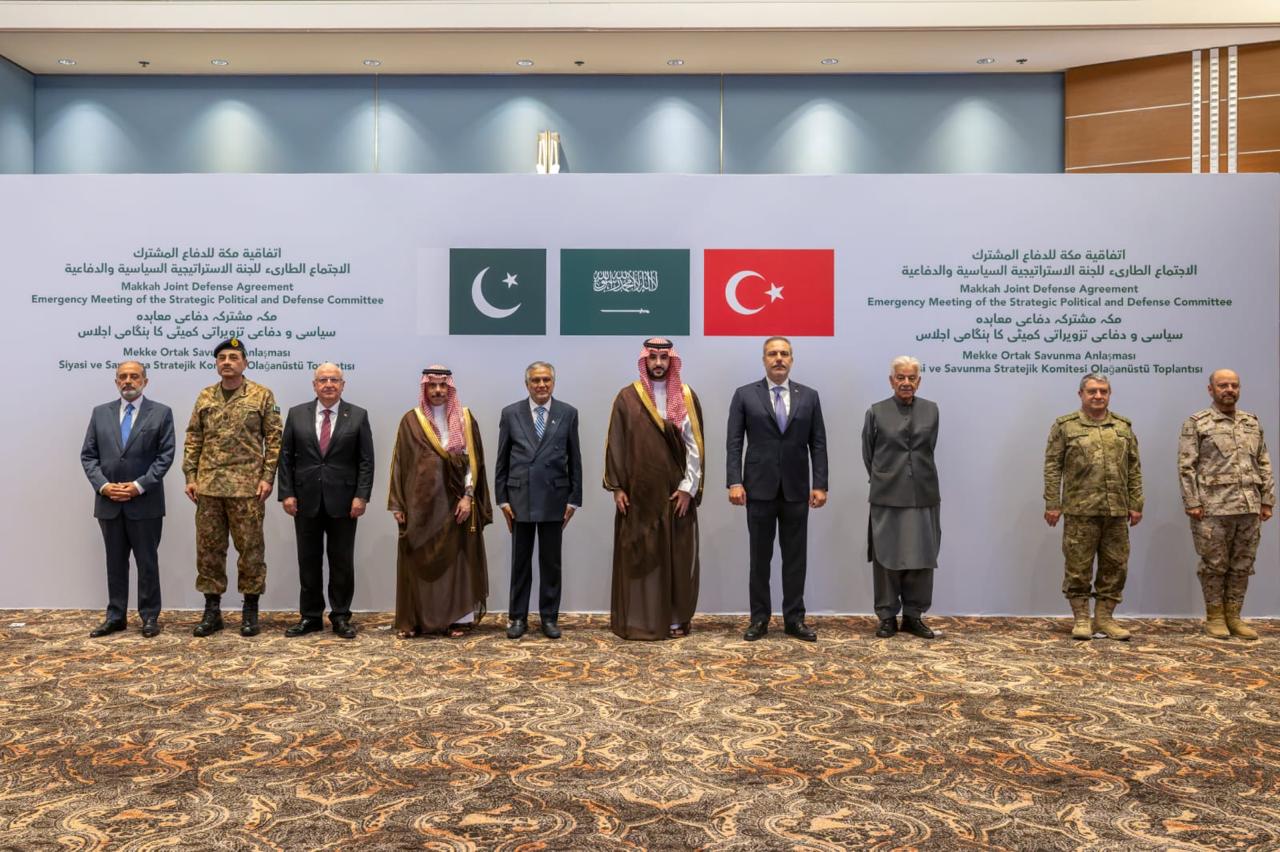
On October 5, 2026, Turkey, Saudi Arabia, and Pakistan agreed in Riyadh "to move immediately to the practical implementation of the collective defense commitments" under the Mecca Joint Defense Agreement and to ensure the rapid deployment of forces in Saudi Arabia. Taken amid escalating Houthi attacks on Saudi Arabia and a Saudi-backed counteroffensive in Yemen, the decision puts the pact to its first real test and raises the question of how far Turkey is prepared to go in Saudi Arabia's defense. Our experts weigh in.
Turkey has set about providing equipment, intelligence and drone operators to help Saudi Arabia counter the Houthis, and Turkish officials expect further support to follow in the coming weeks. These plans follow the extraordinary meeting of the Mecca alliance in Riyadh, at which the three members agreed to implement their collective defense commitments immediately and to ensure the "rapid deployment" of forces in Saudi Arabia. Thus far, Turkey's plans are designed primarily to defend Saudi sites.
As I have argued earlier, Turkey's contribution to the war in Yemen is likely to remain technical and defensive: equipment, intelligence, drone operators and air defense, but no combat troops on Yemeni soil. Defending Saudi territory is a fundamentally different undertaking from fighting the Houthis in Yemen, which helps explain why even Saudi Arabia remains reluctant to commit its own ground forces there. In the latest counteroffensive, it provided only air support. The likelihood of Turkey deploying combat units is therefore low for now, although this assessment could change.
While these developments may appear to be a major escalation, the Turkish commitment does not differ substantially from what some Western countries have already pledged; unlike Turkey, however, they have done so with little publicity. In other words, Turkey would be joining a defensive effort to which others have contributed for some time. Greece has operated a Patriot battery in Saudi Arabia since 2021 and has intercepted Houthi missiles and drones aimed at the refinery in Yanbu. France is sending troops to guard the Yanbu oil terminal, and the United Kingdom is refueling Saudi aircraft on defensive missions.
Pakistan already maintains troops in Saudi Arabia, but Turkey will not formally deploy troops without parliamentary approval. The Riyadh statement stresses that deployments will proceed in accordance with "the national legislation of the Parties," which points in the same direction. In this regard, Turkish officials state that a 2010 training agreement permits limited technical deployments, whereas any larger deployment requires parliamentary authorization, which is expected this month now that parliament has reconvened.
If Turkey's role remains limited to defending facilities inside Saudi Arabia, without targeting the Houthis in Yemen, Ankara will probably be able to compartmentalize its relations with Iran. Although Tehran opposes any strengthening of Saudi defenses, a purely defensive role may be regarded as less hostile.
The Mecca agreement matters more as a framework for action than as a motive for it, since Ankara's own interests drive its decisions. Nevertheless, the emergency meetings in Riyadh, the "rapid deployment" commitment and the ratification process all run through the pact. Turkey is likely to continue using it as the main channel for its defense relations with Saudi Arabia. This does not mean that Turkey will fight Riyadh's war; rather, Ankara will use the pact to advance its own interests with Riyadh.
Turkey, Saudi Arabia, and Pakistan decided to put the Mecca Joint Defense Agreement into action on October 5. Accordingly, Turkey, alongside Pakistan, will deploy an agreed amount of military force to Saudi Arabia to help counter the Houthis. Ankara is planning limited participation, with mostly technical assistance. Sources in Ankara suggest that Turkey will mainly deploy air defense systems and aircraft. Turkish sources downplay these deployments and portray them as solely defensive.
However, as the collective defense mechanism of the Mecca Agreement has been initiated, Turkey has become a part of the war in Yemen, even if its participation remains as limited as Ankara intends. More importantly, Turkey has become part of something bigger: a regional conflict with Iran and its allies.
The Houthis are quite useful allies for the Iranian regime. Their attacks against energy facilities, airports, tankers, and other strategic targets multiply the impact of Iran's pressure on the US, its allies, and the global economy. Their position next to the Bab al-Mandab Strait also increases their strategic importance to Iran. In this respect, it would not be a surprise if Tehran wanted to escalate against Ankara, even if the Turkish government tries to compartmentalize its participation in the war in Yemen from the rest of the regional conflict and maintain relations with the Iranian regime.
A possible Iranian escalation against Turkey would have three stages: diplomatic and economic escalation, asymmetric attacks, and direct confrontation.
Diplomatic and Economic Escalation
Turkey's deployment of its forces in Saudi Arabia would provoke a diplomatic reaction from Tehran. Indeed, the Iranian regime has already shown its discontent with Turkey's neutrality during its war with the US. Diplomatic spats, or even a severing of diplomatic ties, would therefore not be a surprise.
Ankara's tilt toward the anti-Iran camp is not limited to the Mecca Agreement and Yemen. Although Turkey once evaded US sanctions against Iran, it now complies with the Trump administration's Operation Economic Outcast campaign, which aims to strangle the regime in Tehran. The Turkish government has already taken several economic steps, such as suspending commercial flights to and from Iran and revoking the operating license of Bank Mellat.
Yet Iran has a better weapon in its arsenal: natural gas. Turkey sourced 13% of its natural gas imports from Iran in 2025. The 25-year gas deal between the two countries expired in July 2026. Although Iran was not Turkey's top natural gas supplier, a halt in gas flows could cause serious trouble for the already struggling Turkish economy in the coming winter months. Turkey has diversified its natural gas sources in recent years, with an increasing share of US gas. Nevertheless, the Turkish energy minister says that the country still needs gas from Iran for its energy security.
Asymmetric Attacks
Turkey is accustomed to diplomatic tensions with Iran and to Iranian manipulation of its energy dependency. Turkey and Iran are regional rivals that have clashed in Syria, Iraq, and the Caucasus. Asymmetric and terrorist attacks, however, would represent an unprecedented crisis between the two countries.
During the recent Iran-US war, Iran's military escalation against the US and other regional actors marked a definitive break from its previous, much more restrained strategy. Since February 2026, Iran has not refrained from initiating escalation and broadening the scope of the conflict. In fact, it even fired four missiles toward Turkey, although Ankara had not been involved in the conflict at the time.
Turkish participation in the Yemen war could therefore trigger Iranian retaliation against Turkish targets without Tehran claiming responsibility. Turkish troops in northern Iraq, for instance, could become targets of Iran-aligned militias in Iraq. Likewise, the Baku-Tbilisi-Ceyhan pipeline, which carries 600,000 barrels of crude oil per day from the Caspian Sea to the Mediterranean, could be targeted. The fact that some of this oil goes to Israel makes it a more attractive target for Iran.
Incirlik Air Base, which hosts US forces; the NATO radar installation in Malatya; and US and Israeli diplomatic missions could also be potential Iranian targets. Moreover, hitting Turkish strategic, economic, political, or tourist targets could undermine Turkey's fragile political stability or worsen its economic troubles without Iran taking responsibility.
In response, Turkey could use PJAK and other Kurdish or dissident groups against the Iranian regime, providing them with arms and military support. Nevertheless, Turkey has more to lose than Iran, which has been under US military, political, and economic pressure for months.
Direct Confrontation
The final stage of escalation would be a direct confrontation, in which Iranian missiles and drones hit Turkish cities, as they have in Saudi Arabia, the UAE, and elsewhere. The Iranian regime has already demonstrated its readiness for such an escalation. Turkey could retaliate, but the additional cost of Turkish retaliation for Iran would be relatively limited, given that Iran has already been under intense US bombardment for months. As with asymmetric attacks, a direct confrontation could be highly costly for Turkey.
Turkey's participation in the Yemen war could go wrong in many ways. Turkish forces in Saudi Arabia could become targets of Houthi attacks. Turkey, however, is also becoming part of the broader regional conflict. Although Ankara will do its best to downplay its role in the Yemen war and maintain diplomatic ties with Tehran, the Iranian regime, with newfound confidence on the battlefield, could choose to impose costs on the Turkish government in an effort to push it back to the sidelines. This could open the door to a new stage of escalation between Turkey and Iran.
By activating the collective defense mechanism, the Turkish government is not only joining a war in Yemen but also becoming part of a regional conflict that could have much larger consequences than Ankara anticipates. As this regional war drags on, the stakes will rise for all parties, pushing them to take greater risks. Ankara may therefore find that what begins as a limited military deployment in Saudi Arabia ultimately ends centuries of relative peace between Turkey and Iran.
When Turkey, Pakistan, and Saudi Arabia signed the Mecca Joint Defense Agreement on August 7, 2026, the accord was quickly compared with NATO's Article 5. Many observers initially treated the agreement as more political than operational: its precise military obligations were unclear, and when Houthi attacks on Saudi Arabia intensified in September, Pakistan explicitly said that no military response under the pact was under discussion at the time.
That calculation has now changed. Since early September, the Houthis have repeatedly targeted Saudi cities, energy infrastructure, and shipping. On September 19, Turkish Foreign Minister Hakan Fidan said that Saudi Arabia had serious military needs and that Turkey was ready to meet them under the trilateral agreement. Riyadh also sought assistance from several partners. On September 22, Britain agreed to provide an RAF Voyager air-to-air refueling aircraft following a Saudi request, while France announced the deployment of soldiers, radars, and air defense systems to protect the Yanbu oil terminal. The United States, meanwhile, provided intelligence and targeting assistance but declined to take direct military action.
The decisive step came on October 5, when the Strategic Political and Defense Committee of the Mecca Alliance met in Riyadh in an emergency session. The meeting brought together the foreign and defense ministers and senior military officials of the three countries. Following the meeting, the parties stated that they would move "immediately to the practical implementation of the collective defense commitments," take the necessary measures to provide the agreed military forces and capabilities, and ensure their rapid deployment to Saudi Arabia, subject to each country's national legislation.
This is the point at which the Mecca Agreement becomes more than a diplomatic declaration. The language of the joint statement is deliberately stronger than that of previous statements, as it explicitly refers to the rapid deployment of military forces and capabilities. However, the statement does not specify the size, composition, or mission of the forces to be deployed. It therefore does not yet mean that Turkish or Pakistani troops are being sent into combat in Yemen.
For Turkey, however, the implications are becoming increasingly concrete. The agreement's institutional framework was already being built before the current crisis. At the first Strategic Political and Defense Committee meeting in Istanbul on August 31, the three countries agreed to establish a permanent secretariat in Saudi Arabia, initially headed by a Pakistani secretary-general for three years. On October 5, Lieutenant General (ret.) Nauman Mahmood was formally appointed to the post.
The next question is therefore not simply whether the Mecca Pact exists, but how far Turkey is prepared to implement it militarily. With the Turkish parliament expected to review the agreement after reconvening in October, the nature of any proposed deployment will be crucial. Air defense assets, trainers, logistics, or technical personnel would raise a very different political and legal question from combat troops or forces intended to operate inside Yemen.
If a substantial Turkish military deployment ultimately comes onto the table, taking the issue to parliament would be both a matter of legal procedure and of political responsibility-sharing. Turkey has previously sought parliamentary authorization for overseas military deployments, including its deployment to Afghanistan under NATO. The Mecca Pact may therefore be entering its most consequential phase: the question is no longer whether the agreement can be activated, but what "collective defense" will mean in practice.





.svg.avif)