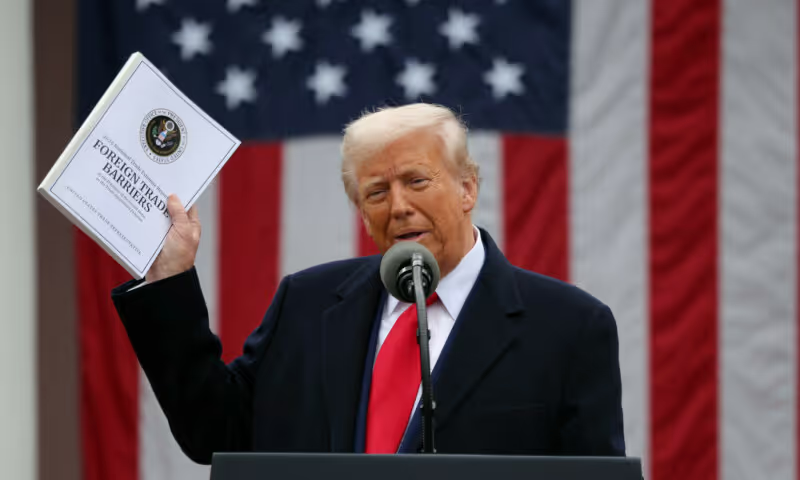
The World Trade Organization (WTO) plays a crucial role in fostering international trade by establishing and enforcing a common set of rules that make global trade more open, predictable, and fair. Through its trade agreements, the WTO works to reduce tariffs and other trade barriers, uphold the principles of non-discrimination such as most-favored-nation and national treatment, and increase transparency in members’ trade policies. It also provides a formal dispute settlement mechanism that helps resolve trade conflicts peacefully, reinforcing trust among nations and preventing unilateral trade actions. Beyond trade facilitation, the WTO occupies a central position in the international rules-based order by anchoring economic relations in law rather than power politics. By promoting compliance with agreed rules, offering a forum for negotiations, and supporting developing countries’ participation in global trade, the WTO strengthens multilateralism and contributes to stability, cooperation, and predictability in the global economic system.
As stressed by the Canadian Prime Minister Mark Carney, this is how the frameworks established by the WTO was meant to function in theory: to embed global trade within a stable, predictable, and rules-based system that disciplines state behavior and limits the use of economic power for political ends. More recently, however, this vision has been increasingly undermined as great powers have begun to instrumentalize economic integration—using tariffs as leverage, financial infrastructure as a tool of coercion, and global supply chains as strategic vulnerabilities to be exploited. These practices mark a shift away from multilateralism toward power-based economic statecraft, eroding trust in the WTO’s norms and weakening its capacity to act as a neutral arbiter within the international rules-based order.
One further step taken by the United States to undermine the financial frameworks associated with the WTO is the instrumentalization of international law itself to that end. This development is particularly striking because it involves leveraging the very legal mechanisms that were originally designed to construct and safeguard the institutional foundations upon which the WTO rests. Rather than reinforcing multilateral discipline, international law is thus repurposed to entrench unilateral economic strategies. This dynamic is evident in two trade agreements signed by the United States with Malaysia and Cambodia during the ASEAN summit in October 2025, which require both countries to align their tariff policies with U.S. economic confrontation with China. Notably, Article 2.12 of the Malaysia agreement and Article 2.11 of the Cambodia agreement address “Border Measures and Taxes.” While the Malaysian provision merely stipulates that “no Party shall contest at the WTO a measure adopted by the other Party,” the Cambodian provision goes significantly further, explicitly stating that “Cambodia shall not contest, including through countervailing measures or at the WTO, any measure adopted by the United States to rebate or to refrain from imposing direct taxes in relation to exports from the United States.” Taken together, these clauses illustrate a deliberate effort to contractually neutralize WTO dispute settlement mechanisms, thereby weakening the multilateral, rules-based trade order from within.
Trump’s contempt for international law and the institutions underpinning the rules-based order is not new, as evidenced by actions such as imposing sanctions on judges of the International Criminal Court in what the court and United Nations described as a direct attack on judicial independence and the rules-based system of international criminal justice, undermining a foundational institution of international law. More pertinently in the economic realm, the Trump administration has systematically debilitated the dispute settlement mechanism of the World Trade Organization by repeatedly blocking the appointment of appellate judges, leaving the WTO Appellate Body without the quorum needed to issue binding rulings and effectively paralyzing the two-tier dispute-settlement system that is central to enforcing WTO obligations. This long-running blockage, which has persisted through multiple administrations, undermines the WTO’s capacity to adjudicate disputes and enforce agreed rules, weakening the multilateral trading system that the United States once championed as part of the post-war liberal order.
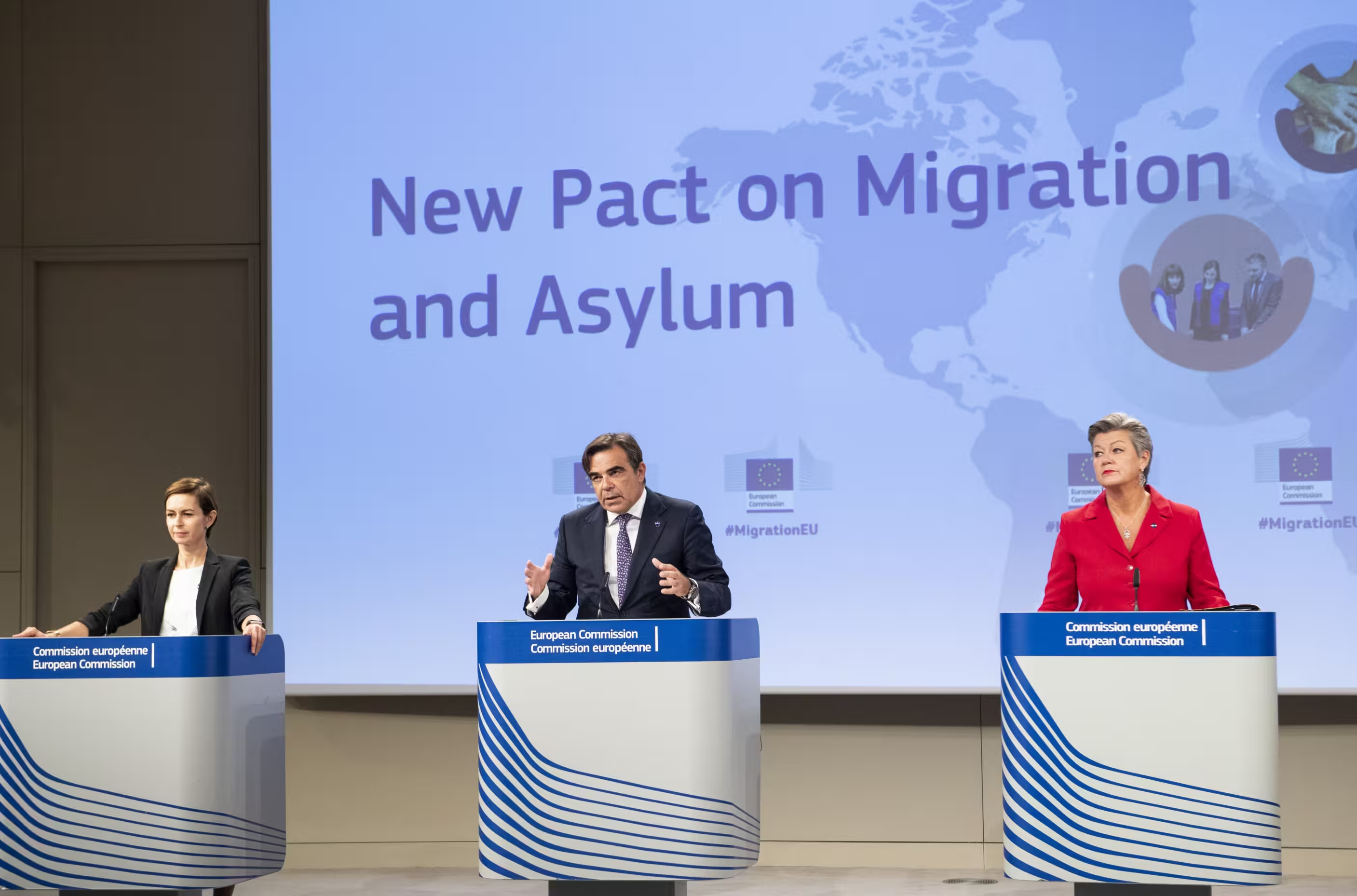
While such actions reflect a broader pattern of skepticism toward multilateral institutions, the integration of clauses within trade agreements that contractually limit access to WTO dispute settlement represents a novel instrument in the US’s economic statecraft, as it uses international legal mechanisms to circumvent a core institution of the rules-based order. By contrast, recent major agreements such as the EU–India Free Trade Agreement concluded on 27 January 2026 explicitly incorporate state-of-the-art dispute settlement mechanisms with independent panels and pre-established lists of experts designed to ensure impartial enforcement of commitments consistent with WTO principles. Similarly, the United States’ current trade deals with El Salvador, Argentina, Guatemala, and Ecuador include numerous references to obligations under the WTO Agreements and do not exclude recourse to WTO dispute mechanisms, reflecting an adherence to multilateral norms rather than their negation.
All in all, the US’s recent trade agreements with Cambodia and Malaysia exemplify the use of coercive economic statecraft targeting “connector states” that occupy critical nodes between U.S.- and China-centered value chains. Through bilateral trade agreements, the United States leverages this structural asymmetry to expand its influence, effectively displacing China’s economic soft power in Southeast Asia. These agreements exploit supply-chain chokepoints, market-access leverage, and tariff threats, creating conditions in which affected states are constrained not only in negotiating substantive obligations but also in contesting measures or invoking multilateral remedies. This form of coercion operates without the use of military force, instead embedding economic dependence and legal pre-commitments that limit the autonomy of smaller economies within the global trading system, thereby advancing U.S. national security and geopolitical objectives.
From a legal perspective, the validity of such agreements raises complex questions under modern treaty law, particularly the Vienna Convention on the Law of Treaties. Article 52 codifies invalidity due to coercion by the threat or use of force, but its scope is narrowly construed to apply only to armed force, leaving economic and political pressure largely outside its formal ambit. At the same time, provisions in U.S. agreements with Cambodia and Malaysia that limit recourse to WTO dispute settlement challenge the collective enforcement logic of multilateral trade law. While WTO litigation remains the most legally grounded avenue for addressing such coercive clauses, smaller states face political and economic risks in invoking these rights, especially given the current paralysis of the Appellate Body.
Overall, the combination of strategic economic coercion and the manipulation of international legal mechanisms to bypass key institutions of the rules-based order reflects a worrying shift toward power-driven treaty-making, exposing a growing gap between multilateral principles and the realities of power-based economic statecraft.





.svg.avif)