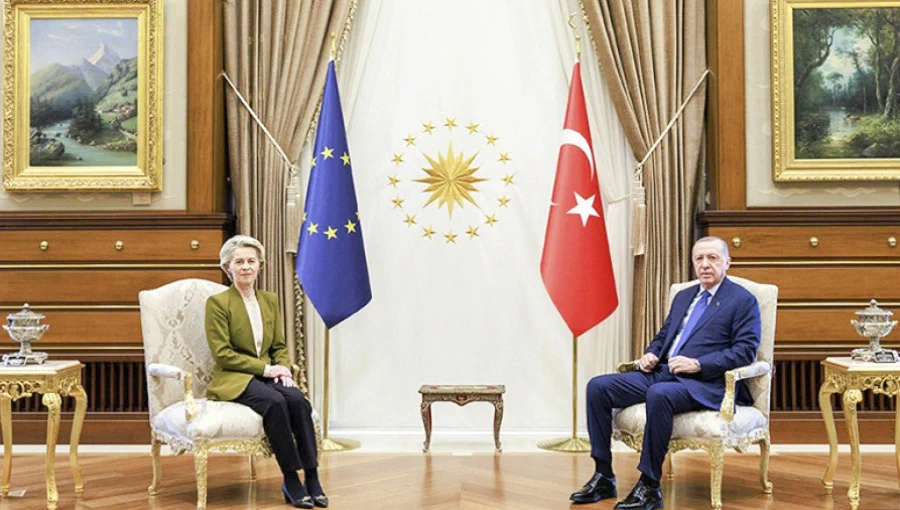
Every autumn, Brussels and Ankara perform the same ritual. The European Commission publishes its enlargement report on Turkey, replete with criticism of the country's democratic backsliding. The Turkish Foreign Ministry then issues a statement rejecting the findings and accusing the EU of bias and double standards, in some years almost word for word the same statement as the year before.
This year was no different. On November 4, the European Commission published its 2026 report on Turkey. Like its predecessors, it painted a bleak picture: democratic standards, the rule of law, and judicial independence continued to deteriorate, while legal action against elected officials, opposition figures, and civil society intensified. Also like its predecessors, the report gave the Turkish economy reasonable marks: a functioning market economy, able to cope with competitive pressure inside the Union.
The same day, Turkey's Ministry of Foreign Affairs responded. It again rejected the report's findings. Anyone who read the ministry's 2025 statement, which rejected "biased, prejudiced, and baseless allegations," or its 2024 statement will recognize the template, and in places the sentences.
Yet beneath this ritual lies an undeniable trend: the EU has less and less influence over Turkey's foreign policy decisions, and its transactional approach to Ankara is not working, as Brussels' own annual figures on Turkey's foreign-policy alignment demonstrate.
Turkey's accession talks have been practically frozen for a decade. In June 2026, the European Parliament concluded once more that the process cannot resume under current circumstances and called for reflection on a different framework for the relationship.
Many European leaders made that adjustment long ago. They accepted that Turkey would not join the EU, whether because of its democratic record, its governance standards, or deep cultural differences (as former French President Nicolas Sarkozy used to emphasize). They thus settled on a transactional relationship with President Recep Tayyip Erdoğan. Turkey would cooperate on what Europe cares about most: migration, security, and crises from Ukraine to Iran. NATO membership keeps the security channels open, and candidate status keeps EU money flowing.
Angela Merkel was the architect of this model. The EU-Turkey Statement of March 18, 2016, committed Turkey to take back irregular migrants crossing to the Greek islands in exchange for €6 billion through the Facility for Refugees in Turkey. By the Commission's own count, the EU has allocated €12.4 billion to refugees and host communities in Turkey since 2011.
Emmanuel Macron has been just as candid about the relationship. In 2017, he told Le Point that the global stage was not "cool," adding, "I am the one who has to talk with Erdoğan every 10 days." A few months later, standing next to Erdoğan in Paris, he proposed rethinking the relationship as a partnership rather than an integration process.
Ursula von der Leyen went further this year. Speaking in Hamburg in April, she said Europe must complete the continent "so that it is not influenced by Russia, Turkey, or China," a reference her spokesperson tied to the Western Balkans. The clarification that followed was telling: the Commission described Turkey as an important partner on connectivity, the Middle Corridor, and migration, and as a NATO ally.
The Istanbul meeting of October 23 showed the same logic from the other side. Foreign Minister Hakan Fidan hosted the R4 (Turkey, Egypt, Pakistan, and Saudi Arabia) together with Britain, France, and Germany, and Italy joined as well. The agenda covered exactly the issues Europe wants Ankara's help on: the Strait of Hormuz, Gaza, Yemen, Iran, and the war in Ukraine.
There is rarely a statistical way to judge whether a foreign policy works. In this case, however, the EU has supplied its own data set, and it shows how Brussels gauges Turkey's foreign policy. Alas, it reveals that the transactional approach to Turkey has largely failed by the EU's own standards. The yardstick sits in Chapter 31 of the enlargement report: foreign, security, and defense policy. Each year, the Commission records how often a candidate country joins the EU's foreign-policy positions when invited to do so.
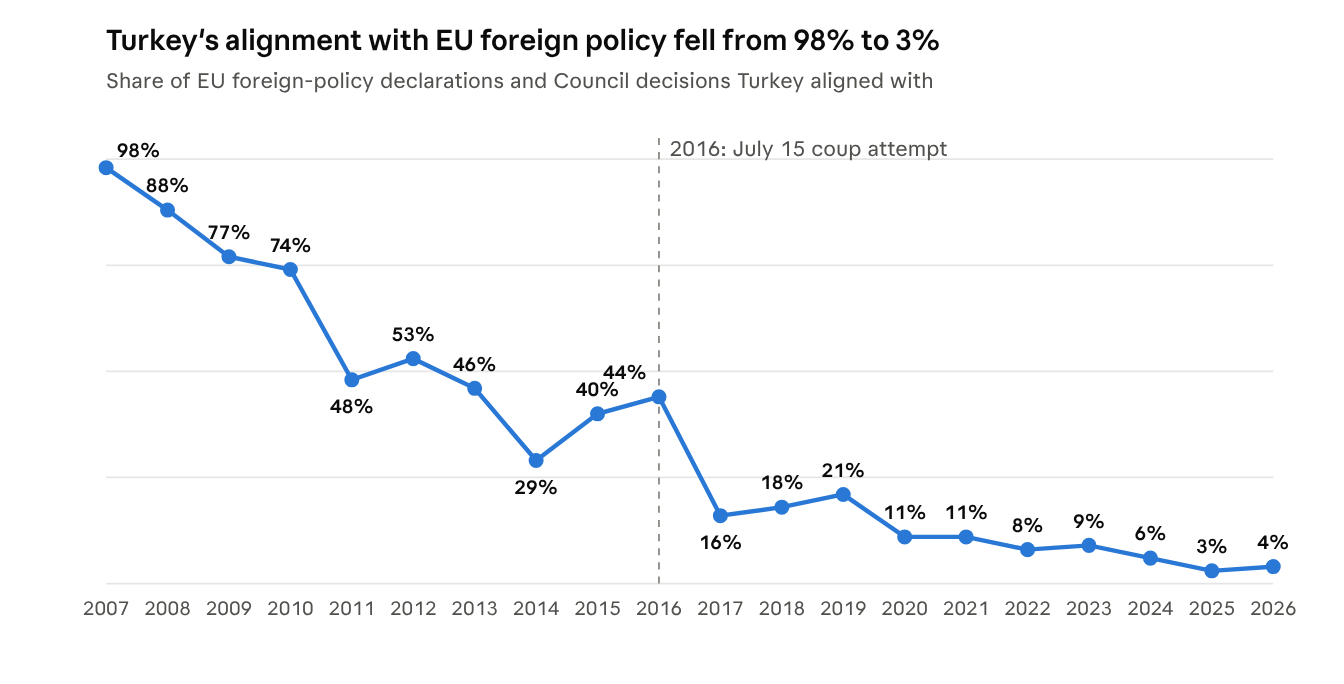
In 2007, the Commission reported that Turkey had aligned with 45 of the 46 Common Foreign and Security Policy (CFSP) declarations it was invited to join. In 2008, the figure was 109 of 124, and in 2009, 99 of 128. The 2010 report was the first to give a percentage: 74 percent. Over the next three reports, the rate ranged between 46 and 53 percent before dropping to 29 percent in 2014.
Following the July 15, 2016, coup attempt, however, the alignment rate fell sharply. The year 2016 was also the year of the EU-Turkey Statement of March 18. The rate dropped to 16 percent in 2017. It declined to 11 percent in 2020, 8 percent in 2022, 6 percent in 2024, and 3 percent in 2025. So far, the alignment rate for this year stands at 4 percent.
For comparison, the Commission rated Ukraine's alignment at 99 percent and Moldova's at 88 percent as of October 2025, and Georgia's at 40 percent in 2025. Even Serbia, the Western Balkan laggard, stood at 63 percent in May 2026.
The ramifications for Turkey and the EU are already visible. The modernization of the Customs Union, which Ankara demands every year, has gone nowhere. A Franco-German proposal for "Made in Europe" rules in the automotive sector, still under discussion, would exclude Turkey despite three decades in the Customs Union. And Turkey remains outside SAFE, the EU's €150 billion defense loan instrument. Much of the EU's reluctance to move forward with Turkey on these files stems from this divergence.
On the other hand, Turkey refused to join the Western sanctions on Moscow after the outbreak of the Ukraine war in 2022. Flights between Turkey and Russia, for instance, have continued. Ankara has only partially cooperated in curbing the circumvention of those sanctions (mainly to deflect Western pressure). The Commission also notes that Ankara does not cooperate with the EU to align with its common rules on arms exports. For Brussels, Turkey's course in the Eastern Mediterranean, most recently the Turkey-Libya maritime agreement, is also worrying.
This growing divergence is, inter alia, a result of Ankara's policy of hedging its bets. Marc Pierini, a former EU ambassador to Turkey, wrote that Ankara has positioned itself as "equidistant from China, Europe, Russia, and the United States." That, Pierini argues, is Turkey's sovereign choice, but one that is incompatible with the EU accession process.
Pierini also counts Turkey's equally close relationship with the Trump administration among the reasons Ankara remains outside Europe's security structures. As he notes, Washington has declared its aim to reshape Europe according to US interests, and hard-right parties are gaining ground across the continent with US encouragement. Washington is no longer a neutral third party, he argues, and when Ankara grows closer to it, Brussels has reason to worry. It is hard to say how widely these views are shared in Brussels. But it is safe to assume they are not marginal.
When it comes to foreign policy, hard interests usually take precedence over values, and the EU is no exception. Yet even judged by those interests, the EU's transactional approach toward Turkey falls short: it secures Ankara's limited cooperation on certain files, such as migration, but not on the broader foreign policy to which Brussels itself attaches importance.