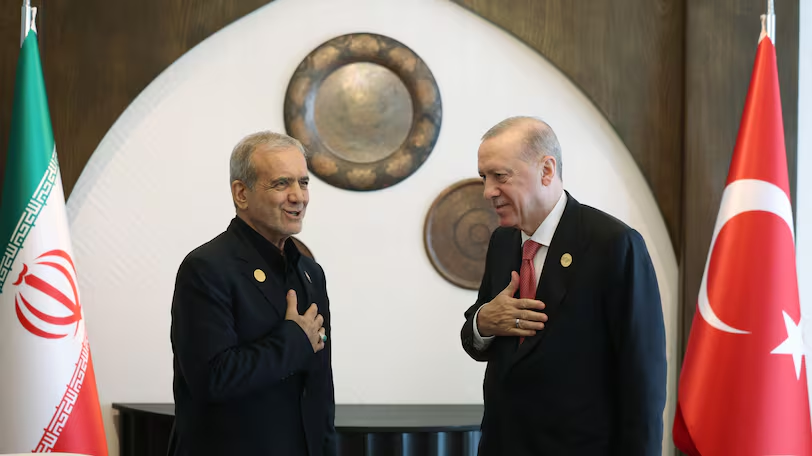
The Turkish government views the potential collapse of the Iranian regime as a harbinger of regional instability. Nonetheless, Ankara remains convinced that the Iranian regime will survive this ordeal, even after the assassination of Iran’s Supreme Leader, Ali Khamenei. For this reason, Ankara has adopted a dual-track approach: while unsuccessfully lobbying for an end to the war, it has simultaneously kept its channels open with Tehran.
The decapitation of Iran’s leadership on the first day of the war did not lead to the regime’s capitulation. On the contrary, the Iranian military has escalated the conflict by targeting Gulf countries and other regional actors. Thus far, despite being Iran’s immediate neighbor and hosting U.S. military bases, Turkey has largely been spared from missile strikes and Shahed drones. The only reported incident occurred on March 4, when an Iranian missile heading toward Turkish territory was intercepted by NATO. Nonetheless, Turkey still faces several risks.
Kurdish Insurgency
First, the prospect of a Kurdish insurgency in Iran is viewed in Ankara as a significant security threat. Several media reports suggest that the Trump administration is considering opening a new front in western Iran by encouraging an uprising led by a newly formed Kurdish coalition. At the time of writing, there were already unconfirmed claims that thousands of Kurdish fighters had infiltrated Iran.
Among these Kurdish factions, only one organization appears to possess the experience and operational capacity to launch even a limited insurgency against Iran. PJAK, the PKK’s Iranian branch, is designated as a terrorist organization by both Turkey and the United States. However, it remains uncertain whether this designation would carry much weight if Washington ultimately decides to recruit the group as part of an invasion force. The ongoing peace process between Turkey and the PKK could also lead to the release of thousands of PKK fighters, some of whom might subsequently join PJAK.
Nonetheless, Kurdish groups remain deeply skeptical about the level of U.S. commitment. The fact that Trump reportedly had to call Barzani and Talabani, the leaders of the two main Kurdish factions, only days after the largest U.S. military operation in the region since the invasion of Iraq illustrates their reluctance to serve as a launchpad for an invasion of Iran.
According to Amberin Zaman, a journalist well connected to Kurdish circles, leaders in northern Iraq asked the United States to establish a no-fly zone over western Iran to demonstrate Washington’s commitment. Maintaining such a zone would pose significant challenges, particularly once the active combat phase of the war ends. The United States is withdrawing from Syria and may withdraw from northern Iraq by the end of 2026. Turkey would therefore remain the most viable platform for a U.S. no-fly-zone mission, yet Ankara would have strong reservations about hosting an operation that provides air cover to a PKK-linked organization in Iran. Gulf states would likewise be wary of Iranian retaliation if their bases were used to support a ground invasion of Iran.
Even if these challenges were resolved, questions about U.S. resolve would remain. As the Syrian civil war demonstrated, Washington can abandon Kurdish partners when its strategic priorities change. Whether such an insurgency will materialize is uncertain.
Energy Security and Infrastructure
Second, as a country with limited natural resources, Turkey is highly vulnerable to energy price fluctuations. Iran remains a non-negligible energy provider for Turkey, and a war involving Iran therefore poses risks to Turkey’s energy security. In 2024, Iran accounted for approximately 14 percent of Turkey’s natural gas imports. A gas swap agreement signed in 2025 between Turkey and Turkmenistan also relies on Iranian infrastructure.
According to a report by the research services of the Turkish Parliament, roughly 20 percent of Turkey’s crude oil imports originate from Gulf countries and transit through the Strait of Hormuz. Energy flows through the Strait have been significantly disrupted since the outset of the war.
The Baku–Tbilisi–Ceyhan (BTC) pipeline, which has a capacity of 1.2 million barrels per day, represents another vulnerability. According to British Petroleum, the pipeline transported 207 million barrels of crude oil in 2025 and loaded 283 tankers. There are growing concerns that Iran might target the pipeline—not only to disrupt global energy markets but also because approximately 30 percent of Israel’s oil supply passes through it.
Migration Risks
Finally, both Ankara and the European Union are concerned that the war in Iran could trigger another migration wave in the region. While a limited air campaign alone is unlikely to generate large-scale displacement, the collapse of the Iranian government or the outbreak of a civil war—an outcome that some within the Netanyahu administration might welcome—could produce refugee flows similar to those seen during the civil wars in Syria and Iraq.
Although this scenario remains unlikely in the near term, for now, Turkey appears to have undertaken contingency planning. Ankara typically considers establishing refugee camps just beyond its borders in order to prevent large numbers of refugees from entering Turkish territory. This logic partly explains speculation about a potential Turkish military incursion into Iranian territory.
The Turkish government hopes Iran will avoid targeting a NATO member. Nonetheless, the March 4 incident suggests that Turkey should not assume its neutrality guarantees security. Given the country’s limited air defense capabilities and concerns about potential threats to critical infrastructure such as the BTC pipeline, Ankara may need to take precautionary steps. Although Turkey is unlikely to invoke NATO’s Article 5, it could consider initiating Article 4 consultations, as it did in 2003 during the Iraq War, when NATO allies deployed Patriot missile defense systems to Turkey.
President Erdoğan extended condolences to the Iranian people following Khamenei’s death and described the attacks on Iran as a clear violation of international law. These statements reflect Ankara’s belief that the Iranian regime will ultimately survive this existential war. Until Turkish decision-makers conclude that regime collapse in Tehran is either inevitable or desirable, Ankara is likely to remain largely neutral in the conflict.




.svg.avif)