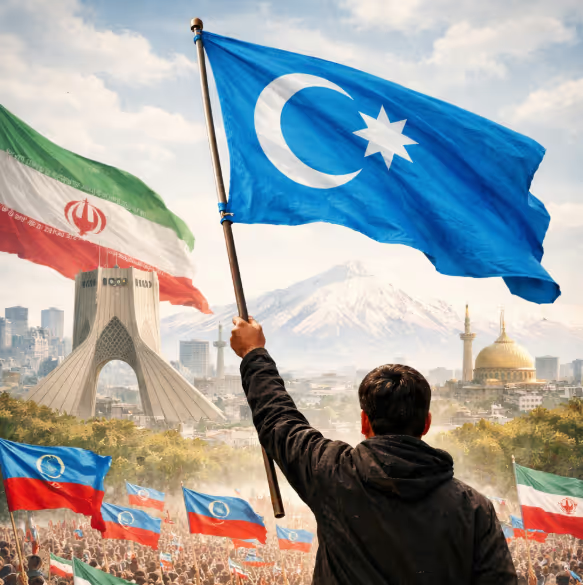
Iran built an extensive sphere of influence across the Middle East between 2003 and 2023. This influence has largely—at least for the time being—collapsed following the 2023 war in Gaza with Hamas, the 2024 conflict in Lebanon with Hezbollah, and the December 2024 fall of Syria’s Baath regime. Together, they formed the backbone of Iran’s regional influence.
Since the June 2025 war with Israel, Iran has emerged as an even more fragile polity, following direct attacks and covert operations. Street protests that began in the final days of 2025, lasted roughly two weeks, and then subsided further increased this fragility.
A longstanding question in Turkey has been whether Iranian Turks might break away from Iran and align with Turkey or Azerbaijan. Is such a scenario possible? Is it realistic or politically feasible? More fundamentally, do Azerbaijani Turks have a genuine demand or a large-scale collective will in this regard?
It is necessary to clarify these questions before providing a framework. Setting feasibility aside, two scenarios are typically debated:
These scenarios, however, remain incomplete without consideration of a third possibility that is almost entirely absent from public debate:
The Foundations of Separatist Arguments
Iran does not conduct population censuses based on ethnic or sectarian categories. As a result, it is impossible to determine with precision the ethnic composition of the country. All demographic estimates therefore remain speculative. This uncertainty explains why, particularly in some circles, claims fluctuate that between 30 and as much as 60 percent of Iran’s population is Turkish.
Public discourse in Turkey tends to equate “Turks in Iran” almost exclusively with Azerbaijani Turks—often referred to as “Azeris”—living in the country’s northwest. In reality, several other groups also fall under this category, albeit in smaller numbers. These include the Qashqai, Afshar, Khalaj, Khorasan Turks, and Turkmens.
If one assumes that between one-third and one-half of Iran’s population of approximately 93 million may be Turkish, it becomes easier to understand why separatist narratives may gain traction. President Pezeshkian, a native of Tabriz, and several Iranian Turkish intellectuals have emphasized historical unity during visits to the Republic of Azerbaijan. They also highlight the argument that northern and southern Azerbaijani Turks were forcibly separated by Russia in the early nineteenth century, during a period of weakness under the Turkic Qajar dynasty. The Treaties of Gulistan (1813) and Turkmenchay (1828) are typically cited as decisive moments in this division. This discourse naturally leads to expectations of a “historical correction” on both sides of the border.
The idea of a “divided people” thus functions, at least at the ideational level, as a mobilizing narrative on both sides of the border. Historical precedent further reinforces such expectations. Periods of weakening central authority in Iran have occasionally triggered secession movements in some ethnic and sectarian groups at the periphery. The “Azadistan Republic,” established in 1920 under Sheikh Mohammad Khiyabani, and the Soviet-backed South Azerbaijan Democratic Republic led by Ja‘far Pishevari in 1945–46 are significant examples. Although both entities were short-lived, they remain embedded in collective memory and continue to serve as reference for contemporary separatist discourse.
A similar pattern can be observed in other cases. These include the Kurdish experience with the Mahabad Republic during the same period, the uprisings by Kurds and Turkmens in northeastern Iran following the 1979 Revolution, and the severe anti–Velayat-e Faqih protests in Tabriz in late 1979 by supporters of Ayatollah Shariatmadari. All of these developments can be assessed within a broader pattern of center–periphery tension.
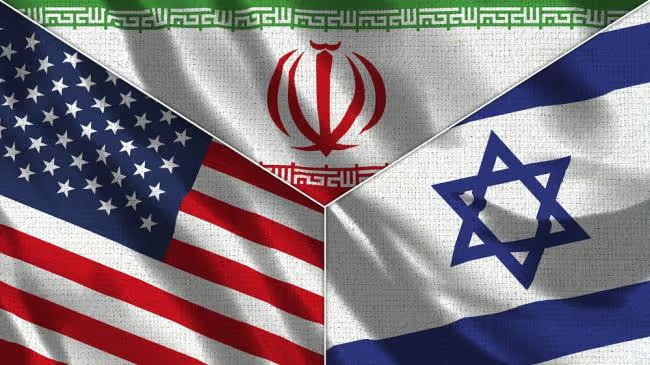
As in earlier periods, demands by Turks and other ethnic and sectarian communities could resurface if central authority were to weaken substantially. In the contemporary context, the most significant factor feeding such expectations is the possibility that ethnic identities could be instrumentalized by external actors, notably the United States and Israel. The articulation of separatist expectations by certain circles in Azerbaijan with geopolitical motives—particularly those with close ties to Israel—reinforces these narratives. Within this environment, the “ethnic card” has acquired renewed relevance.
Structural and Identity Dynamics That Weaken Separatist Arguments
Despite these considerations, the analytical strength of separatist arguments depends not on sentiment or symbolism, but on balance of power and social structure. As such, it must be clearly stated that the majority of Azerbaijani Turks—whose numbers reach into the tens of millions—does not want to secede from the Islamic Republic of Iran. This preference rests on concrete and identifiable structural factors.
a) Historically, Iran was governed by Turkic dynasties from the Samanids (819–999), who ruled much of Khorasan, until the establishment of the Pahlavi dynasty by Reza Shah in 1925. Turks should therefore not be understood as a foreign or “immigrant” population within Iran. Rather, they consider themselves as one of the principal founding and ruling components of the Iranian state. The absence of a colonial experience or a perception of external domination deprives separatist narratives of a crucial structural foundation.
b) Azerbaijani Turks are deeply embedded within Iran’s political and institutional elites. The current Supreme Leader, Ayatollah Ali Khamenei, is a Turk originally from Tabriz and has exercised executive authority since 1981, first as president and then as supreme leader. The current president, Masoud Pezeshkian, elected in May 2024, is also a Turk from Tabriz. Mir-Hossein Mousavi—one of the most influential and longest-serving prime ministers of the Khomeini era and the central figure of the Green Movement in 2009—is likewise from a Turkish background.
Beyond individual figures, Turks hold significant influence across key institutions. A substantial portion of the bazaar and broader economy remains under Turkish control. Alongside Persians, Turks constitute the dominant ethnic groups within the military, the defense establishment, and clerical networks in Qom. In practical terms, there is no position within the state apparatus that an Azerbaijani Turk cannot attain on the basis of a Turkish-Shiite identity. This inclusivity, however, does not extend to Sunni Turkmens, whose marginalization represents one of Iran’s most sensitive social fault lines.
c) It is also necessary to acknowledge that northern and southern Azerbaijani populations have lived apart for nearly two centuries. Over time, this separation has produced a degree of sociopolitical divergence. In the north, Russian and Soviet rule fostered a more secular and modernist outlook, weakening religious tradition. In contrast, Azerbaijani Turks in Iran—where religion retained social importance even under the Qajar and Pahlavi dynasties—strongly supported the 1979 Revolution and subsequently emerged as one of the Islamic Republic’s principal pillars.
Comparable dynamics can be observed among Turkmens living on opposite sides of the Iran–Turkmenistan border, who were similarly divided during the period of Russian imperial expansion. Beyond cultural differences, Azerbaijan’s authoritarian political system and persistent regional inequalities offer Iranian Azerbaijanis little promise of political or economic advancement through unification. Moreover, the population of Iranian Azerbaijan is three to four times larger than that of northern Azerbaijan, rendering any such integration unlikely.
d) Iran’s modern history of responding to separatist movements with uncompromising repression constitutes another major constraint. This approach is reinforced by a highly centralized security doctrine. As demonstrated in the 1940s, separatist movements that emerged during periods of foreign occupation were decisively dismantled once occupying forces withdrew. Even in the Kurdish case—despite mountainous terrain, armed capacity, and longstanding traditions of de facto autonomy—only limited cultural concessions have been granted and political independence was not achieved. Azerbaijani Turks, who are far more deeply integrated into Iranian society, lack both the logistical and organizational prerequisites for sustained separatist mobilization.
e) The viability of any separatist project ultimately depends on sustained support from regional and international actors. In this regard, prospects remain extremely limited. No major power is likely to support a process that fundamentally undermines Iran’s territorial integrity. The fragmentation of Iran, with its several minorities, could risk cascading instability, disrupt critical energy corridors, and—most significantly—activate centrifugal pressures within Turkey, Russia, and China themselves.
No new state is likely to emerge without backing from neighboring states or protection from great powers. A project that relies primarily on a foreign destabilization agenda led by a non-neighboring country such as Israel, and on uncertain support to such a project by a power that can be easily distracted, such as the United States, is therefore unlikely to succeed.
f) Aspirations for unification with Azerbaijan are particularly weak. There is little analytical basis for assuming that Iran would tolerate such a development, or that Azerbaijan could impose it—even with Israeli backing. Azerbaijan lacks the military, economic, and diplomatic capacity to absorb such a transformation. Moreover, it requires little strategic imagination to conclude that Turkey would oppose any development that fundamentally destabilized regional balances. The sociopolitical factors outlined in point (c) further underscore the near-impossibility of such a scenario.
Iranian Turks within the Framework of Iran-Shahr Thought and Shiism as a Supra-Identity
The Iran-Shahr thesis has long been debated in Iran as an integrative framework of identity and statehood. Nonetheless, in Turkey, this is often portrayed as a vehicle of Persian nationalism. Analytically, however, Iran-Shahr rests on the idea of a shared historical and political space encompassing all populations inhabiting Iranian territory. Drawing on Sasanian political thought and the post-Islamic concept of mamālik-i mahrūse-yi Iran, the thesis emphasizes civilization and state tradition rather than ethnic homogeneity. Its core objective is to bind diverse communities to a supra-identity of “Iranian-ness.” Within this construct, Azerbaijani Turks are treated not as peripheral actors, but as foundational contributors to the Iranian polity. This alone is sufficient to illustrate the central role that Turks play in Iran.
The territorial contours of the modern Iranian state further reinforce this position. These borders largely reflect the legacy of the Safavid dynasty, itself a Turkic ruling house. As the Safavids’ direct heirs, Azerbaijani Turks are not framed as late arrivals, but as custodians of Iran’s state tradition. This perception strengthens a sense of political belonging and weakens narratives portraying Iran as oppressor.
Shiism plays an equally critical integrative role. It vertically binds Iranian Turks to the ideological core of the state, while the Iran-Shahr framework horizontally anchors them to a shared historical and territorial conception of homeland. Together, these dimensions operate as powerful constraints against ethnic fragmentation. As a result, although restrictions on the public use of Azerbaijani Turkish and the dominance of Persian as the official language generate cultural grievances, they tend to manifest as demands for reform and recognition rather than as separatist cause.
It should also be acknowledged that the Iran-Shahr framework is sometimes implemented in a Persian-centric manner. This has generated periodic backlash among Azerbaijani intellectuals. Yet such reactions overwhelmingly translate into calls for autonomy or expanded cultural rights. Explicit secessionist discourse remains marginal.
What Should Be Expected from Azerbaijani Turks After 2026?
Within broader imaginaries that treat the Middle East as a geopolitical puzzle to be rearranged, a unified and resilient Iran is clearly not Israel’s preferred security outcome. Nevertheless, Azerbaijani Turks—one of Iran’s largest and most influential communities—do not exhibit a sustained separatist political consciousness. This is precisely because they are considered not as a “minority,” but as a central constituent of both Shiism and the Iran-Shahr framework. From this perspective, separatist rhetoric appears largely externally generated, lacking elite endorsement and mass societal support, and circulating primarily at the symbolic and emotional level.
From an analytical standpoint, five conditions are necessary for a separatist project to succeed in Iran: a) a strong and widely shared separatist identity, b) substantial weakening of the central state, c) the presence of an attractive alternative state, d) sustained international support, and e) organized or armed capacity.
The relative presence of only the first condition, while the remaining factors remain weak or absent, undermines the plausibility of separatist scenarios. That said, following developments in June 2025 and January 2026, it is plausible that subsequent phases of U.S.–Israeli pressure on Iran may include efforts to mobilize peripheral ethnic and sectarian communities against the central authority.
Tehran’s longstanding narratives of inclusivity, economic resilience, and ‘patience and struggle’ are under growing strain. Whether these narratives can still deliver tangible outcomes will play a decisive role in shaping the future of Azerbaijani Turks in Iran.



.svg.avif)