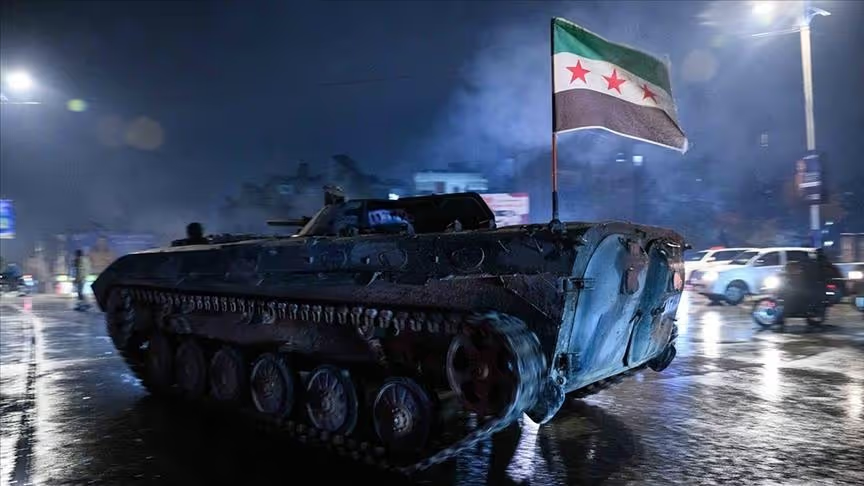
Videos showed fighting erupting in residential areas as civilians fled en masse, while green buses later transported defeated fighters out of the city under a mediated evacuation arrangement. The Aleppo clashes in early January 2026 brought back grim memories of Syria's civil war, even as the new government in Damascus, led by President Ahmad al-Sharaa, claimed another military win against the Syrian Democratic Forces (SDF) in Aleppo.
Backed by Turkish intelligence and drone support, Syrian forces launched an assault on January 6 against Kurdish-held neighborhoods; Sheikh Maqsoud and Ashrafieh. After four days of intense fighting, including artillery shelling, suicide attacks by Asayish members, and street battles, the government declared victory. By January 10-11, the last SDF and Asayish fighters withdrew on buses to northeastern Syria, leaving the areas under full Damascus control.
The clashes killed at least 30 people, including civilians, and wounded over 100. They displaced more than 160,000 residents, many fleeing to safer areas like Afrin or shelters in Aleppo. The Syrian Observatory for Human Rights (SOHR) reported widespread damage from bombardments on densely populated areas and documented alleged abuses against captured fighters, including torture and mistreatment.
This quick victory gave Ankara and Damascus clear advantages. It ended the last SDF/Asayish pockets in Aleppo city, delivering a final blow to any Kurdish hopes of influence in the northwest. While Aleppo delivered a clean tactical win, the operations could continue in other SDF pockets west of the Euphrates. It also reminded everyone of the power balance on the ground: Syrian forces, with Turkish backing, could act decisively if U.S. protection doesn't apply.
The operation exposed the limits of international support for the SDF. U.S. Ambassador to Turkey and Special Envoy for Syria, Tom Barrack, met al-Sharaa in Damascus and urged "maximum restraint," an immediate end to hostilities, and a return to dialogue. He emphasized that Marco Rubio's team was ready to mediate. Nonetheless, Washington offered no military involvement in Aleppo, consistent with its focus on east-of-the-Euphrates areas. Israel was silent too, despite recent sympathetic statements toward Syrian Kurds and concerns over growing Turkish influence. No airstrikes or aid materialized for the trapped fighters.
Yet these gains came at a cost. Graphic footage of mistreated captives, including women, spread online and deepened Kurdish distrust. SDF commander Mazlum Abdi stated that the violence undermined chances for agreement, created risks of demographic changes, and exposed civilians to danger. He called on mediators to stop violations and allow safe returns for the displaced. The abuses make it harder for Abdi to compromise on autonomy demands – something al-Sharaa may find unacceptable in his push for a unitary state.
The root issue traces back to the March 2025 integration deal between al-Sharaa and the SDF, meant to fold Kurdish forces into a single Syrian army under centralized control. Al-Sharaa seeks one unified republic with a strong national military. The SDF wants to keep hard-won autonomy. Since 2012, the group has built significant gains: U.S. training, equipment, and protection; battle experience against ISIS; control over oil-rich northeast (producing much of Syria's oil and wheat); and local administrative structures.
Trust between the sides has always been low. Recent violence against Alawites and Druze has only reinforced SDF fears about disarmament. Still, a compromise isn't impossible. Al-Sharaa could offer limited autonomy in exchange for Damascus oversight, gaining legitimacy and international aid for rebuilding. The SDF needs protection and recognition in any new setup. The U.S. has tried to mediate, shuttling between sides.
But Turkey stands firmly against any SDF autonomy. Ankara sees the YPG (core of the SDF) as an extension of the PKK, its decades-long enemy. It wants full dissolution and uncontested Syrian sovereignty. The SDG sources claim Ankara dissuaded Damascus from deals when talks neared completion around January 4, just before the assault. “As an extension of the PKK, the SDG has this characteristic: it cannot be persuaded through dialogue unless it sees force or the threat of force. It acts only when confronted with power or the threat of power,” told Hakan Fidan, Turkish Foreign Minister.
So, what did Aleppo achieve? Tactically, a win. Strategically, it may prove pyrrhic. The SDF's main strength (around 900 U.S. troops, oil fields, and farmlands) lies east of the Euphrates, where American protection remains firm. A direct push there risks clashing with U.S. forces, and Trump's reaction is unpredictable, he has praised military successes elsewhere. A Turkish military operation east of the Euphrates could make Trump appear weak (echoing Biden's chaotic Afghanistan withdrawal) and prompt him to mount a surprisingly muscular defense of the SDF as U.S. allies.
Turkey will either accept a kind of autonomy for the SDF in eastern Euphrates or President Erdogan might try to convince Trump to pull U.S. troops from the east, as he did in 2019. Trump admires strongmen and could see Syria as "Erdogan's sphere of influence." But so far in his second term, Erdogan hasn't directly raised eastern Syria in talks with Trump. His top priority appears to be reintegration into the F-35 program and sanctions relief. Recent phone calls and meetings focused on defense ties, not a Syria pullout push. For now, complicating F-35 talks with aggressive moves on eastern Syria seems unwise for Ankara.
Or, Ankara may be biding time, betting Trump will eventually withdraw anyway (he was skeptical of the troops during his first term). After all, US troops are scheduled to leave Iraq, main logistical route for US forces in Syria, in 2026. So, after Iraq, Syria might be next in the withdrawal schedule. If Turkey is left alone with the SDF in Syria, Ankara would have free hand to use any military option in the area.
In the end, Aleppo delivered short-term control but hardened divisions and complicated talks. Without U.S. withdrawal east of the Euphrates, the power balance stays largely unchanged. Syria's puzzle still points to Washington: dialogue offers the best path to a united country, but mistrust and external interests make it tough. President Trump’s eventual call on whether to stay or go in Syria will shape whether this fragile transition leads to lasting stability or more chaos. For ordinary Syrians, displaced, grieving, and caught in the middle, more military "wins" risk more suffering, not lasting peace.


.svg.avif)