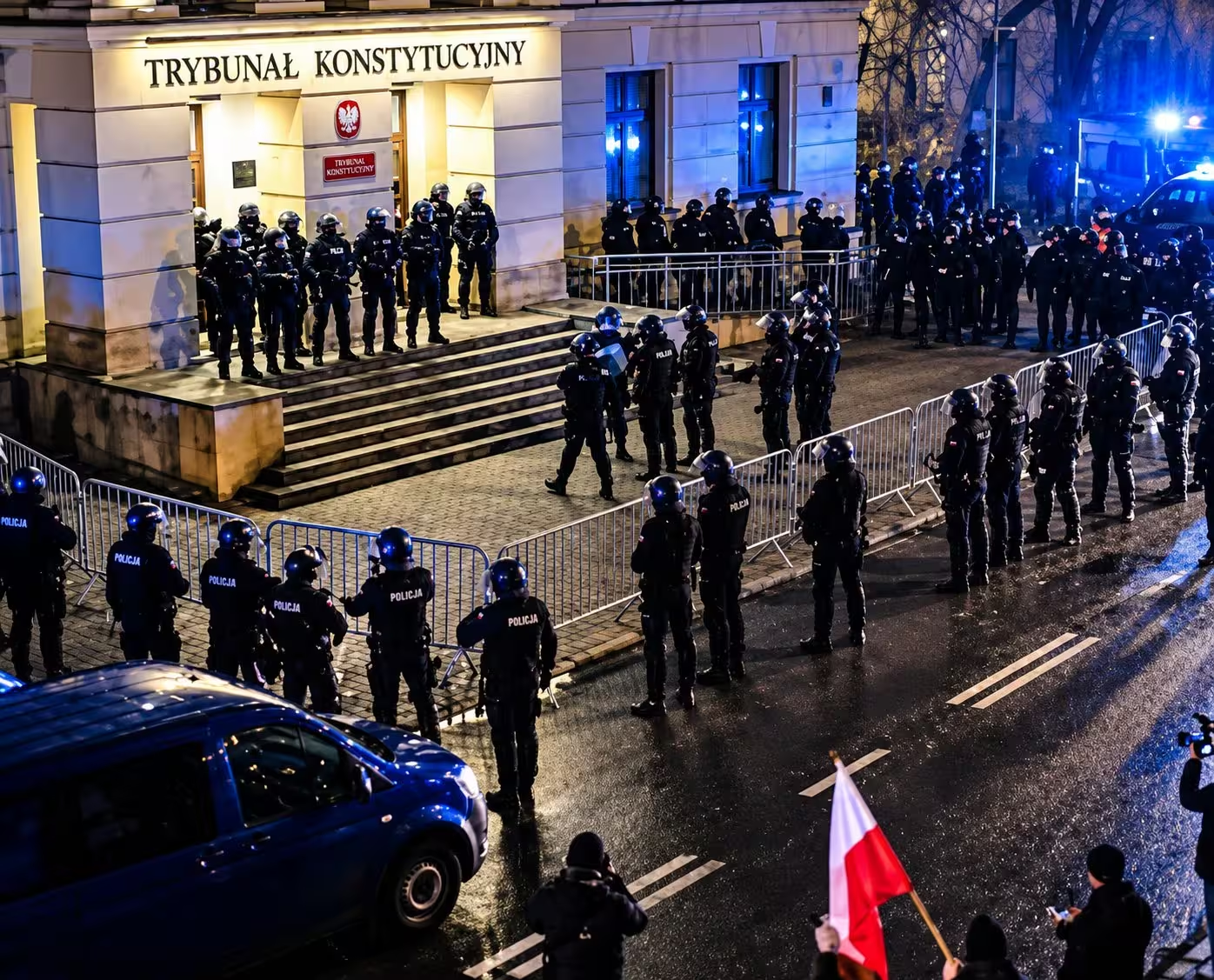
The controversies surrounding the Constitutional Tribunal in Poland are not new, but on Friday, October 30, 2026, they culminated in a protest triggered by news that the president of the Constitutional Tribunal, Bogdan Święczkowski, had been suspended, effectively ousting him from the court’s leadership.
Demonstrators gathered outside the Tribunal’s headquarters, with some attempting to force their way into the building. The Constitutional Tribunal plays a fundamental role in the Polish legal system, tasked with ensuring that all national laws conform to the Constitution.
Yet Friday’s events did not come out of nowhere. They mark the latest escalation in a struggle over the Tribunal that has been building for more than a decade.
The conflict surrounding the court traces back to the conservative Law and Justice (PiS) administration that governed Poland from 2015 to 2023. In 2015, both the outgoing parliament and the incoming PiS-dominated one elected Tribunal judges, but President Andrzej Duda swore in only the PiS appointees. This left more judges than vacant seats, creating the so-called "double judges" and marking the beginning of prolonged debates over the court’s judicial independence.
A further flashpoint occurred on October 22, 2020, when the Tribunal ruled that the primary legal basis for legal abortion in Poland was unconstitutional, a decision that closely aligned with the conservative government's platform. This ruling led to widespread protests across Poland and Polish diasporas abroad, and it raised questions about the lack of respect for the Constitutional Tribunal, which is supposed to stand above party politics.
The next important step that led to the crisis we see today is the December 2025 ruling of the Court of Justice of the European Union, which stated that some rulings the Constitutional Tribunal issued in 2021 went directly against EU law, and that the 2015 process of appointing judges was not impartial.
In March 2026, the parliament (Sejm) elected six new judges. However, President Karol Nawrocki, who is backed by PiS, accepted the oaths of only two of them. This started another string of controversies and arguments between Prime Minister Donald Tusk’s government and the President.
The following month, the remaining four judges took their oaths of office in parliament before the Speaker of the Sejm. Although the oaths were delivered to President Nawrocki, both he and Tribunal President Bogdan Święczkowski refused to recognize them, effectively preventing the judges from assuming their duties.
Late in the evening, a notice was published on the website of the Constitutional Tribunal that Judge Anna Korwin-Piotrowska has taken over as head of the Constitutional Tribunal, following a decision to suspend its president, Bogdan Święczkowski, and vice-president Bartłomiej Sochański.
However, neither the president of the Constitutional Tribunal nor the president of Poland has recognized Judge Korwin-Piotrowska, as she was one of the four judges who could not take their oath before the President.
The decision was based on the fact that Święczkowski and Sochański had prevented the General Assembly of all the judges from convening. As the legal basis, Judge Korwin-Piotrowska cited Article 130 of the Law on the System of Common Courts, which she argues also applies to the Tribunal.
Shortly thereafter, Minister of Justice Waldemar Żurek requested that the Tribunal lift the judicial immunity of the two ousted officials. Outside, crowds of protesters gathered, joined by prominent right-wing figures including PiS leader Jarosław Kaczyński and far-right politician Grzegorz Braun.
The ousted president of the Constitutional Tribunal, Bogdan Święczkowski, attempted to force the gate and enter the building. President Karol Nawrocki, who was on his way to Senegal for an official visit, canceled the trip and returned to Poland, where he landed after 10 p.m. Upon arrival, President Nawrocki met with the two ousted officials before entering the Tribunal headquarters, saying he had helped Święczkowski get inside as well. Reports indicate he remained inside the building until 5 a.m.
Tensions are high in Poland, with some members of the president's team going as far as saying the judges are attempting a coup d’état, and threatening them with lengthy prison sentences. Prime Minister Donald Tusk wrote on his X account: “Restoring the rule of law is our duty. After years of PiS lawlessness, this is a difficult, sometimes painful process that requires decisive action. There is no other way.”
Opposition politicians, including Confederation leader Sławomir Mentzen and Jarosław Kaczyński, echoed accusations of an illegal power grab. Meanwhile, the fallout widened as Polish ambassadors to both Romania and China resigned in protest of the crisis.
The President will start a series of meetings with parliamentary leaders today. Judge Korwin-Piotrowska has called a general assembly of the judges for November, while Święczkowski, who rejects his suspension, has ordered Tribunal staff to take November 3–6 off, setting up a fight over who controls the building next week. We can only wait to see how the meetings will go.
The standoff will not be easy to resolve. President Karol Nawrocki and the government of Prime Minister Donald Tusk have been at odds many times since the start of the presidency, and this is another example.
Polish politics has become increasingly polarized over the past decade, with controversies surrounding the Tribunal dating back to 2015. The crisis is the latest product of that polarization, as both the governing coalition and the largely right-wing opposition call on their supporters to mobilize. As the next elections are scheduled to take place next year, tensions are likely to rise.