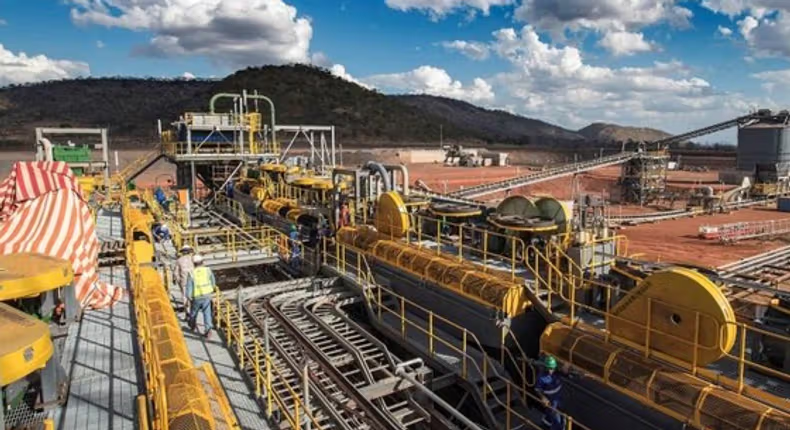
On Jan. 31, 2026, Mozambican President Daniel Chapo inaugurated a 200,000-metric-ton-per-year graphite processing plant in the Nipepe district of Niassa Province. The facility, built and operated by DH Mining (a subsidiary of China’s Jinan Yuxiao Group), represents one of the largest graphite operations on the continent. The ceremony received little to no coverage in Western media. It should have. The Nipepe plant is the clearest signal yet that Beijing is extending its control over critical mineral supply chains beyond Chinese borders, moving upstream into African extraction and processing at the precise moment Western operators have pulled back. The implications for the global battery supply chain, and for European and American efforts to diversify away from Chinese mineral dependence, are significant.
Graphite is essential to every lithium-ion battery produced in the world. It constitutes roughly 30% of an EV battery by weight and is the primary material used in anodes, the negatively charged component that stores lithium ions during charging. China dominates this supply chain at every level. According to Benchmark Minerals Intelligence, China controls approximately 75% of natural graphite production, 99% of spherical graphite processing, and 74% of synthetic graphite output. In October 2023, Beijing imposed export licensing requirements on high-grade graphite products, followed by tighter end-user controls in December 2024. A temporary suspension of enhanced controls on U.S.-bound shipments was announced in November 2025, but it expires in late 2026, leaving the structural leverage intact.
Mozambique’s graphite sector experienced a sharp contraction just before DH Mining’s facility opened. According to U.S. Geological Survey data cited by the Ecofin Agency, national output fell from 98,000 metric tons in 2023 to 75,000 metric tons in 2024. Dutch firm AMG confirmed its exit from the Ancuabe mine in Cabo Delgado Province. Australia’s Syrah Resources, which operates the Balama mine in Mozambique (the world’s largest integrated natural graphite operation outside China), idled production since mid-2024 and only resumed on a limited, campaign-basis model in June 2025. Weak natural graphite prices, oversupply of Chinese synthetic graphite, and falling global demand created conditions that made continued full-capacity production uneconomic for Western-aligned operators.
DH Mining moved into this vacuum with a $200 million investment and a 25-year operational timeline. The company had been developing the Nipepe concession since 2014, building approximately 110 kilometers of roads, a bridge across the Lúrio River, and 100 kilometers of high-voltage power transmission lines. The project currently employs roughly 1,000 permanent and 200 temporary workers, with employment expected to reach 2,000 in its second phase. This is a classic example of the infrastructure-for-resources model that Chinese firms have deployed across Africa for two decades, creating long-term dependencies by providing transportation and energy infrastructure that local governments cannot finance independently.
The strategic logic is clear. By establishing upstream graphite production and processing capacity outside China, Beijing ensures that Chinese battery manufacturers retain access to feedstock even as the government restricts exports of Chinese-origin graphite to Western buyers. DH Mining’s concentrate flows into Chinese supply chains. On the other hand, Syrah Resources’ Balama output in Mozambique, backed by U.S. Development Finance Corporation support and supply agreements with Tesla, feeds a processing facility in Louisiana. Two separate graphite ecosystems now operate within roughly 500 kilometers of each other in northern Mozambique, serving two separate industrial blocs. This geographic proximity conceals a widening supply chain divergence that has gone largely unexamined.
The timing of DH Mining’s inauguration is important. Western operators retreated from Mozambique because prevailing market conditions made production unprofitable. Chinese state-connected firms operate under different constraints. Access to subsidized capital, tolerance for lower near-term returns, and the strategic priority Beijing places on securing critical mineral supply chains allow Chinese companies to invest countercyclically, building capacity during downturns that positions them to dominate when prices recover.
The result is that market-driven withdrawal by Western firms creates openings that strategically motivated Chinese investment fills. This pattern has played out in cobalt in the Democratic Republic of Congo, in rare earths across Central Asia, and now in graphite in Mozambique.
The European Union and the United States have recognized this dynamic in policy terms. The EU Critical Raw Materials Act (2024) and the U.S. Inflation Reduction Act’s sourcing requirements for EV battery tax credits both aim to incentivize non-Chinese mineral supply chains. Mozambique’s graphite deposits are explicitly cited in Western supply chain diversification strategies.
The problem is that policy frameworks have not yet translated into durable investment at scale. Syrah’s Balama mine remains the only significant Western-aligned graphite producer in the country, and its operations have been intermittent. DH Mining’s Nipepe facility, by contrast, opened at full industrial scale with a clear 25-year commitment.
The inauguration of the Nipepe graphite plant is a concrete expression of how China is extending its critical mineral dominance beyond its own borders. China builds parallel extraction and processing capacity in Africa that serves its industry while Western supply chain diversification efforts remain aspirational. If the United States and the European Union are serious about reducing dependence on Chinese-controlled graphite, the response will need to go beyond tax credits and trade agreements. It will require sustained, counter-cyclical investment in African mining operations that can compete with state-backed Chinese capital on timeline, scale, and infrastructure commitment. The Nipepe plant is already producing. The Western alternative, for now, is not.




.svg.avif)