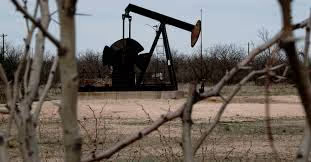
Suriname, a small South American country of roughly 640,000 people located between Guyana and French Guiana, is about to become rich. In October 2024, the French oil major TotalEnergies and its American partner APA Corporation committed $10.5 billion to a single deepwater project off its coast. When production begins in 2028, the country will pump 220,000 barrels a day. Revenue over the life of the field could reach $26 billion, more than six times the size of Suriname’s current $4.3 billion economy.
The problem is that Suriname’s government is already behaving as though the money has arrived. In January 2026 the International Monetary Fund warned that the country’s public debt had risen back to 106 percent of GDP, the fiscal deficit had widened to 10 percent, and inflation had returned to double digits. The IMF had just approved the final review of Suriname’s three-year reform program in March 2025, calling it broadly successful. By the end of the same year, those gains had reversed.
Resource-rich governments frequently borrow and spend against future oil revenue once a project is approved but before production begins. Chad did this in the mid-2000s after an ExxonMobil-led consortium built the Doba field and its export pipeline. The Chadian government weakened the revenue-management law that the World Bank had demanded as a condition of the project, borrowed against expected oil earnings from Swiss commodities trader Glencore, and required multiple rounds of debt restructuring in the years that followed. Governments that know large revenue is coming spend on the assumption that it will arrive. When production slips or prices fall, the debt remains while the projected income fails to materialize.
Suriname already knows the cost of this mistake. The country defaulted on its sovereign debt three times during the pandemic, and public debt peaked at 148 percent of GDP at the end of 2020. A $688 million IMF rescue in 2021 restored discipline. The 2025 reversal shows how fragile that discipline was. The fiscal slippage happened on expectations alone, before any oil revenue was booked.
Staatsolie, the state oil company, adds a second pressure. It has to fund a 20 percent stake in the GranMorgu project, valued at $2.4 billion. In March 2025 it raised $515.8 million at 7.75 percent through an oversubscribed bond issue, and in May 2025 it secured an additional $1.6 billion bank loan from a consortium of 18 banks. The 2028 timeline assumes the project runs on schedule. Deepwater projects rarely do.
The obvious reference point is Guyana, next door, where ExxonMobil’s Stabroek Block has driven 47 percent average annual GDP growth since 2022. That figure looks impressive at first. Other data points temper the picture. Housing, food, and service prices in sectors unrelated to oil have risen sharply. The Guyanese dollar has strengthened, which hurts every other exporter in the country. Questions about the terms of the ExxonMobil contract, and about who actually receives the revenue, have shaped every recent election in Georgetown. Guyana has produced oil for six years and has not resolved any of these issues. Suriname will face the same pressures with a smaller population, a heavier debt load, and weaker institutions.
The second contradiction is environmental. Suriname is one of three countries that absorb more carbon dioxide than they emit, because forests cover 93 percent of its land. The government treats this status as permanent. It will not stay permanent once 220,000 barrels a day are processed in refineries in Rotterdam and Houston. Under current accounting rules, those emissions belong to the importing country, which allows Suriname to retain its carbon-negative label in official reporting. That rule is already under negotiation at the UN level. About $80 million in annual carbon credit revenue that Suriname expects to earn under Article 6 of the Paris Agreement depends on the credibility of that label.
The IMF prescription is standard, and politically costly under any government: electricity subsidy cuts, public-sector wage restraint, a broader tax base, and modernized tax administration. Suriname’s more important task is how it handles the oil revenue once it starts flowing. Norway’s sovereign wealth fund, frequently cited as the global model, works because the law forces oil revenue directly into the fund and restricts the government to spending only the expected real return. Chile’s copper stabilization fund follows a similar rule. Suriname has passed a sovereign wealth fund law and a public financial management law, and has implemented almost nothing in either.
The country should now write a hard spending rule into statute, assign enforcement to an independent body that cannot be removed in a political cycle, and route all oil revenue directly into the fund. It should also be honest about the limits of its carbon-negative status in a world where it exports crude, and use carbon credit income to build long-term credibility rather than to fund recurring expenses. Tightening fiscal policy in the three years before first oil is essential, rather than continuing to spend as though the money has already come in.
GranMorgu is under construction and on schedule. A second project, the Sloanea gas field in Block 52, is moving toward a final investment decision in the second half of 2026. Oil production will begin. The open question is whether Suriname’s institutions can catch up before it does. At current speed they will not. President Jennifer Geerlings-Simons, who took office in July 2025, inherited a budget that has already been written as though Suriname is an oil producer. Three years is enough time to change course, but the willpower to restrain spending is in short supply.




.svg.avif)