Escalating Protests and Looming Foreign Intervention
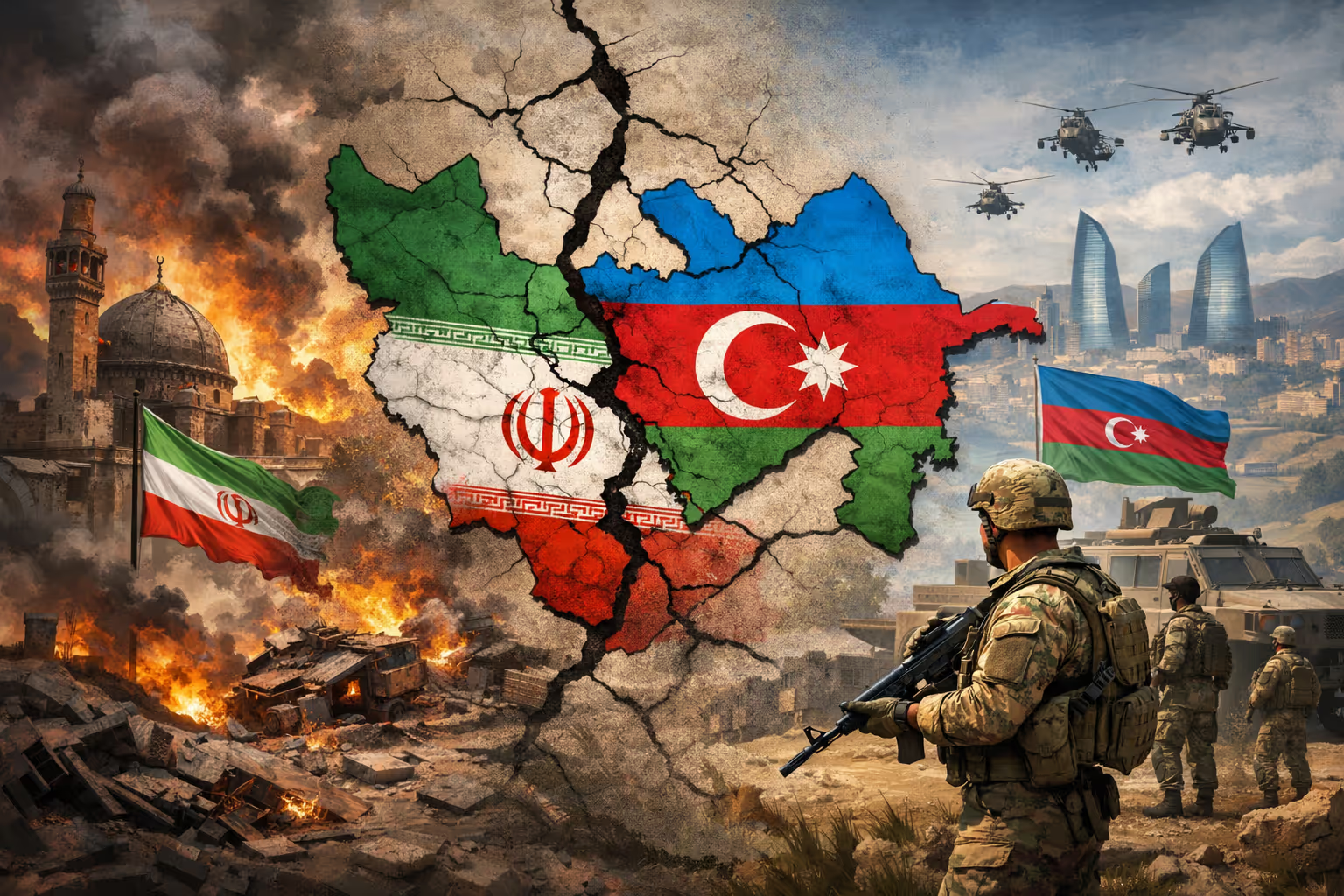
The protests in Iran are continuing to escalate. What started as a protest by traders against the fall in the value of the local currency, rising prices, economic mismanagement and worsening economic conditions in the country has quickly transformed into a growing movement for political change. This is evident from the chants of protestors and is threatening the legitimacy of the ruling clerical regime. Reports of a crackdown, clashes with the security forces and rising casualties among protestors indicate that Iran’s rulers are facing a serious threat to regime survival, the second such event since the 12 days of war with Israel in June 2025. Supreme Leader Ayatollah Khamenei had branded the protesters “rioters” and “mercenaries” instigated by the US. Meanwhile, US President Donald Trump is openly backing the protests and has made it clear that if the Iranian authorities kill the protestors, the United States will intervene militarily to protect them from Tehran’s reprisals. The latest reports saying that the US president has even been presented with possible strike options.
At the same time, Reza Pahlavi, the eldest son of Iran’s last shah, and his backers are trying to hijack the protests and brand them a popular demand for his return to the country and restoration of an absolute monarchy. However, Reza Pahlavi has a very poor reputation among Iran’s non-Persian ethnic minorities, who make up at least 50 per cent of the population of the country. As evident from the protests in regions and cities such as Tabriz and Ardabil, where ethnic Azerbaijani Turks are concentrated, local Azerbaijanis chant both anti-Islamic Republic and anti-Pahlavi slogans, rejecting any notion that an absolute Pahlavi monarchy is the solution. Having faced discrimination from the former Pahlavi dynasty and the current regime, Iran’s Azerbaijanis are mainly sticking to their national slogans such as “Freedom, Justice and National Government”.
Iran’s Azerbaijanis Reject Both Pahlavi and the Islamic Republic
Historically, Azerbaijani Turks have played a significant role in Iran’s politics, not only providing the successive Turkic dynasties that for centuries ruled what is today called Iran, but also shaping political thought and spearheading political changes such as the 1906-1911 Constitutionalist Revolution. Azerbaijanis are primarily concentrated in the northwestern regions of Iran, where they constitute the world’s largest Azerbaijani community, bigger than the one in the Republic of Azerbaijan. There are estimated to be 25-30 million Azerbaijani Turks in Iran, making them the second largest ethnic and linguistic group after Persians. As part of the Pahlavi regime’s forced homogenisation policies to create a Persian-centric Iranian supra national identity, Azerbaijanis suffered systematic erasure of their identity, such as a ban on the Azerbaijani Turkic language in print media, education and theatres. Reza Shah’s policies to forge a homogenous national identity via forced assimilation and promotion of the Persian language with suppression of non-Persian languages, became a defining state initiative, part of the Pahlavi monarchy’s promotion of centralism, modernism and secularism in an attempt to create an Aryan European nation state. Reza Shah’s centralization policies resulted in the decline of Azerbaijan’s significance within Iran, the reallocation of state resources and changes in economic development trends. In his book Nationalism and Ethnicity after Khomeini, Rasmus Christian Elling asserts that the diminishing status of Azerbaijan was accompanied by restrictions on Turkic elements of Azerbaijani culture and initiatives aimed at promoting Persian as the only language of Iran. New provinces were established to fragment Azerbaijani strongholds, important locations were renamed in Persian, and Persian names were promoted for Azerbaijani children. The short-lived 1945-1946 Autonomous Azerbaijan People’s Government, which demanded self-determination within Iran and recognition of Azerbaijani rights, was violently suppressed in December 1946 by Mohammad Reza Pahlavi’s army; more than 20,000 Azerbaijanis were killed and even the Iranian army’s records, which downplayed the numbers, reported that 2,500 individuals were executed, 8,000 were imprisoned, and 36,000 were expelled from the Azerbaijan province. In his 1977 book The Crowned Cannibals: Writings on Repression in Iran, Iranian Azerbaijani writer Reza Baraheni recalls how the ban on the Azerbaijani language personally affected him when he wanted to inscribe a poem in Azerbaijani on his father’s headstone during Mohammad Reza Pahlavi’s reign.
State level discrimination against Azerbaijanis continues to this day, as the provision for education in their mother tongue for Iran’s minorities, set out in Article 15 of the Constitution, remains on paper only. Azerbaijani rights activists are subjected to arbitrary arrests and punishments for trying to raise awareness of their identity and language, for protesting against the environmental disaster of Lake Urmia, which has completely dried up as a result of the Islamic Republic’s mismanagement, for raising demands for schools in the Azerbaijani language etc. The Islamic Republic’s ethnic discrimination is visible in cases of parents being denied the right to give their children Azerbaijani Turkic names. The Islamic Republic’s use of Shia Islam to override ethnic differences and forge a homogenous Persian-centric Iranian identity is a continuation of the Pahlavi-era policies.
Possible Security Threats for the Azerbaijan Republic
The Iranian regime has posed serious challenges to Azerbaijan’s security over the years. Some of the contentious issues cited by Azerbaijani officials and analysts include Iran’s support for the Armenian occupation of Azerbaijan, export of Khomeinist political Islam and instigation of radical Shia elements against the secular Azerbaijani state, espionage and the killing of Azerbaijani citizens, creation of a terrorist proxy called the Huseyniyyun brigade under Soleimani’s supervision and the infamous 2018 Ganja terror attack and pouring narcotics into Azerbaijan on an almost daily basis. As the protests grow and US military intervention looms, Azerbaijan needs to be prepared for possible scenarios in the context of the chaotic political environment in Iran.
In a scenario of regime collapse, Azerbaijan needs to formulate a proactive policy by engaging with regional countries such as Turkey and Israel, along with the U.S. and be ready to prevent any bloodshed in Iran. Chaos may trigger another migration crisis in the region.
A second threat might emerge if the regime or an alternative central authority engages in a bloody crackdown against the Azerbaijani minority, which also needs to be prevented. The cities where the Azerbaijani minority are particularly restive in these days might be targeted by the Iranian regime.
Third, a power vacuum in Iran may create opportunities for terrorist organizations. There are already reports of PJAK attempting to infiltrate Iran since the beginning of the protests. The PKK-linked PJAK has territorial claims on Iran’s Azerbaijani cities such as Urmia, and could seek to exploit a chaotic situation.
A more democratic Iran would also serve Azerbaijan's national interests and might help to mend the ties between the countries. For Baku, the preferred outcome would be an Iran that respects the rights of its minorities, including its Azerbaijani population, and guarantees equality before the law. Equally, Azerbaijan would not want a future Iranian state that interferes in the domestic affairs of its neighbors. Such an approach would help reduce long-standing grievances and enhance stability along Azerbaijan’s southern border.




.svg.avif)