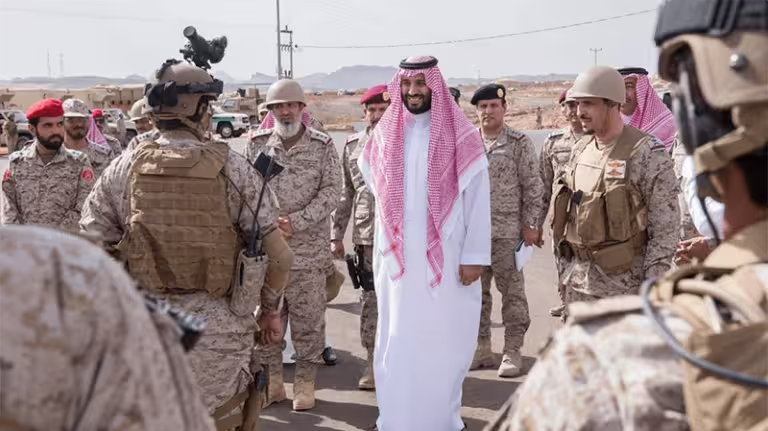
Saudi Arabia has spent years cultivating influence in southern Yemen, supporting forces opposed to the Houthis while attempting to manage the competing ambitions of the separatists fighting alongside them. Over the weekend, tens of thousands of people gathered in Yemen's cities, Aden, Mukalla and Seiyun in a display of mobilisation that suggested the Southern Transitional Council (STC) continues to command significant support across the south.
The STC advocates for the restoration of an independent southern state, which existed between 1967 and 1990. Participants gathered despite punishing temperatures that exceeded 44°C in some areas, carrying the flag of the former South Yemen and portraits of STC President Aidarus Al-Zubaidi.
Chants and slogans focused not on the Houthis in the north but on opposition to Saudi policies and what many participants described as foreign interference in southern affairs. Across all three cities, demonstrators reaffirmed their support for the STC and its leadership, presenting the movement as the most significant political force representing southern aspirations.
The relationship between the STC and Saudi Arabia has long been marked by both cooperation and tension. While both have shared interests within the broader anti-Houthi coalition, disagreements over the future political status of southern Yemen have remained a persistent source of friction. The rallies highlighted those tensions in a highly public way, demonstrating the extent to which support for the STC remains tied to a distinct southern political identity.
It would be a mistake to dismiss the events as a routine political gathering. The scale of participation across three major cities pointed to a level of organisation and coordination that few political movements in Yemen are currently capable of achieving. For supporters, the rallies served as a public reaffirmation that the STC remains capable of mobilising large numbers of people despite ongoing economic hardship, security challenges and political pressures.
According to local reports, security forces implemented restrictions in some locations, including the closure of roads leading to gathering sites in Aden and Seiyun. Reports also suggested that efforts were made to limit access to the demonstrations. Yet participants continued to arrive in large numbers throughout the day. If anything, those reported obstacles appeared to reinforce the determination of many attendees to make their presence felt.
The significance of the rallies lies not only in their size but in what they suggest about the current political landscape in southern Yemen. For years, debates over the future of the south have competed with the immediate demands of war, governance and economic survival. The weekend's demonstrations indicated that questions of political representation and self-determination continue to resonate strongly among large sections of the southern population.
Riyadh has not publicly responded to the demonstrations, nor has the internationally recognised Yemeni government. That silence may prove temporary. The rallies carried a political message that extended beyond the events themselves: support for the STC remains visible, organised and capable of being expressed on a significant scale.
Whatever one's view of southern independence, the demonstrations provided a reminder that the STC remains a major political actor in southern Yemen. For Saudi Arabia and the Yemeni government alike, the events underscored a reality that has shaped the conflict for years, that any lasting political settlement will need to account for southern aspirations and the movement that continues to articulate them.


.svg.avif)


