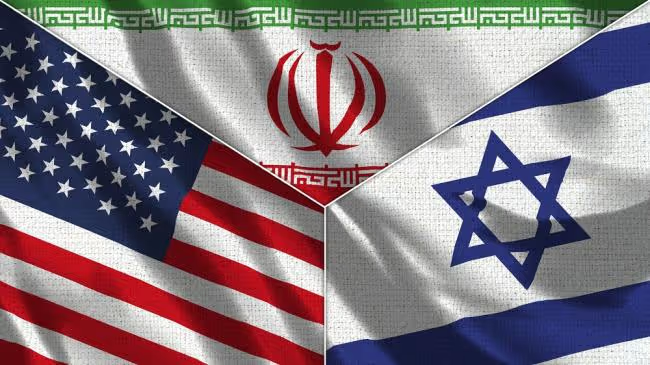
October 7, 2023 represents an inflection point in the modern Middle East. That day, thousands of Hamas militants breached the heavily fortified perimeter surrounding Gaza and launched attacks that killed hundreds of Israeli civilians and soldiers.
Yet the aftermath produced an outcome that neither Hamas nor its backers had intended: much of the group's leadership was eliminated, its military capabilities dismantled, Gaza left in ruins, and more than 75,000 Palestinian civilians killed. The International Court of Justice is now hearing a case accusing Israel of genocide in Gaza.
While it remains too early to fully assess the long-term consequences of the Gaza war, one outcome is obvious: whatever Hamas hoped to achieve on October 7, the fallout has significantly undermined Iran's quasi-hegemonic position in the region.
From the 2003 Iraq Invasion to Gaza 2023: A Pattern of Strategic Miscalculation
This pattern of unintended consequences did not begin on October 7. When the United States invaded Iraq in March 2003 — driven in part by post-9/11 imperatives — it failed to anticipate that removing Saddam Hussein would effectively hand Iraq over to Iranian influence. By dismantling the Baathist regime in Iraq, Iran's foremost regional rival, Washington inadvertently cleared the way for Tehran's regional expansion. The parallel with Afghanistan is instructive: having invaded in October 2001, the U.S. ultimately withdrew and left the country to the Taliban in the summer of 2021 following long negotiations in Doha. Some conspiracy theorists have argued this was by design, but that understanding is as mistaken as their broader misunderstanding of the Iran–Israel rivalry.
Iran had been preparing for exactly this kind of opening since 1979. It cultivated deep ties with Iraq's Shiite majority — which constitutes roughly two-thirds of the country's population — hardened its revolutionary institutions during the Iran–Iraq War (1980–1988), and entered the post-2003 landscape better positioned than any other regional actor. Capitalizing on its advantageous position, Iran first dominated Iraq's political scene through its Shiite networks — particularly during Nouri al-Maliki's tenure (2006–14). It also signed defense and security agreements in 2006–07 with Syria, which was deeply uncomfortable with U.S. presence in the region.
Hezbollah, which Tehran had cultivated since the early 1980s, had by then become the dominant political and military force in Lebanon. Iran backed it fully through each successive confrontation with Israel. At the same time, Tehran established a continuous land corridor stretching from Iran through Iraq and Syria to Lebanon — providing it a threatening presence along Israel's northern border. Its support for Palestinian Islamist groups Hamas and Islamic Jihad, along with Yemen's Zaydi movement Ansarullah, completed this picture. Shiite minority populations across the Gulf states provided an additional foundation for Iran's regional influence.
Shifting Regional Dynamics After October 7, 2023
From the 2003 invasion through October 7, 2023, Iran's regional influence appeared to be at its zenith. Tehran held decisive sway in four Arab capitals: Beirut, Damascus, Baghdad, and Sana'a — with Gaza often added to that list. Iranian leaders made no secret of their satisfaction.
The post–October 7 landscape has fundamentally altered that picture. First, Hamas and Islamic Jihad in Gaza were severely degraded. Then, Hezbollah's unified command structure — carefully built over decades and spanning civilian, religious, and military branches — was systematically hollowed out.
However, from Iran's perspective, the real blow came with the collapse of Syria's 61-year Baathist regime. Iran's ties with Syria had originally taken shape during the Iran–Iraq War in the 1980s, when Damascus supported Tehran, and deepened further through a series of agreements and shared regional security concerns in the mid-2000s. When the Arab uprisings swept through Syria in 2011 — whether one should call them a 'Spring' is another debate entirely — Iran's influence in Damascus only grew. But so did the rift between Iran and the Gulf Arab states and Turkey.
After 14 years of civil war, a coordinated effort involving Gulf Arab states, Turkey, Israel, and the U.S. severely undermined the Assad regime. With Hezbollah weakened and neither Iran nor Russia able to mount an effective response, the Syrian government collapsed with startling speed in December 2024. Syria had been the linchpin of Iran's "Axis of Resistance" since the 1980s.
The "Octopus Doctrine" and the Phases of Escalation
The strikes on Iran were part of a broader and deliberate strategy pursued by Israel — backed by the United States — aimed at systematically weakening Iran and dismantling its network of allied armed groups across the region.
Adopted in the wake of the military campaign in Gaza, this strategy — widely known as the 'Octopus Doctrine' — frames Iran as the head of the operation and its allied armed groups as its tentacles. The underlying premise is to degrade the periphery first, then target the center. With the military and civilian leadership of organizations such as Hamas, Islamic Jihad, and Hezbollah systematically eliminated, directly targeting Iranian leadership was, in this logic, the inevitable next step.
Phase One: Decapitation Strategy
The first phase began in June 2025. Even as nuclear negotiations were underway in Oman with the U.S., Israel eliminated Iran's senior military leadership. Several high-ranking military commanders — including the Chief of Staff and Revolutionary Guard commanders — were killed, and President Pezeshkian reportedly narrowly survived an assassination attempt.
The strikes heavily targeted the Iranian military and the IRGC, with the primary goal of eliminating the hawkish upper echelon of the military leadership. Beyond decapitation, the broader aim was to engineer a power shift toward more moderate elements — a regime change playbook not unlike what had been attempted in Venezuela. It failed. The strategy rested on a fundamental misreading of Iran and how its political system actually works. After Trump declared victory following the strikes on Iran's nuclear facilities, and Iran responded with a heavy ballistic missile attack on Israel, both sides stepped back and waited for the next phase.
Phase Two: Internal Destabilization
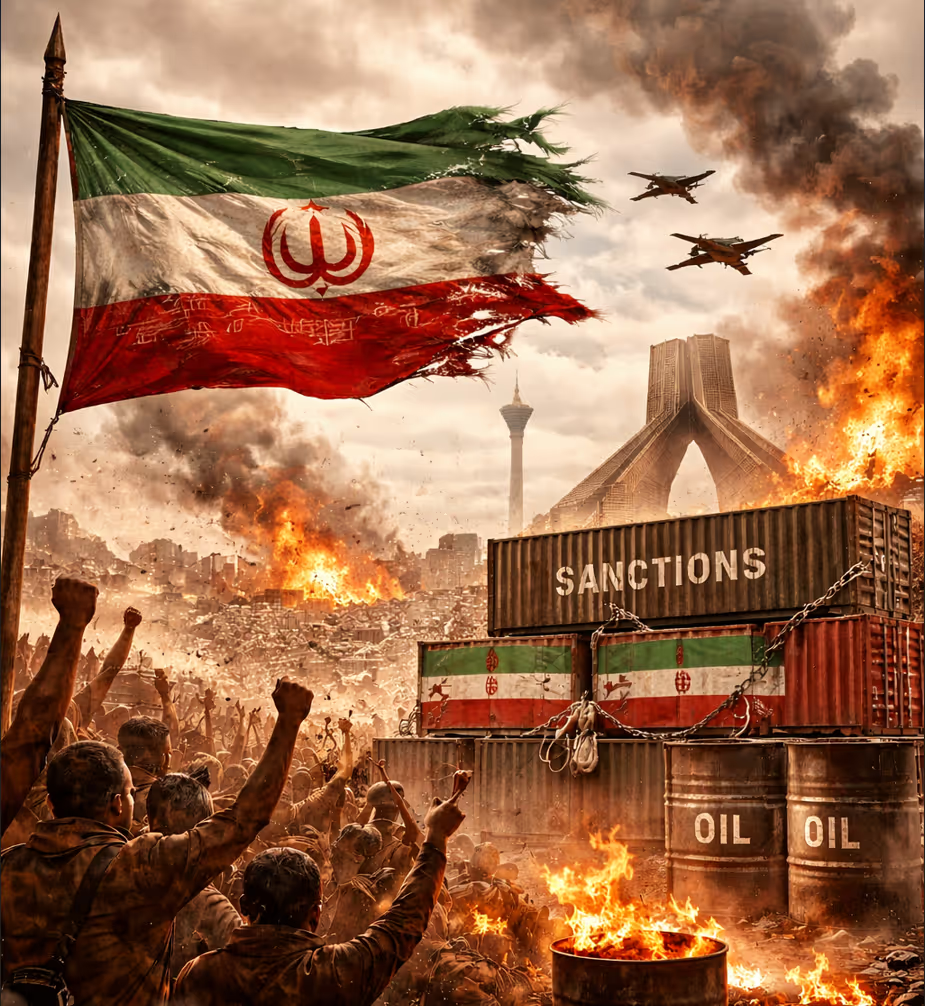
The second phase came six months later. In late December 2025, years of economic hardship and a fresh round of sanctions under Trump finally pushed Iranian society past its breaking point. Protests broke out among merchants in Tehran's Grand Bazaar and spread quickly, moving from the capital into provincial cities and peripheral regions, where ethnic minority communities had long harbored their own grievances.
From Washington and Jerusalem, the calls were explicit: take to the streets, seize government buildings, bring down the regime. They found some traction — particularly in western provinces with Kurdish, Lor, and Bakhtiari populations, where unrest tipped, in places, into armed struggle. Trump further warned that a harsh crackdown would prompt direct intervention to topple the regime. The regime, framing the protests as a foreign-orchestrated conspiracy, made a brutal calculation: crush it fast, before the U.S. and Israel could exploit it. It worked, at considerable cost. Thousands of civilians were killed within days in a swift and overwhelming response by the Iranian regime.
The second phase failed. By this point a pattern had emerged. The first phase had begun in June 2025, six months after Syria's fall. The second followed six months after that. But two failures had done nothing to slow the momentum. If anything, the rhetoric from Washington and Tel Aviv was sharpening, and the gaps between phases were narrowing. The next move would not wait another six months. Just six weeks after the second phase subsided — and while nuclear negotiations were still underway in Oman and Geneva — the U.S. and Israel launched a new and intensified wave of attacks against Iran.
Phase Three: Direct Military Confrontation and Iranian Retaliation
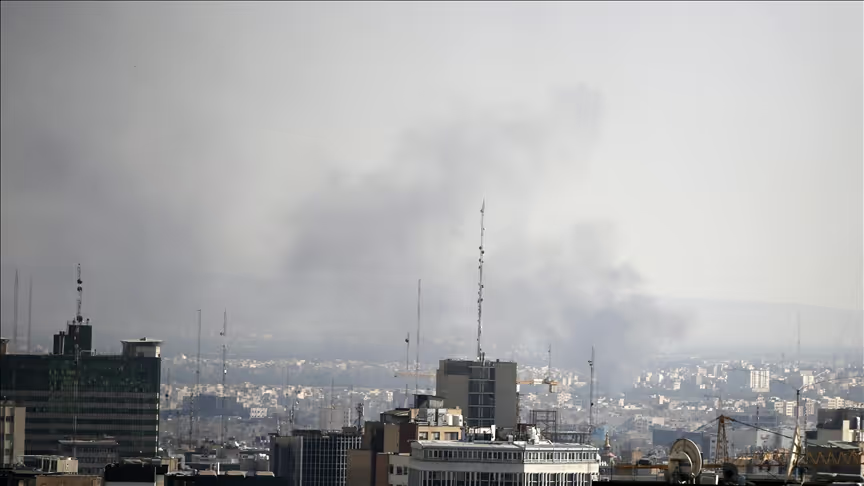
This third phase began in the final days of February 2026 and has, at the time of writing, sustained a high level of escalation for five weeks. The strikes killed numerous civilian and military leaders — most notably Supreme Leader Ayatollah Khamenei and Ali Larijani, Secretary of the Supreme National Security Council and the country's de facto commander-in-chief. Iran's response was far more forceful than anything it had mustered during the first phase in June 2025. It struck U.S. bases across the Gulf, launched extensive attacks on Israel, and closed the Strait of Hormuz — through which roughly a quarter of global energy flows — reasserting its deterrence in the most direct way possible. It also struck the Diego Garcia base in the Indian Ocean using missiles with a range of up to 4,000 kilometers, signaling a capacity to escalate in ways few had anticipated.
None of the objectives pursued in the first and second phases materialized. No internal coup took place. No broader uprising emerged — neither in major cities nor in peripheral regions. Despite widespread frustration, Iranians did not rally behind the calls made by Trump and Israeli leaders to overthrow their government. The trauma of the 1953 CIA and MI6 coup against Prime Minister Mossadegh runs too deep in Iran's collective memory.
After five weeks, the third phase, too, appears to have failed to achieve its intended outcome. The Iranian government survived. The United States has been unable to protect its allies in the Gulf. Israel could not stop the Iranian missiles. All sides now have strong reasons to seek a ceasefire, at least in the short term. Nonetheless, another round is likely to follow.
Outlook
All three phases have failed to produce regime change or eliminate Iran as a rival power center in the Middle East. Talk of de-escalation is growing, but the form it takes matters. Recent signals from the Trump administration suggest an informal pause rather than a ceasefire agreement.
The root causes of the conflict remain unaddressed. Iran retains both the motivation and residual capacity to revive its regional network. Israel and the United States, for their part, have not achieved the strategic transformation they sought. What makes the current trajectory dangerous is not only the scale of the conflict but also its open-endedness. Each previous phase has normalized a higher level of violence, narrowing the space for negotiation while increasing the likelihood of miscalculation.
Against this backdrop, the most plausible near-term trajectory involves a fourth phase centered on hybrid warfare — cyberattacks, covert operations, and proxy wars — emerging in the coming months. Should that prove insufficient, further rounds of direct conflict are likely to follow — each more dangerous for regional stability than the last.




.svg.avif)