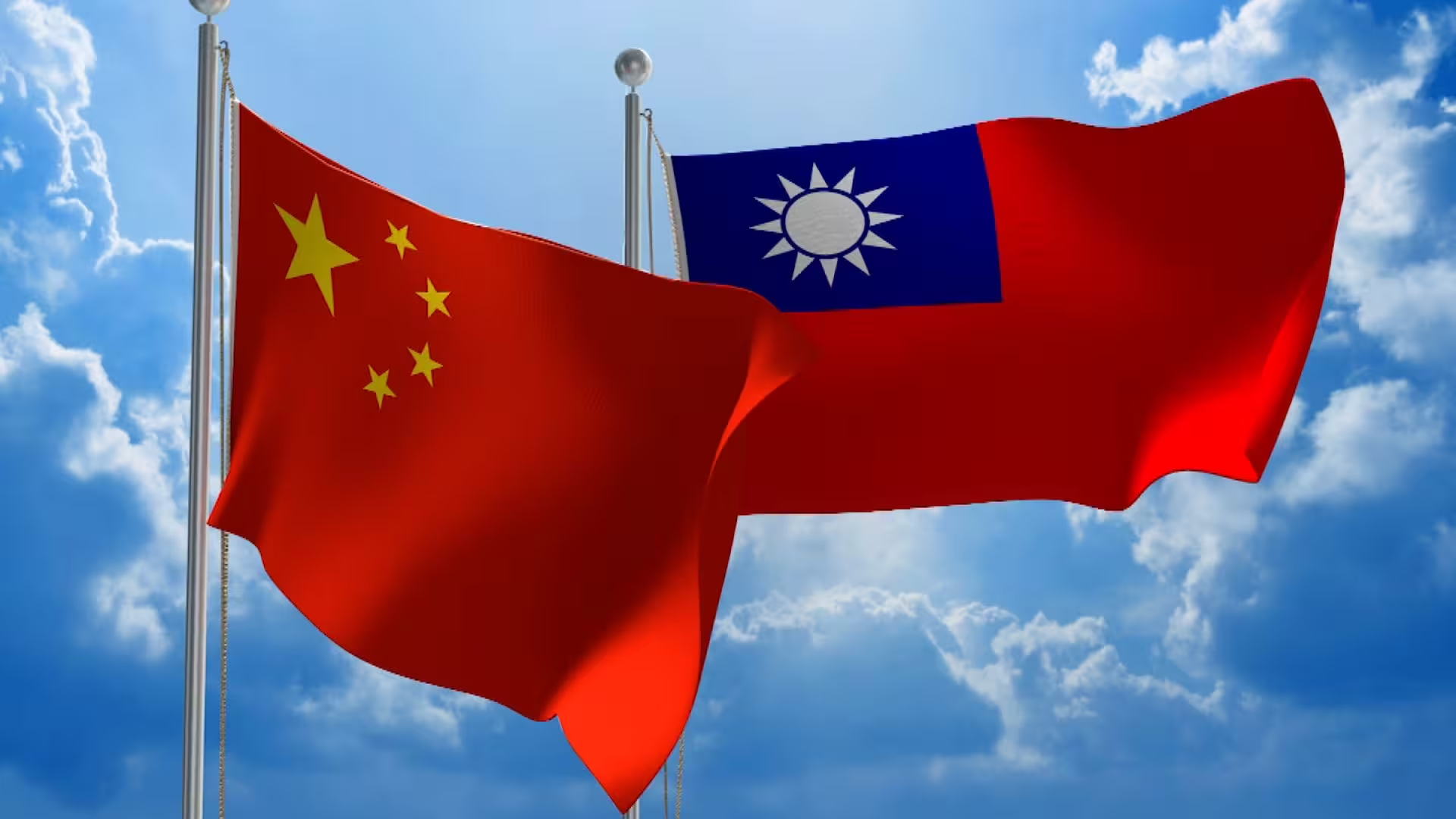
A major global flashpoint the world is watching is the Indo-Pacific, where China seeks to unify Taiwan under its rule, either diplomatically or by force, as stated in Beijing’s own constitution. Over the last several decades, Beijing has built up its military (PLA) into a force that rivals the U.S. Armed Forces in preparation for regional expansion and influence.
Despite Taipei’s increased defense spending and preparations, a Chinese blockade or amphibious assault could still succeed because of factors such as a lack of allied support or internal sabotage. If Taiwan were to fall, the Chinese government (CCP) would immediately move not only to quell a potential uprising or insurgency, but also Taiwanese nationalism that has particularly formed after decades of a one-party Kuomintang dictatorship.
China would move carefully to assimilate Taiwanese into the mainland fold, but also tactfully and ruthlessly to potential self- determination dissidents akin to templates used on Tibet, Xinjiang, and Hong Kong. With the world’s attention on potential forcible assimilation practices and quelling of dissidents, Beijing will look to quietly pacify Taiwanese civilians into Chinese nationals while enacting a hardline stance on freedom of speech if occupation is successful.
A Structural Counterinsurgency System for Taiwan
If Beijing conquers Taipei and fully collapses its government and military, the CCP would look to install concrete structural changes in Taiwan to quell any potential uprising or insurgency. After the end of martial law and the one-party system, Taiwanese citizens currently enjoy a plethora of civil liberties that Chinese citizens under the CCP do not have.
In Taiwan, citizens enjoy an independent judicial system, access to independent social media, and freedom of speech and assembly—something mainland Chinese citizens lack. Taipei allows multiple parties, regardless of their political status, to participate in elections, while Beijing remains under a one-party authoritarian rule.
If China were to conquer Taiwan, the Chinese government would likely enact a form of martial law, as Beijing would expect resistance to initial rule, akin to Tibet and Xinjiang. A Marshall representing the People’s Liberation Army (PLA) would be appointed to oversee the occupation, with Beijing using the premise of a puppet collaboration government in control of Taiwan.
A similar structure is being applied in Ukraine to pro-Russian collaborators overseeing occupied oblasts, with the Kremlin having supreme authority that led to direct illegitimate annexation. Likewise, the CCP would slowly enact a similar hybrid warfare plan, especially as Taiwan is dealing with pro-China agents that include numerous politicians and military officials accused and convicted of spying.
Plans for Re-education and Cultural Assimilation
After the Chinese Civil War and state-building, Beijing has applied state-sanctioned curriculum, with some of the strictest in regions with self-determination movements such as Tibet, Xinjiang, and Hong Kong. As the ruling Chinese government emphasizes a Han identity, assimilation practices have been mixed in with reeducation.
During China’s invasion of Tibet, Mao Zedong and the CCP carefully tiptoed around talks of annexation or direct assimilation and instead called for national unity and used language of ‘decolonization.’ Simultaneously, Taiwan is at the forefront of China’s reversal of the ‘century of humiliation,’ and the CCP would emphasize anti-American and anti-Japanese educational materials as Washington and Tokyo hold the closest ally status of an independent Taipei.
Leaders who profess self-determination, particularly in the Democratic Progressive Party, would likely stand trial, with some of the biggest independence advocates being purged or silenced completely in reductional facilities as Tibetan and Uyghur political activists have faced. However, because Taiwan is not attached to the mainland, the CCP would tiptoe around indoctrination camps for fear of negative international exposure and would attempt to use a Hong Kong model.
Against the backdrop of the 1997 handover between the United Kingdom and China, Hong Kong was meant to have a semi-autonomous status known as ‘one country, two systems,’ with its own laws, trading policies, local leadership, and judicial system. Beijing has quietly reneged on Hong Kong’s autonomy, with current President Xi Jinping openly eroding what’s left of the island’s freedoms.
After a controversial 2019 national security law that gave Beijing authority to extradite convicted Hong Kongers to the mainland, the Chinese government heavily cracked down on protestors, activists, and dissidents, such as Jimmy Lai. Beijing and its local government in Hong Kong mass-arrested over 10,000 protestors and key activists and essentially ended the pro-democracy movement along with semi-autonomy.
Taiwan could expect a hybrid of the Tibet and Hong Kong-style crackdowns. Initially, during the media blackouts, a PLA military occupation would see hardline measures to pacify Taiwanese as Beijing would move to enact a media blackout akin to the ones seen in Xinjiang. Then, under the ‘Chinese Taipei’ plans, it would install a local government that would promote a One-China national identity and suppress democratic practices seen in Hong Kong today.
Public Relations Implementation After Unification
A naval blockade or direct amphibious assault on Taiwan by the Chinese military would coincide with months-long headlines in international media, as it could stoke fears of regional or global war. A potential Chinese military victory simultaneously would also gather global headlines due to fears of persecution of Taiwanese citizens, dissidents, politicians, and activists.
Because of the expectations, the CCP would enact one of the largest media/public relations campaigns in history to whitewash what would happen in Taiwan post-Chinese occupation. With Russia’s occupation of Ukrainian territories being seen for its horrors, particularly in Bucha, Izium, Kherson, and Zaporizhzhia, China’s media campaign would attempt to whitewash a unification with Taiwan and portray the occupation in a positive light.
State-controlled media such as CGTN would have full access to a media environment in a Beijing-occupied Taiwan, with Taiwanese media channels effectively being cancelled and independent media not being allowed to broadcast. A PLA occupation would see signal jamming and restrictions for foreign nationals to leave Taiwan while Taiwanese citizens with one passport would be forced to stay.
Beijing would bring in and utilize its large domestic and foreign influencer network to whitewash any abuses and authoritarian measures in an occupied Taiwan. The Xinjiang Data Project and numerous media organizations have all documented a paid foreign influencer campaign employed by the CCP to whitewash crackdowns of Uyghurs, and an occupation of Taiwan would be no exception to a foreign influencer campaign.
If the CCP were to allow international media in Taiwan during the occupation, it would come from countries with firm state control over their broadcast networks, such as Russia, North Korea, Belarus, Cuba, Eritrea, and other closely linked Global South nations. Getting the free flow of information out to the global community would be a top priority if Taiwan were to fall.
A Hong Kong Model Mixed with Tibet, Xinjiang, and Quiet Purges
Overall, a PLA military conquest and occupation of Taiwan will look like a hybrid model of Tibet, Xinjiang, and Hong Kong, with heavy crackdowns seen in uprisings and protests previously in those locations.
Pacification and assimilation of Taiwanese will be an utmost priority for any annexation and occupation by Beijing, with PLA commanders given heavy-handed authority to quell uprisings as seen in Tibet, Xinjiang, and Tiananmen Square. However, media blackouts will be nearly guaranteed to hide any brutality of an occupation and cultural assimilation, which could bring actions, divestment of trade, or years of uprisings and hit-and-run tactics in Taiwan.
Xi Jinping, if China’s President when a war over the Taiwan Strait occurs, will prioritize his public image above all in a potential occupation. Xi wants to be seen as the Chinese premier who ended the century of humiliation. Still, after hardline stances in Taiwan and Xinjiang, Beijing’s President can ill afford international leaks of abuses against Taiwanese citizens under a potential PLA occupation.
In the aforementioned circumstance, Beijing would tread carefully in an occupation of Taiwanese citizens, and even more meticulously in planning a blockade or amphibious assault over Taiwan that could see a collapse of the CCP if it’s anything short of a failure.
* The views expressed in this article are those of the author and do not necessarily reflect the views of instituDE.


.svg.avif)