The Prussian general and military theorist Carl von Clausewitz famously defined war not merely as an act of violence, but as "the continuation of politics by other means" — an extension of diplomacy rather than its abandonment. Wars are not fought to satisfy some destructive impulse, nor do states enter conflict for its own sake. They go to war to overturn an unfavorable status quo and to secure a stronger hand at the negotiating table when the fighting is done.
With that in mind, what were the objectives behind the war that the United States and Israel launched against Iran, and what kind of postwar settlement did they envision?
On March 21, 2026, President Trump declared that he did not want a ceasefire with Iran. Yet two days later, on March 23, he reversed course: "I am pleased to report that the United States of America, and the country of Iran, have had, over the last two days, very good and productive conversations regarding a complete and total resolution of our hostilities in the Middle East. I have instructed the Department of War to postpone any and all military strikes against Iranian power plants and energy infrastructure for a five-day period, subject to the success of the ongoing meetings and discussions."
Subsequent developments suggest that a ceasefire may not be far off, and that some progress has been made in mediated talks between Iran and the United States. I have long maintained, however, that any such ceasefire would likely be temporary. The underlying conflict has not been resolved; at best, the war may only be paused. What is the basis for that assessment?
Geopolitical Competition: The Shia Crescent and the Axis of Resistance
Since the 2010s, four principal actors — Iran, Israel, Turkey, and the Gulf Arab states — have shaped the Middle East through a shifting mix of rivalry and selective cooperation. Other countries, including Egypt, Syria, and Iraq, along with non-state and sectarian groups such as the Kurds and the Druze, have maneuvered within the strategic space these four powers created.
Iran built significant regional influence in the wake of the 2003 invasion of Iraq, sustaining it until roughly 2023. At its peak, Iranian officials proudly claimed that Tehran held decisive sway over four Arab capitals: Beirut, Damascus, Baghdad, and Sana'a — and even Gaza. The chain of events that began on October 7, 2023, however, reversed this dramatically. Iran's key allies — Hamas and Hezbollah, which cannot be reduced to mere "proxies" given their own autonomous agendas — were severely weakened. The other three major regional actors, together with the United States, backed the overthrow of Syria's Ba'athist regime in December 2024, dismantling a cornerstone of Iran's regional network.
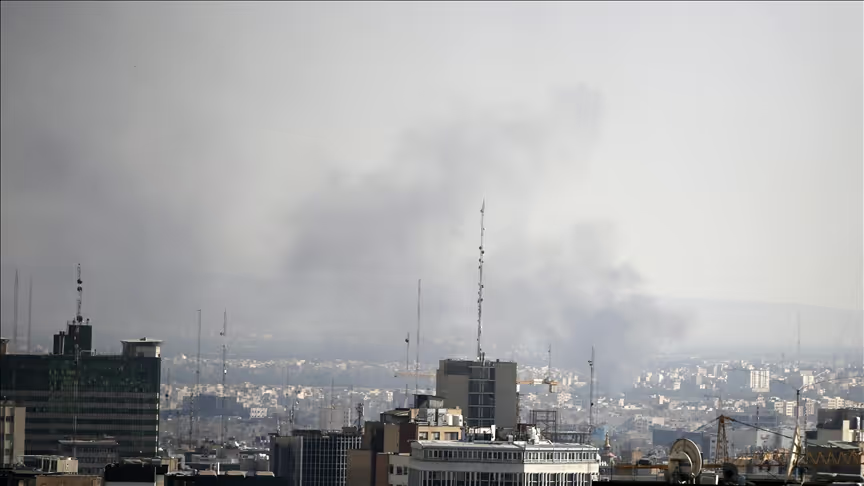
Six months later, Iranian territory came under direct and sustained military attack for the first time. This was followed by an armed uprising in Iran's western provinces in January 2026, and then a third phase of the war beginning in February 2026. For decades, Iran had cultivated ties with Hamas and Islamic Jihad in Gaza, Hezbollah in Lebanon, the Houthis in Yemen, and Shiite militias and Popular Mobilization Forces in Iraq — all as part of a broader alignment against U.S.–Israeli dominance in the region.
The U.S.-backed assault on Iran must therefore be understood within this wider geopolitical context: as a concerted effort to dismantle Iran's regional influence and permanently degrade its network of allies. Iran's two-decade project of extending its reach to the Eastern Mediterranean via Iraq and Syria had not only threatened Israel, but had unsettled the Gulf Arab states and curtailed their strategic autonomy. Turkey, too, had watched Iran's expansion with growing unease and moved actively to counter it.
Security Dynamics: Nuclear Capability and Ballistic Missiles
Geopolitics aside, security concerns and threat perceptions lie at the heart of this conflict. Contrary to assumptions that often dominate Western commentary, Israel is not the only actor in the region that feels existentially threatened.
It has long been understood in security and intelligence circles that Israel has possessed nuclear warheads. During the devastation in Gaza between 2023 and 2025, far-right members of the Israeli cabinet had floated the idea of using nuclear weapons. Israel's undeclared arsenal — developed entirely outside the Nuclear Non-Proliferation Treaty — has periodically alarmed its neighbors, Iran included.
Hardline factions within Iran have long argued that in a region where Israel possesses nuclear weapons, Iran's failure to develop comparable capabilities would amount to a serious and lasting strategic vulnerability. In their view, Israel bolsters U.S. hegemony in the region and coordinates militarily with the Gulf states against Iran — a dynamic that Iran's strikes on Gulf countries in the current war directly reflect — deepening Tehran's sense of threat toward Tel Aviv. Iran's support for groups such as Hamas, Hezbollah, and Islamic Jihad during the 1980s and 1990s was driven, in part, by a desire to shift Arab perceptions on this matter.
On the other side, although Iran officially denies any intention to build a nuclear weapon, its uranium enrichment capabilities place it firmly in the category of a threshold state. Israel, shaped by the historical trauma of the Holocaust, has made clear through what is known as the Begin Doctrine that it will not permit any hostile regional actor to acquire nuclear weapons — a stance that reflects the depth and seriousness of Israeli threat perception.
Beyond the nuclear dimension, Iran has compensated for the chronic weakness of its conventional air force by developing one of the region's most formidable ballistic missile and drone arsenals. The demonstrated ability of these systems to penetrate Israel's layered air defenses — Iron Dome, David's Sling, and Arrow — and the damage they inflicted during the June 2025 and March 2026 confrontations have locked both sides into an accelerating arms race.
Ideological, Theopolitical, and Historical Drivers
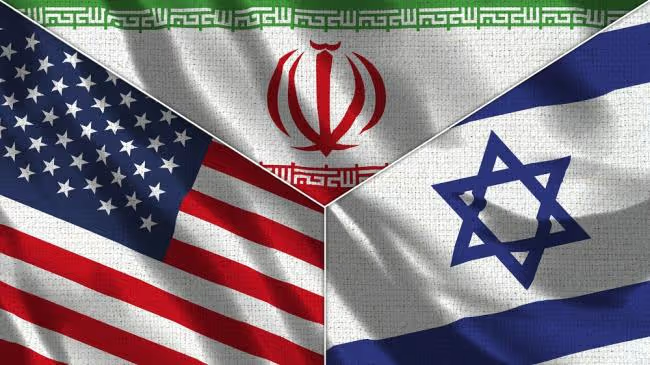
Until the 1979 Revolution, Iran under the Pahlavi dynasty was a close ally of both the United States and Israel. The revolution upended that alignment entirely. Ayatollah Khomeini's doctrine of Velayat-e Faqih not only transformed Shiite political thought but elevated the defense of the world's oppressed (mustazafin) into a revolutionary obligation. Within that framework, the United States and Israel were cast as the principal "arrogant powers" (mustakbirin) and designated as primary adversaries.
In official Iranian discourse — in the speeches of Khomeini and later Khamenei — Israel is routinely described as "the West's forward outpost in the region" and "a cancerous tumor," language that Israel has consistently interpreted as an existential threat.
Opposition to U.S. global dominance ("the Great Satan") and Israel's presence in the region ("the Little Satan") has become inseparable from Iran's revolutionary identity. Chants of "Death to America" and "Death to Israel" at political rallies and Friday prayers are not mere rhetoric; they speak to how deeply this antagonism is embedded at the societal level.
Historical grievances have only deepened these fault lines. The 1953 CIA-backed coup against Prime Minister Mohammad Mossadegh left a lasting wound in the Iranian psyche and a durable distrust of Washington. The Iran–Iraq War of 1980–88 entrenched Iran's sense of isolation and cemented a doctrine of strategic self-reliance. More recently, the Trump administration's unilateral withdrawal from the 2015 JCPOA, followed by coordinated U.S.–Israeli strikes during active negotiations in June 2025 and February 2026, has all but erased whatever trust remained.
Conclusion
Rooted in geopolitical rivalry, deep-seated security concerns, and ideological conviction, this conflict shows no sign of having run its course — and yet, once again, the fighting has given way to ceasefire talks. Any agreement, however, would likely be just that: a pause. The underlying causes remain entirely unresolved, and under such conditions, even a limited provocation could trigger renewed escalation.
The pattern that followed the confrontations of June 2025 and January 2026 suggests this conflict is unlikely to end here. What lies ahead may well be not a resolution, but simply the next round.




.svg.avif)