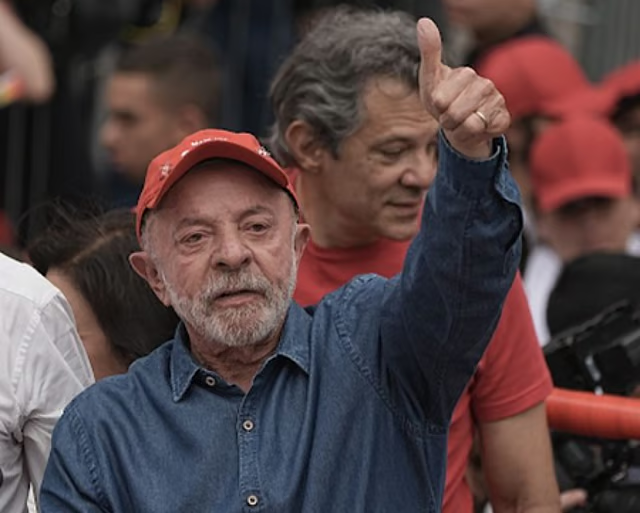
Luiz Inácio Lula da Silva’s second-round win in Brazil's presidential election was a stunning political comeback. Three weeks after trailing Flávio Bolsonaro by about 2.2 million votes in the first round, he won 51.79% of the vote and was about 4.3 million votes ahead. Lula picked up over 10 million votes between the two rounds, and Bolsonaro just under 4 million. Lula was the first candidate in Brazil's democratic history to finish second in the first round and still win the presidency. He also became the first person to be elected President of Brazil four times.
It should by no means be seen as a fundamental shift in Brazil's political disposition. Lula's return to the fold was very much a function of his campaign's ability to re-mobilise its electoral coalition, to get a clear message out prior to the election and to exploit the weaknesses of his opponent. The real issue now is what Lula will do with this victory and how he will go about his fourth term. He'll have to turn this electoral success into actual governing capacity in a country where the conservative forces still have a very real amount of institutional power.
The mechanics of Lula's comeback
Lula pulled the first round result back by broadening his geographical reach, increasing turnout and running a more disciplined campaign. Minas Gerais was the key to that. He'd lost the state in the first round by just short of 590k votes. In the runoff he won it by some 99k. He also took the capitals of São Paulo and Rio de Janeiro, flipped Rio city and maintained his grip on all nine of the states in the north east.
Following the first round defeat Lula immediately redoubled his ground game and ramped up his social media activity. He went back to the personal story which has always been at the heart of his appeal. His story of growing up in poverty, his time as a factory worker and union leader and his various poverty reduction programmes all came back to the fore. In the same period he was very astute in exploiting the openings Flávio had provided him in the debates. In the final debate Flávio's 'nine fingers' remark gave Lula the opportunity to link the personal attack to the very dignity of the worker who works in such difficult and hazardous conditions. The exchange wasn't in any way the decisive moment, but it did show how Lula was able to connect the personal to the appeal of the working class.
Flávio's own failings were also part of the equation. His campaign was still very much a campaign in the shadow of his father, particularly with Jair Bolsonaro's own conviction over the coup attempt that followed the 2022 election. The various controversies and lack of discipline during the campaign made it very difficult for Flávio to broaden his appeal beyond the existing conservative base. Lula's victory was therefore not simply a story of mobilisation. It was also a story of Lula being able to effectively capitalise on the weaknesses of his opponent whose very identity was so inextricably linked to that of his father. There was a real sense of concern in Brazil that the country could go back to fascism under the younger Bolsonaro which in turn helped Lula.
Voter turnout provided Lula with the necessary margin for victory. Abstention decreased from 21.08% in the first round to approximately 19.2%, representing an increase of roughly three million voters. Lula's campaign effectively mobilized supporters who had abstained in the first round and attracted sufficient new voters to overcome Bolsonaro's initial lead.
Transportation issues and the confusion caused by a late order which effectively extended voting hours have provided Flávio Bolsonaro with a basis on which to challenge the result. That said, the challenge is not going to go very far. Flávio doesn't have the federal government behind him. He never mounted a sustained challenge to the country's electronic voting system (only raised a question briefly in July and then dropped it). And with a margin of over 4 million votes (almost double the 2022 margin Lula enjoyed) it's very difficult to overturn that kind of lead via a technical challenge. All the other leaders in Latin America have already publicly congratulated Lula so Bolsonaro's challenge is not going to alter the result.
Challenges facing Lula's governing mandate
Lula's biggest problem is a Congress which is overwhelmingly dominated by forces outside his own coalition. The right will have around 303 of the 513 seats in the Chamber of Deputies (124 for the left, 86 for the centre) and will also hold just about two thirds of the Senate. Lula will therefore have to negotiate with opponents whose support he may well be able to buy at a considerable political cost.
Economic policy will be Lula's first real test. The level of public debt, the high interest rates and the fiscal pressures mean that there's very little the government can spend. Mandatory spending and demands from Congress leave very little scope for new initiatives. Even with the cooperation of Congress it's not going to be easy for Lula to juggle his social agenda with the need to maintain fiscal credibility.
Security is another issue. The right have public safety as a core plank of their political appeal. Lula's willingness to go as far as to reduce the age of criminal responsibility to 16 for serious offences is a clear indication of the pressure on the left to deal with an issue where the right have made significant inroads. The Lula government will need to have a credible security agenda in place without necessarily losing its own base.
Lula will also have to deal with the successions issue which has dogged the Brazilian left for so long. Lula's personal stature is at the very core of the PT's electoral strength and his final term will be an opportunity to build a successor who can actually hold the coalition together. If the party continues to be so dependent on Lula's personal brand then Lula's personal success at the polls may not be a lasting legacy.
Brazil's changing regional position
Lula's win puts Brazil in a very different regional moment than the one he was in in 2023. Argentina, Chile, Ecuador and Colombia now all have right wing presidents. Brazil is now the principal counterweight to the rightward shift across the region. That said, ideology doesn't have to be the barrier. Several of the conservative leaders actually sent their congratulations to Lula, which is a clear indication that co-operation is still very much possible. Brazil's regional clout will of course be down to Lula's ability to forge practical partnerships outside of his normal orbit.
Relations with Washington will be particularly important. The Trump administration's backing of the Bolsonaro camp opens up the possibility of some friction on trade and other regional issues. Lula will of course be keen to protect Brazil's economic links with China (its largest trading partner) but will also need to maintain a workable relationship with the US. His challenge is to defend Brazil's strategic autonomy without being constrained by the US-China rivalry in terms of his options.
The real test begins now
Lula's victory shows the resilience of his political coalition, but it does nothing to resolve the country's underlying divisions. Just over half the electorate went to Bolsonaro. Conservatives still have a strong presence in Congress and in the states. Lula has won another term, but not a mandate for his entire program.
He's shown he can put together a winning coalition and take advantage of his opponent's errors. His fourth term will be the real test of whether he can translate that electoral power into actual governance. He'll need to deliver tangible economic results and be in a position to prepare the Brazilian left for a future in which they don't have to rely on his personal presence. The issue is no longer whether Lula can win the next election. The issue is whether he can govern effectively in the absence of a broad popular mandate or a favourable balance of power.